Table 1: Magnetic Field Due to Straight Current-Carrying Wire
Condition
Magnetic field
Finite straight wire
\(B=\frac{\mu_0I}{4\pi x}(\sin\alpha+\sin\beta)\)
Infinitely long straight wire
\(B=\frac{\mu_0I}{2\pi r}\)
Point at perpendicular distance \(x\)
\(B=\frac{\mu_0I}{2\pi x}\)
❖ Symbols:
•
\(x\) or \(r\) = perpendicular distance from wire
•
\(\alpha,\beta\) = angles subtended by two ends of wire at point
•
\(I\) = current
▢ Force Between Two Parallel Current-Carrying Wires:
Table 1: Force Per Unit Length
Condition
Formula
Two long parallel wires separated by distance \(x\)
\(\frac{F}{l}=\frac{\mu_0I_1I_2}{2\pi x}\)
Same direction currents
Attraction
Opposite direction currents
Repulsion
▢ Current Carrying Solenoid:
Table 1: Magnetic Field Due to Solenoid
Condition
Magnetic field
Finite solenoid
\(B=\frac{\mu_0nI}{2}(\sin\alpha+\sin\beta)\)
Long solenoid / inside central region
\(B=\mu_0nI\)
Number of turns per unit length
\(n=\frac{N}{l}\)
❖ Symbols:
•
\(N\) = total number of turns
•
\(l\) = length of solenoid
•
\(n\) = turns per unit length
•
\(I\) = current
▢ Toroid:
Table 1: Magnetic Field Due to Toroid
Condition
Formula
Toroid
\(B=\mu_0nI\)
Number of turns per unit length
\(n=\frac{N}{2\pi R}\)
Magnetic field
\(B=\frac{\mu_0NI}{2\pi R}\)
❖ Symbols:
•
\(N\) = total number of turns
•
\(R\) = mean radius of toroid
•
\(n\) = turns per unit length
▢ High-Yield Recall:
Table 1: Magnetic Field Induction One-Liners
Fact
Formula
Circular loop axial field
\(B=\frac{\mu_0IR^2}{2(R^2+x^2)^{3/2}}\)
Circular loop centre
\(B=\frac{\mu_0I}{2R}\)
Finite straight wire
\(B=\frac{\mu_0I}{4\pi x}(\sin\alpha+\sin\beta)\)
Infinite straight wire
\(B=\frac{\mu_0I}{2\pi r}\)
Force per unit length between two wires
\(\frac{F}{l}=\frac{\mu_0I_1I_2}{2\pi x}\)
Long solenoid
\(B=\mu_0nI\)
Solenoid turns per unit length
\(n=\frac{N}{l}\)
Toroid turns per unit length
\(n=\frac{N}{2\pi R}\)
Toroid magnetic field
\(B=\frac{\mu_0NI}{2\pi R}\)
Q1.
Electron moves towards North and experiences force vertically upward. Direction of magnetic field is
📅CEE MBBS 2025
Q2.
A long solenoid has 20 turns/cm. Current required to produce 20 mT inside it is
📅CEE MBBS 2025
Q3.
Infinite straight wire produces magnetic field 3×10^-5 T at 10 cm. Current is
📅CEE MBBS 2025
Q4.
Electron with speed 10^5 m/s moves in E = 2×10^5 N/C. Magnetic field for undeflected motion is
📅CEE MBBS 2025
Q5.
Magnetic field inside the solenoid is:
📅CEE MBBS 2024B
Q6.
Two current-carrying conductors carrying current in opposite directions:
📅CEE MBBS 2024a
Q7.
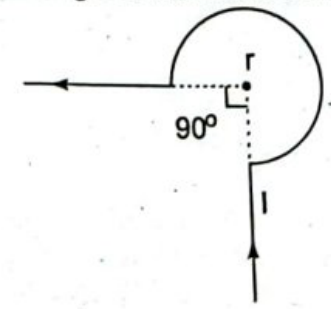
For the current-carrying wire geometry shown in the source figure, the magnetic field at the centre is:
📅CEE MBBS 2023
Q8.
A current-carrying circular loop is freely suspended by a long thread. The plane of the loop will point in which direction?
📅CEE MBBS 2023
Q9.
A proton and an electron enter a uniform magnetic field perpendicularly with the same kinetic energy. Which is true?
📅CEE MBBS 2022
Q10.
An electron enters a uniform magnetic field B with velocity v parallel to B. Its path is:
📅CEE MBBS 2022
Q11.
A beam of protons and a beam of electrons move parallel to each other in the same direction. They:
📅CEE MBBS 2022
Q12.
Two parallel wires A and B carry 10 A and 2 A respectively in opposite directions. Wire A is infinitely long; wire B is 2 m long and 10 cm away. The force on B is:
📅CEE MBBS 2021
Q13.
Proton and electron have the same kinetic energy. In perpendicular magnetic field, the deflection experienced by:
📅CEE BDS 2024
Q14.
A current carrying circular loop is suspended freely by a long thread. The plane of the loop will point:
📅CEE BDS 2023
Q15.
Two parallel current carrying wires in same direction gets:
📅CEE BDS 2023
Q16.
The magnetic force on a charged particle moving in a magnetic field is:
📅CEE BDS 2023
Q17.
When an electron moves through a uniform magnetic field, its speed:
📅CEE BDS 2021
Q18.
A proton is moving in the direction parallel to both electric and magnetic field, proton will [BP 2014]
Q19.
An electron enters X-direction and magnetic field is in Y-direction, The motion of electron after entering inside field is [BP 2014]
Q20.
A coil of metal wire is kept stationary in a non uniform magnetic field [BP 2014]
Q21.
Electric and magnetic field is in same directions and proton is also send in same direction then proton gets: [BP 2014]
Q22.
A wire bent in the form of a square lamina of side \(10 m\) in which a current I = \(10 A\) circulates. The lamina is placed inside a magnetic field B = \(10\) tesla perpendicularly to the lamina surface. The force experienced by it is: [BP 2014]
Q23.
A length of wire carrying current when bent to form a circle magnetic field is B. If the same length is bent to form 'n' no. of circular loops, then magnetic field at centre is. [BP 2013]
Q24.
Uniform magnetic field has its direction from east to west, then direction of current due to motion of proton is directed towards: [BP 2012]
Q25.
The magnetic field intensity at one end due to long current carrying solenoid is:
Q26.
The radius of the path followed by a particle in a magnetic field directly proportional to its [BP 2011]
Q27.
A current is flowing north along a power line. The direction of the magnetic field above it, neglecting the earth's field is [BP 2011]
Q28.
Which of the following equation represents fourth Maxwell's law magnetic field above it, neglecting the earth's field is [BP 2011]
Q29.
Find the value of torque when the value of magnetic field is \(0.2\) tesla and magnetic moment is \(2\) amp \(m^{2}\) acting perpendicular to each other [BP 2011]
Q30.
When a charge moves , in a direction perpendicular to magnetic field then [BP 2010]
Q31.
A toroid with \(2000\) turns and diameter of \(40 cm\) has \(2A\) current flowing through it. Then magnetic field at it's centre is [BP 2010]
Q32.
Earth's magnetic field always has horizontal component except: [IOM]
Q33.
A metallic wire is folded to form a square loop of side 'a'. It carries a current 'i' and is kept perpendicular to a uniform magnetic field. If the shape of the loop is changed from square to a circle without changing the length of the wire and current, the amount of work done in doing so is [BP 2009]
Q34.
Two circular coils \(1\) and \(2\) are made from same wire but radius of \(1s\)t coil is twice that of \(2\)nd coil. What potential difference should be applied across them so that the magnetic field at their centers is the same? [BP 2009]
Q35.
The magnetic induction at a point \(3 cm\) from a long current carrying wire is \(10^{-3} T\). The field induction at \(12 cm\) is [MOE 014]
Q36.
When an electron moves through a uniform magnetic field, its speed [MOE 2013]
Q37.
An alpha particle of mass \(6.65\times 10^{-27} kg\) travels at right angle magnetic field of \(0.2 T\) with a speed of \(6 \times 10^{5} m/s\). The acceleration the particle will be [MOE 2013].
Q38.
Two straight parallel conductors carrying current in opposite directions: [MOE 2013,12]
Q39.
One meter wire carrying \(2A\) is placed in magnetic fields \(2\) tesla force action on wire is [MOE 2012]
Q40.
An electron travelling with a velocity \(2 \times 10^{5} m/s\) enters a magnetic field of \(2 \times 10^{-5} T\) normal to velocity of electron, the radius of path the electron in magnetic field is. [MOE 2012]
Q41.
An electron enters in a magnetic field of \(10^{-3} T\) normally with velocity \(10^{6} m/s\). The radius of electron is : [MOE 2011]
Q42.
An electron passing in direction east perpendicular to vertical magnetic field acting downwards. The deflection of the electron is towards: [MOE 2010]
Q43.
A positively charged particles moving due east enters a region of uniform magnetic field directed vertically upwards. The particle will: [IOM 2013]
Q44.
When a rod of length \(2m\) carrying current \(10 A\) is placed perpendicular to magnetic flux density of strength of \(0.15 T\). What is the force experienced by it [IOM 2013]
Q45.
A current is flowing through a circular wire in clockwise direction. What will be the direction of magnetic lines of force:" [IOM 2013]
Q46.
When a charged particle enters in strong magnetic field, its kinetic energy. [IOM 2011]
Q47.
A long solenoid is formed by winding \(20\) turns/ cm. The current necessary to produce a magnetic field of \(20 m\)illitesla inside the solenoid will be approximately: [KU 2014]
Q48.
A charged particle of mass m and charge q is moving with a velocity v in a magnetic field B. The work done by the magnetic field in moving the particle is given by [KU 2011]
Q49.
An electric current is flowing in a circular coil of radius 'a' at what distance from the centre on the axis of the coil will the magnetic field be \(1\)/\(8\)th of its value at the centre.
Q50.
A long wire carries a current of \(0.5 A\). The flux density at a distance of \(0.01 m\) is [Bangladesh Emb.]
Q51.
An electron is moving in circular path in magnetic field intensity B then its time period is independent of [MOE 2056]
Q52.
Suppose we double the current flowing, the number of turns and the length of the coil of a long solenoid. If the original value of the magnetic field induction is B , then what is the value of the new magnetic field induction? [MOE 2053]
Q53.
A coil of area \((50 cm)^{2}\) is perpendicular to a uniform field of flux density \(10^{-3}\) Wm^{-\(2\)}. Then the flux passing through the coil is: [MOE 2062]
Q54.
A magnetic needle is kept in a non-uniform magnetic field. It experiences [MOE 2062]
Q55.
An electron enters in magnetic field with velocity \(2\times 10^{6} ms^{-1}\) perpendicular to the field of \(2\times 10^{-5} T\). What is the radius of the path of electron? [MOE 2065]
Q56.
Energy stored in magnetic field of \(2.5 \times 10^{-3}T\) is [IE-05]
Q57.
If the rectangular coil is set with plane of symmetry along z-axis in a parallel magnetic field then torque experienced by coil is [IE-05]
Q58.
When an electric beam is shot horizontally in an electric field and perpendicular to a magnetic field, the beam follows: [BPKIHS-94]
Q59.
A wire of length l carries a steady current. It is about first to form a circular plane loop of one turn. The magnetic field at the center of. The same length is now bent more sharply to give a double loop of smaller radius. The magnetic field at the center caused by the same is: [BPKIHS-08]
Q60.
A charged particle enters a magnetic field at right angles to the magnetic field. The field exist for a length equal to \(1.5\) times the radius of the circular path of the particle. The particle will be deviated from its path by. [BPKIHS-09]
Q61.
An electron enters a region where magnetic (B) and electric (E) fields are mutually perpendicular. Then, [BPKIHS 01]
Q62.
An electric charge q moves with a constant velocity v parallel to the lines of force of a uniform magnetic field B. The force experienced by the charge is [MOE 2010]
Q63.
Two thin long parallel wires separated by a distance 'b' are carrying a current'i' ampere each. The magnitude of the force per unit length exerted by one wire on the other is: [IOM 08]
Q64.
A charge of \(2\) coulombs moving with velocity \(0.5 m/s\) at an angle of \(30\)° with the field of \(4 T\) experiences force of: [IOM 07]
Q65.
If a wire carrying current "I" is bent to two arms making right angle, between them then the magnetic field intensity 'B' at the distance "a" from both arms is: [IOM 03]
Q66.
A solenoid of length \(20 cm\) and diameter \(2 cm\) has \(4250\) turns. If a current of \(2A\) is flowing through it, what is the magnetic field at the center of the solenoid? [MOE 066]
Q67.
An electron is moving with a velocity v and enters a uniform electric field perpendicularly. Its trajectory within the field will be [MOE 2009]
Q68.
A charged particle enters in a magnetic field perpendicular to the magnetic lines of force. The path of particles is [Bangladesh 09]
Q69.
The net force on a magnetic dipole in a uniform magnetic field: [IE-07]
Q70.
Magnetic field invariably contain: [[E-\(07\)]
Q71.
Magnetic field do not interact with [IE-08]
Q72.
An electron of mass = \(9\times 10^{-31} kg\), charge =\(1.6 \times 10^{-19}\) C moving with a velocity of \(10^{6} m/s\) enters a region where magnetic field exists. It is described on a circle of radius \(0.1m\), the strength of magnetic field must be: [TE-\(08\)]
Q73.
A particle ' is projected in a plane perpendicular to uniform magnetic field. The path described by the particle is proportional to [BPKIHS-95]
Q74.
An electron is moving in a region where both electric and magnetic fields are present. It will gain energy from
Q75.
A straight wire lies along X-axis from x=−a/\(2\) to x=+a/\(2\) and carries a steady current I. The magnetic field due to the wire at a point x = + a will be
Q76.
Two circular coils are made of two identical wires of same length. If the number of turns of two coils is \(4\) and \(2\), then the ratio of magnetic induction at centres coil will be
Q77.
A proton moving in a perpendicular magnetic field B possesses energy E. If the magnetic field increases to \(4\)B and the particle is constrained to move in the path of same radius, the kinetic energy of proton must be
Q78.
If two streams of protons move parallel to each other in the same direction, then these
Q79.
A wire having length l and carrying current I is bent in circular form. Then find the dipole moment of circular coil
Q80.
A uniform electric field and a uniform magnetic field are produced, pointed in the same direction. An electron is projected with its velocity pointed in same direction. The electron velocity will
Q81.
A strong magnetic field is applied on a stationary electron, then the electron
Q82.
Two particles X and Y having equal charges after being accelerated through the same p.d. enter a region of uniform magnetic field and describe circular paths of radii R_{\(1\)}, and R_{\(2\)}, respectively. The ratio of mass of X to that of Y is
Q83.
If proton and α-particle moving with same energy enter normally in a uniform magnetic field then the ratio of their radii and time period will be
Q84.
An electron accelerated through a potential of V volt enter normally in a uniform magnetic field and experiences force. F. If potential is doubled then force experienced by the electron will be.
Q85.
Three charged particles H^{+}, He^{+} and O^{++} moving with same energy enter normally in uniform magnetic field then
Q86.
An electron and a proton having same kinetic energy enter a magnetic field perpendicularly. Which of the following is true?
Q87.
Two circular coils having their current of radius ratio \(1\):\(1\) are kept normal to each other with their common centres. Then the magnetic field at their common centre is
Q88.
Two circular coils P and Q are made of same wire but radius of Q is twice that of P. Then find the ratio of p.d across them so that magnetic field at their centres is equal
Q89.
A square carrying current I and having side length l. Then find the magnetic field at the centre
Q90.
Find the magnetic field at point O shown in figure
Q91.
Ratio of magnetic field induction at the centre of a current carrying coil of radius R and at a distance \(3\)R on its axis is
Q92.
A long, straight, solid metal wire of radius \(2mm\) carries a current uniformly distributed over its circular cross section. The magnetic field induction at a distance \(2mm\) from its axis is B. Then the magnetic field induction at distance \(1 mm\) from the axis will be
Q93.
Two straight long wires are set parallel to each other with a distance of \(2\)r between them. If each wire carries a current I in the same direction, the strength of magnetic field at a distance r between the two wires is
Q94.
If a long copper current the magnetic field associated with the current will be
Q95.
At the midpoint along the length of a long solenoid, the magnetic field is equal to B. If the length of solenoid is doubled and the current is reduced to half, the magnetic field at the new mid-point will nearest to
Q96.
The frequency of charged particle, moving at right angle to the magnetic field is independent of
Q97.
An electric field of \(1500\) volt/meter and magnetic field of \(0.40\) Weber/m2 act on a moving electron to produce no force. What is the electron speed?
Q98.
A proton and α-particle enter a uniform magnetic field perpendicular with the same speed. If proton takes \(20\)μ second to make \(5\) revolutions, then the periodic time for the α-particle would be
Q99.
A circular loop area \(0.02m\)2 carrying a current of \(10A\) is held with its plane perpendicular to a magnetic field induction \(0.2T\). The torque acting on the loop is
Q100.
Through two parallel wires A and B, \(10A\) and \(2A\) of current are passed respectively in opposite directions. If the wire A is infinitely long and the length of the wire B is \(2m\), then force on the conductor B which is situated at \(10cm\) distance from A, will be
Q101.
Two identical co-axial circular loops carry a current I each circulating in the same direction. If the loops approach each other, then current in each loop.
Q102.
Two parallel long wires A. and B carry currents, I1 and I2 (
Q103.
An electron of charge e moves with a constant speed v along a circle of radius r. Its magnetic moment will be
Q104.
A current carrying rectangular coil is placed in a uniform magnetic field. In which orientation, the coil will tend to rotate?
Q105.
An alpha particle is accelerated through a p.d. of \(10^{6}\) volt. Its K.E will be
Q106.
The magnetic moment of a circular coil carrying current is
Q107.
A long solenoid has \(200\) turns per cm and carries a current of \(2.5\) amp. The magnetic field at its centre is. (μo = \(4\)πx10^{-\(7\)} weber/\(m^{2}\)] IKU \(2014\)
Q108.
Force per unit length at one end of each of the two parallel wires, carrying current I each, kept distance r apart is
Q109.
A particle of charge q and mass m moves in a circular orbit of radius r with angular speed ω. The ratio of the magnitude of its magnetic moment to that of its angular momentum depends on
Q110.
Two wires of same length are shaped into a square and a circle. If they carry same current, ratio of the magnetic moments is
Q111.
A wire is wound in the form of a solenoid of length / and diameter d. When a strong current is passed through the solenoid there is tendency to
Q112.
An electron moves in a circular orbit with a uniform speed v. It produces a magnetic field B at the centre of the circle. The radius of the circle is proportional to
Q113.
A helium nucleus makes a full rotation in a circle of radius \(0.8 m\)etre in \(2s\)ec. . The value of the magnetic field induction B in tesla at the centre of circle will be [BP 2012, MOE 2011]
Q114.
A uniform wire in bent in the form of a circle of radius R.A current I enters at A and leaves at C as shown in figure. If the C is half of the length ADC, the magnetic field at the centre O will be
Q115.
An electron moving upwards vertically enters a uniform magnetic field directed towards north. The force on the electron will be towards
Q116.
The mass of a proton is \(1847\) times that of electron. If an electron and a proton are injected in a uniform electric field at right angle to the direction of the field, with the same kinetic energy, then.
Q117.
When the magnetic field is applied across the north & the positive charge is deflected toward the east then current flowing is: [KU 2016]