📚
PLATYHELMINTHES
▢ Introduction:
❖ Members: Members of Platyhelminthes are called Flat worms because they are dorsiventrally flattened.
❖ Study: Study of Platyhelminthes and Nemathelminthes is called Helminthology.
❖ Diseases: Diseases caused by Platyhelminthes and Aschelminthes is called Helminthic disease.
❖ Habitat:
◉ Parasitic: Most members are Parasitic
◉ Free-living:
- Planaria (Water)
- Bipalium (Land)
▢ General Characters:
❖ First Appeared Characters:
- Triploblastic animal
- Bilateral symmetry
- Cephalization (e.g., Head of Tapeworm – Scolex)
- Brain is seen – Vestigial
- Nervous organ is Primitive ladder-like
- Tissue-organ level of Body-organization (e.g., Excretory organ is Flame cell)

Fig.ladder like nervous system of platyhelmenthes
Credit:Rs' Science
Q1.
Flatworms are
📅IOM 2013•MOE 2010
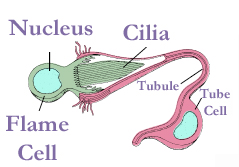
Fig.flame cells (excretory organ of platyhelmenthes)
❖ Body Cavity: Acoelomate (Mesoderm split and filled with Parenchyma tissue)
▢ Classification:
Characters | Turbellaria | Trematoda (Flukeworms) | Cestoda (Tapeworms) |
|---|---|---|---|
Mode of Life | Free-living | Parasitic | Exclusively endoparasitic |
Alimentary canal | Incomplete - Without Anus (Pharynx is present in Planaria which is protrusible/ everted) | Incomplete - Without Anus | Absent |
Cilia | Body is ciliated and Mucus-secreting gland | Body is not ciliated | Body is not ciliated |
Body structure | Unsegmented leaf like | Unsegmented leaf like | Segmented ribbon/ tape like |
Adhesive organs | No hooks nor sucker |
|
|
Receptors |
| X | X |
Development | Direct |
|
|
Examples |
|
|
|
Q1.
Tapeworm using pig as an intermediate host is:
Q2.
Flame cells are present as excretory organs in:
Q3.
Flattened leaf like body belongs to:
Q4.
Tape worm falls in class
Q5.
In which class of platyhelminthes, alimentary canal is
Q6.
Pseudocoelom is found in:
Q7.
Which one of the following animal phyla does not possess a coelom.
Q8.
Flatworms are
Q9.
All worms are
Q10.
Body is unsegmented in
Q11.
What is common amongst tapeworm, liver fluke and planarian?
Q12.
The excretory structures of flatworms are
Q13.
In flatworms, the excretory organs are
Q14.
Flame cells are used for
Q15.
In platyhelminthes
Q16.
Classification of flatworms is based on
Q17.
Class Trematoda includes
Q18.
Alimentary canal is absent in animals of the class
📚
PLANARIA (DUGESIA)

▢ Habit:
❖ Gregarious: Planaria live in groups.
▢ Habitat: Free-living
▢ Diet: Omnivorous
▢ Pharynx: Planaria can evert its pharynx.
▢ Epidermis:
❖ Rhabdites: Presence of Rhabdites.
❖ Type: Syncytial epidermis
▢ Genital Pore: The genital pore lies posterior to the pharynx.
▢ Regeneration: 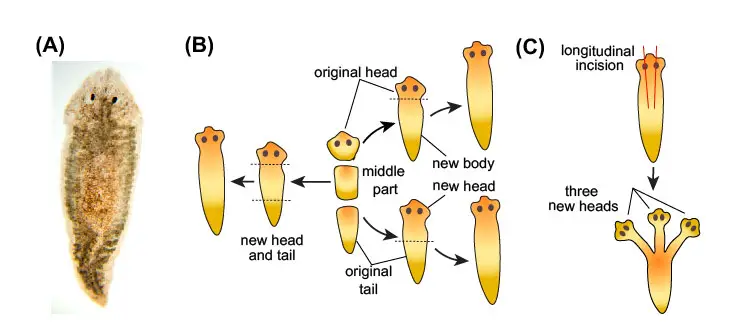
Fig.Regeneration of Planari
Credit:Rs' Science
❖ Power: Planaria have a remarkable power of regeneration.
❖ Mechanism:
◉ Neoblasts: Neoblasts from mesoderm help in regeneration.
◉ Processes:
- Epimorphosis
- Morphollaxis
◉ Lateral Polarity: Planaria has lateral polarity. If the head is cut longitudinally into 2 or several parts along the middle line, each part grows into a complete head, forming a several-headed Planaria. This is heteromorphosis.
◉ Grafting: Pieces of one Planaria can also be grafted into another.
▢ Reproduction:
❖ Sexual:
◉ Hermaphroditism: Planaria are hermaphrodite.
◉ Eggs: Eggs are ectolecithal (i.e., yolk is deposited outside).
◉ Fertilization: Internal
◉ Cleavage: Spiral
❖ Asexual: Binary fission
Q1.
Body is unsegmented in
Q2.
What is common amongst tapeworm, liver fluke and planarian?
Q3.
Which one of the following exhibits high power of regeneration?
Q4.
Which is a free living fresh water flatworm?
Q5.
Pharynx can be everted in
Q6.
In platyhelminthes
📚
LIVER FLUKE
▢ Body Structure: 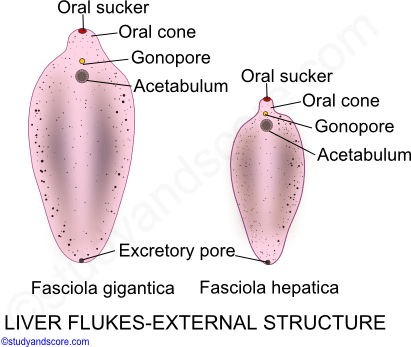
Fig.structure of liver fluke
Credit:study and score
❖ Shape: Leaf-shaped, dorsoventrally flattened
❖ Length: 2–3 cm
❖ Suckers:
◉ Oral sucker: Around mouth, used for attachment and feeding
◉ Ventral sucker: Slightly behind oral sucker, helps in attachment
▢ Habit: Bile passages in the liver of sheep
▢ Epidermis:
❖ Type: Syncytial
▢ Excretory System:
❖ Excretory Organ: Flame cells (Solenocytes)
❖ Connection: Flame cells are connected to excretory canals by their canaliculi.
❖ Excretory Products:
- CO2
- NH3
- Fatty acids
❖ Excretory Pore: Opens at the extreme posterior end of the body.
▢ Reproduction:
❖ Type: Bisexual (Hermaphrodite)
❖ Complexity: Reproductive systems are extremely well-developed and quite complex.
❖ Copulation: Mid-dorsal part contains a minute pore for copulation.
Male Reproductive Organs | Female Reproductive Organs |
|---|---|
◉ 1 pair of testes:
| ◉ Single ovary:
|
◉ Cirrus (Muscular penis): Act as Male copulatory organ | ◉ Laurer’s canal: Act as Temporary vagina (Appears only during Breeding season) |
◉ Genital pore/ Gonopore: (Located between the two suckers) | |
◉ Vitelline glands:
◉ Mehlis gland/ Shell gland:
|
Q1.
Vitelline glands are found in:
Q2.
Fasciola hepatica is
Q3.
Laurer's canal is present in
▢ Life Cycle: 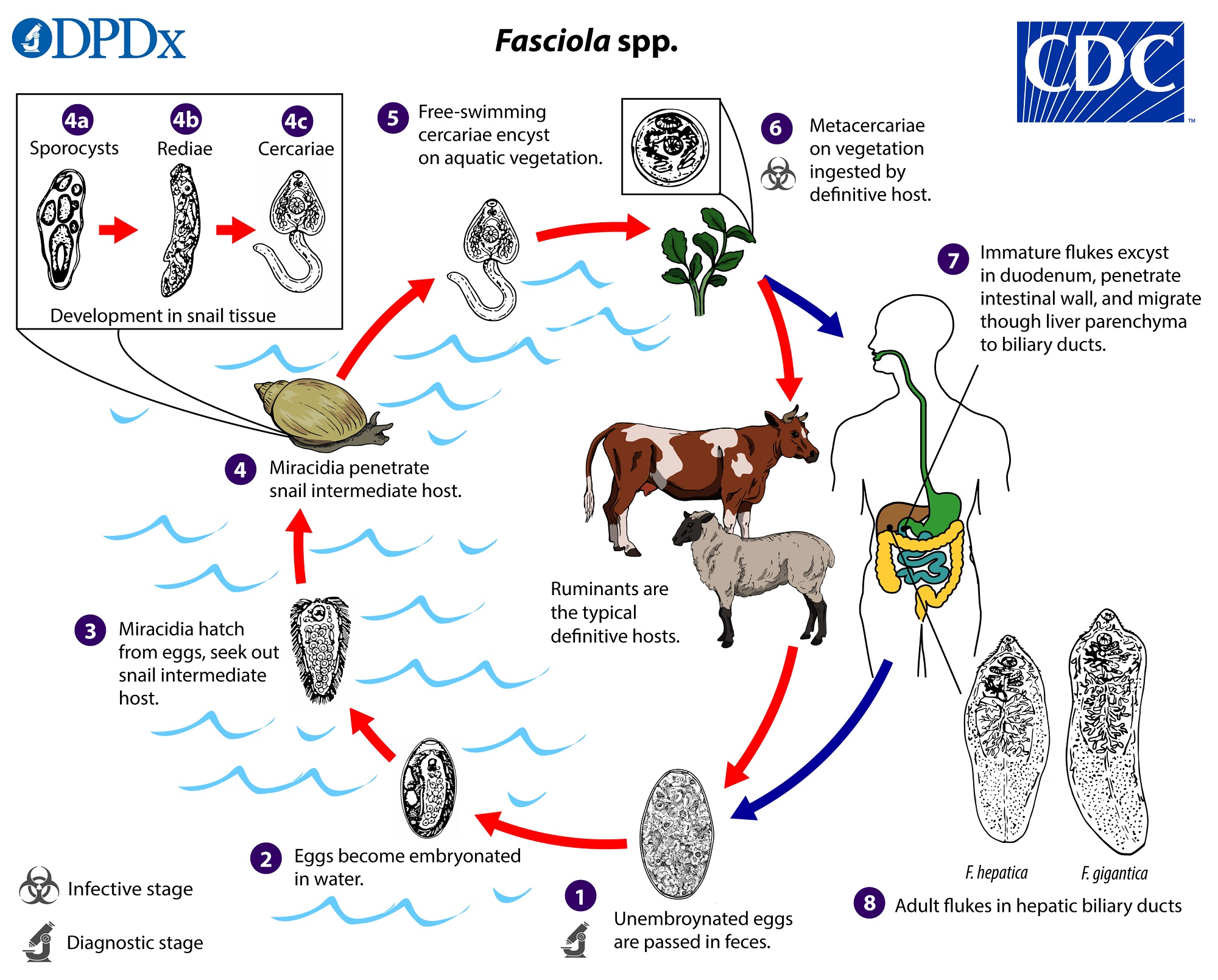
Fig.Regeneration of Planari
Credit:cdc
❖ Type: Digenetic
❖ Primary Host:
◉ Host: Sheep
◉ Disease: Liver rot
◉ Related Disease: Fasciolopsis is caused by Fasciola busci.
◉ Treatment: Fasciola infection can be treated with the veterinary Fasciolide triclabendazole.
❖ Secondary Host:
◉ Host: Snail
◉ Impact: Fasciola is harmless to snails but is pathogenic in vertebrate hosts, including man (rarely).
❖ Larval Stages:
- Sporocyst gives rise to Redia
- Redia to Cercaria
- Cercaria is transformed into Metacercaria
Q1.
Free swimming ciliated stage of liver fluke is
Q2.
Fasciola hepatica is a digenetic parasite. Sheep and snail are two hosts. Snail is
Q3.
Bilaterally symmetrical but acoelomate animal is
Q4.
The liver fluke is a flatworm found commonly in
Q5.
The intermediate host of liverfluke is:
Q6.
Fasciola hepatica is a digenetic parasite. Sheep and snail are two hosts. Snail is
❖ Phenomenon: This phenomenon is Polyembryony.
❖ Alternation:
- Fasciola exhibits both alternation of generation and alternation of host.
❖ Water Dependency: Fasciola cannot complete its lifecycle in the absence of water due to the lack of snails.
📚
BLOOD FLUKE
▢ Species Infecting Humans:
- Schistosoma haematobium
- Schistosoma mansoni
- Schistosoma japonicum
▢ Old Name: Bilharzia
▢ Discovery:
❖ Discoverer: Theodor Bilhartz (German parasitologist)
❖ Significance: Discovered S. haematobium responsible for urinary schistosomiasis.
❖ Impact: Schistosoma haematobium causes kidney damage.
▢ Location in Human Body:
- Small branches of urinary bladder
- Urinary tract
- Mesenteric veins
- Portal veins
- Lymph nodes
▢ Reproduction:
❖ Type: Dioecious with well-defined sexual dimorphism
❖ Male Characteristics: Smaller and thicker
❖ Female Characteristics: Longer, slender, and cylindrical
❖ Unique Feature: Female is lodged in the Gynaecophoral canal of male.
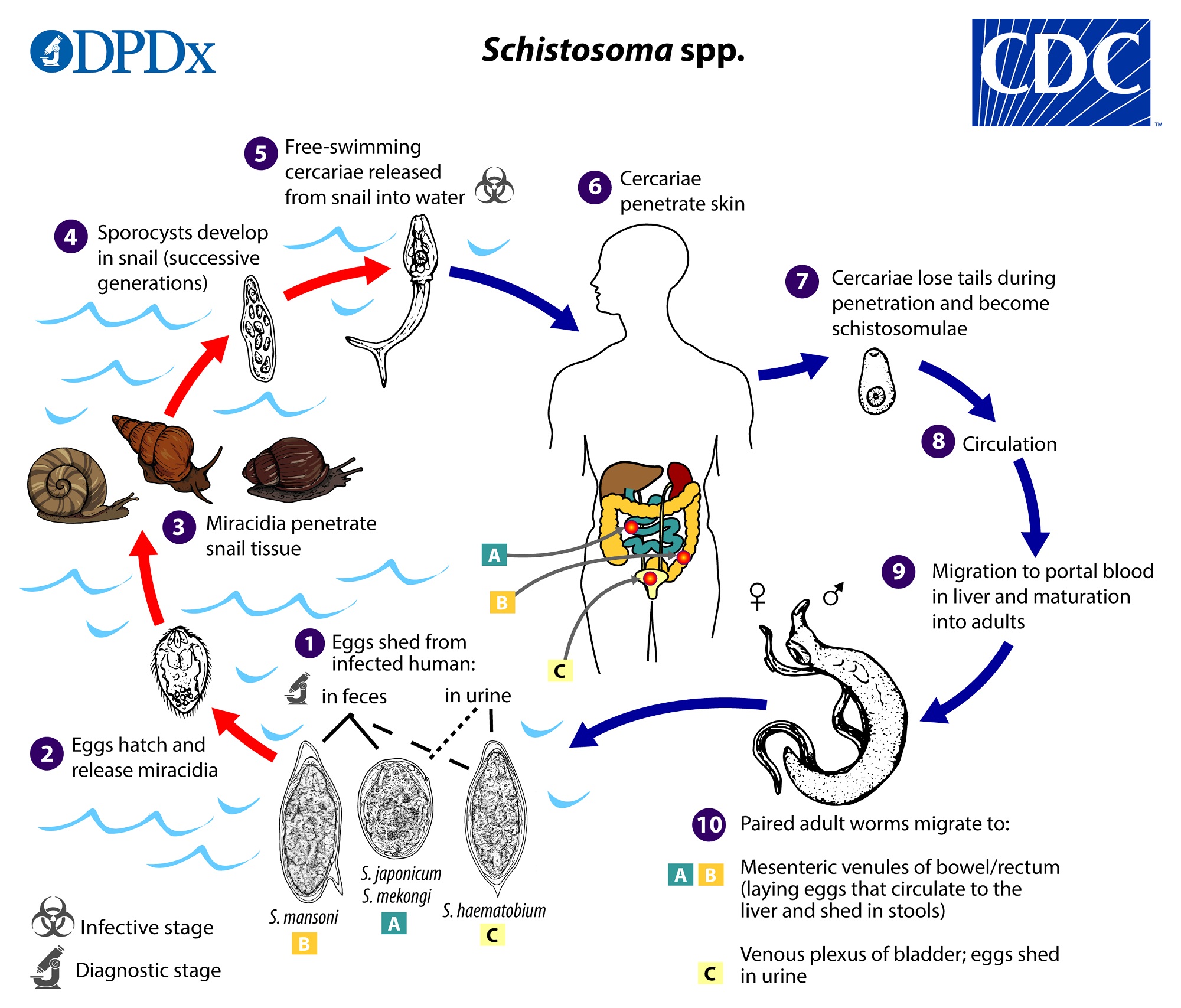
Fig.Regeneration of Planari
Credit:cdc
▢ Life Cycle:
❖ Type: Digenetic
❖ Primary Host: Man
❖ Secondary Host: Balinus or other snails
❖ Egg Development: The eggs pass out from man with urine or faeces and hatch when they come in contact with water.
▢ Disease:
❖ Name: Schistosomiasis or Bilharziasis
❖ Infection Method: Caused by either penetration of Cercaria through the skin or by contaminated water.
❖ Severe Condition: Blood flukes sometimes produce a severe cercarial dermatitis called 'Swimmer's itch'.
▢ Symptoms:
- Skin rash
- Bronchial cough
- Anaemia
- Haematuria
- Bloody stool
▢ Treatment: Praziquantel
Q1.
Infective stage of blood fluke is
Q2.
The intermediate host of Schistosoma is
Q3.
Female Schistosoma is lodged in ....... canal of male:
📚
TAPEWORM
📖
Taenia solium
▢ Body Structure:
❖ Shape: Elongated ribbon or tape-like segmented body (pseudometamerism)
❖ Parts:
- Apical part of Scolex is Rostellum
- Rostellum bears two circles of chitinous hooks (28-32)
- Four suckers or Acetabula
- Suckers and hooks are for attachment with the host body
- Unsegmented part
- New segments are formed in this region (Budding zone or Proliferation zone)
- Narrowest part of the body
- Main body made of 800-1000 similar rectangular segments called Proglottids
- Youngest segments lie near the neck, oldest lie at the rear end
- Three types of proglottids: Young (Male organs), Mature (Male and Female organs), Gravid (Branched uterus with fertilized eggs)
- Gravid proglottids detach one by one and pass out with host faeces (Apolysis)
◈ Part: Head (Scolex)
◈ Features:
◈ Part: Neck
◈ Features:
◈ Part: Strobila
◈ Features:
❖ Body Walls:
◉ Lacks: Cellular epidermis
◉ Consists of:
- Cuticle (Parasitic adaptation)
- Musculature
- Parenchyma (Mesodermal tissue)
■ Outer Layer: Cortical parenchyma with Lime secreting gland cells
■ Inner Layer: Medullary parenchyma with internal organs
◉ Body Cavity: Absent (Acoelomate)
▢ Nutrition:
❖ Type: Osmotrophy
❖ Details:
- No digestive system
- Depends on predigested food absorbed from host's gut through the cuticle
- Cuticle protects from host's digestive enzymes
▢ Respiration:
❖ Type: Anaerobic
▢ Excretion:
❖ System: Longitudinal and cross-connecting excretory canals
❖ Products:
- Ammonia
- Fatty acids
❖ Excretory Organs: Flame cells
▢ Reproduction:
❖ Type: Hermaphrodite
❖ Details:
- A complete reproductive system occurs in each mature proglottid
- Fertilization can occur within the same proglottid or between proglottids of the same strobila
- Larval stages: Oncosphere, Hexacanth (with six hooks), Cysticercus (Bladder-worm)

Fig.lifecycle of taenia solium
Credit:CDC
▢ Life Cycle:
- Each fertilized egg develops into Oncosphere larva within the proglottid
- Oncospheres pass out through host faeces
- Secondary host (Pig) ingests oncospheres
- Hexacanth is released in pig's stomach, travels through blood, and encysts in muscles as Bladderworm (Cysticercus)
- Humans get infected by eating raw or poorly cooked 'Measly pork' (infected pork)
- Cysticercus in pig muscles can remain viable for several years
- Cysticercus develops into an adult tapeworm in human intestine
Q1.
Tapeworm using pig as an intermediate host is:
Q2.
Tapeworm using pig as an intermediate host is:
Q3.
Body segment of Taenia solium is:
Q4.
Common name of Taenia solium is:
Q5.
Vitelline glands are found in:
📖
Taenia saginata
▢ Common Name: Beef tapeworm
▢ Host Details:
- Primary host: Man
- Secondary host: Cattle
▢ Differences:
- Called 'Unarmed tapeworm' because the scolex does not possess hooks
- More prevalent and longer than Taenia solium
▢ Diseases: 14117-7/asset/2da22471-b2eb-44de-8ab8-ba4e5b402379/main.assets/gr1_lrg.jpg)
Fig.Regeneration of Planari
Credit:Rs' Science
❖ Taeniasis:
❖ Cysticercosis:
- Caused by bladderworm (Cysticercus)
- More dangerous than taeniasis
- Encystment occurs in organs such as cardiac muscle, liver, eyes, and brain
Q1.
Tapeworm using pig as an intermediate host is:
Q2.
Taenia saginata differs from T. solium mainly in absence of
Q3.
Diphyllobothrium of phylum platyhelminthes is known as:
Q4.
The hydatid disease in man is caused by the larva of
Q5.
Which one of the following parasites has only one host in its life cycle?
S.N. | Taenia solium (Pork tapeworm) | Taenia saginata (Beef tapeworm) | Echinococcus granulosa (Dog tapeworm/ Hydatid worm) | Diphylobothrium latum (Fish tapeworm) | Hymenolepsis nana (Dwarf tapeworm) |
|---|---|---|---|---|---|
Unique | Longest tapeworm in human | Shortest tapeworm in human | |||
1. Residence of Adult tapeworm | Small intestine of human | Small intestine of human | Small intestine of dog, wolf, jackal, hyena, fox | ||
2. Residence of Larva | Muscles of Pig/ Brain or Eye muscles of human | Muscles of cow or buffalo | Liver/ Lungs/ Muscles of sheep/ human | ||
3. Primary host/ Definite host | Human | Human | Canine animals like dog, wolf, jackal, etc. | • Trigenetic | Human |
A) Human | |||||
4. Secondary host | Pig | Cow/ Buffalo | Sheep/ Human/ Cattle | B) Fish | The life cycle is simple without any intermediate host but flour beetles and fleas may serve as the intermediate host. |
C) Cyclops | |||||
6. Size | 2-3 meter | 5-8 meter | 4-6 millimeter | ||
5. Human acts as | Definitive + Intermediate host | Definite host | Intermediate host | ||
7. Scolex | - Presence of Rostellum with hooks + hooklets | - Absent | - Absent | ||
- Suckers present | - Present | - Present | |||
8. No. of proglottids | 900-1000 | 1800-2000 | 3 or 4 | ||
- Immature = 1 | |||||
- Mature = 1 | |||||
- Gravid = 1 or 2 | |||||
9. Mode of Transmission | - By measly meat of pig; | By meat of cow/ buffalo | - By contaminated food/ water; | ||
- By contaminated water/ food (Cystericercosis) | - By direct contact with infected dogs | ||||
10. Infective stage | Cystercercus cellulosae | Cystercercus bovis | Hydatid cyst (Hexacanth larva) | ||
11. Diseases | - Adult = Taeniasis | - Adult = Taeniasis | - Adult = ……… | ||
- Larva = Cystercercosis | - Larva = …… | - Larva = Hydatid disease/ Echinococcosis | |||
12. Eggs | Are infective | Not infective | Are infective | ||
13. Susceptibility | Both vegetarians and Non-vegetarians are affected | Only non-vegetarians are affected | All (Including those in contact with dogs are affected |
Q1.
Diphyllobothrium of phylum platyhelminthes is known as:
Q1.
Diphyllobothrium of phylum platyhelminthes is known as:
Q2.
Liver-rot is caused by:
Q3.
Tapeworm using pig as an intermediate host is:
Q4.
Body segment of Taenia solium is:
Q5.
Flame cells are present as excretory organs in:
Q6.
Larva of tapeworm in pork meat is:
Q7.
Flattened leaf like body belongs to:
Q8.
Intestinal tape worms obtain their nutrition by:
Q9.
The intermediate host of liverfluke is:
Q10.
Bladderworm larva of tape worm is known as:
Q11.
If a person has eaten not property cooked pork there is a chance that he may suffer from
Q12.
Tape worm falls in class
Q13.
Common name of Taenia solium is:
Q14.
Female Schistosoma is lodged in ....... canal of male:
Q15.
Vitelline glands are found in:
Q16.
Which will show both alternation of generation and alternation of host?
Q17.
The parasitic animals possess well developed
Q18.
In which class of platyhelminthes, alimentary canal is
Q19.
Which one is correct for hexacanth larva of tapeworm?
Q20.
Pseudocoelom is found in:
Q21.
Ectoparasite of fish falls under:
Q22.
Which larval form of tapeworm is present in pork
Q23.
Which one of the following animal phyla does not possess a coelom.
Q24.
The liver fluke is a flatworm found commonly in
Q25.
The secretion of Mehlis' gland
Q26.
Hexacanth remains surrounded by
Q27.
Schistosoma is a parasite found in
Q28.
Taenia saginata differs from T. solium mainly in absence of
Q29.
Apolysis helps in
Q30.
Tapeworm has no alimentary canal because
Q31.
Flatworms are
Q32.
Rhabditis occur in the epidermis of
Q33.
All worms are
Q34.
Body is unsegmented in
Q35.
What is common amongst tapeworm, liver fluke and planarian?
Q36.
The excretory structures of flatworms are
Q37.
In flatworms, the excretory organs are
Q38.
Flame cells are used for
Q39.
One example of animals having a single opening to the outside that serves both as mouth as well as anus is
Q40.
In platyhelminthes
Q41.
Classification of flatworms is based on
Q42.
Class Trematoda includes
Q43.
Alimentary canal is absent in animals of the class
Q44.
Which of the following is a worm but not flatworm
Q45.
Regeneration power can best be studied in
Q46.
Eyes are present in
Q47.
If a tapeworm is carried out from its natural habitat, then what will happen?
Q48.
Fasciola causes
Q49.
Taenia is found in
Q50.
Powerful suckers found in tapeworms are meant for
Q51.
Gravid proglottids of Taenia are
Q52.
Shedding of proglottids in tapeworm is called
Q53.
A proglottid of Taenia is called gravid when it has
Q54.
Which of the following is not the character of Taenia sonum?
Q55.
Tapeworm is
Q56.
Infection of Taenia to secondary host occurs as
Q57.
Cysticerci in pig muscles can remain viable for
Q58.
Cysticercus larva is also known as
Q59.
When cysticerci are present in pork it is called
Q60.
The disease caused by bladderworm is known as
Q61.
Gynaecophoric canal is present in some animals of
Q62.
In tapeworm vitelline gland produces
Q63.
A tapeworm excretes
Q64.
The intermediate host of Schistosoma is
Q65.
Bilaterally symmetrical but acoelomate animal is
Q66.
Pseudocoelom is not found in
Q67.
Flame cells are found in
Q68.
Fasciola hepatica is a digenetic parasite. Sheep and snail are two hosts. Snail is
Q69.
Taenia does not show locomotion because it has
Q70.
The number of testes in each mature proglottid of Taenia is
Q71.
Rhabdites occurs in
Q72.
Free swimming ciliated stage of liver fluke is
Q73.
The function of Mehlis gland in Taenia is
Q74.
Copulation in Taenia occurs between
Q75.
Which is a free living fresh water flatworm?
Q76.
Which of the following larval stage is absent in Schistosoma?
Q77.
Regeneration power can be best studied in
Q78.
Pharynx can be everted in
Q79.
Infective stage of blood fluke is
Q80.
Laurer's canal is present in
Q81.
A digenetic flatworm is
Q82.
Cysticercus of Taenia develops in
Q83.
Tapeworm has no alimentary canal because
Q84.
Alimentary canal in Tapeworm is
Q85.
Pseudometameris is found in
Q86.
Fasciola hepatica is
Q87.
Which of the following statement is true about the alimentary canal of Round worms?
Q88.
Special modification of Ascaris to its parasitic mode of life Is:
Q89.
Filaria is a:
Q90.
Which one of the following is true for Ascaris?
Q91.
Amphid and phasmid glands are found in:
Q92.
The wandering journey of Ascaris takes:
Q93.
Which of the following disease is caused by nematodes?
Q94.
The space between the body wall and the alimentary canal of Ascaris is known as
Q95.
The animal in which sexes can be differented from external morphology is
Q96.
Filaria can be eradicated if the population of following is exterminated
Q97.
Amphids present in ventrolateral lips of Ascaris are:
Q98.
Which one has no intermediate agent to cause disease?
Q99.
The correct matching about body wall of Ascaris is:
Q100.
Which of the following parasite causes iron (Fe) deficiency anaemia?
Q101.
Which of the following penetrate through human skin?
Q102.
In hookworm, ingested blood is prevented from clotting by formed secreted by:
Q103.
The alimentary canal of nematode is:
Q104.
Hookworm infection causes the deficiency of:
Q105.
Filariform larva is infective stage of:
Q106.
The organism which is NOT blood parasite:
Q107.
After how many moulds does a round worm grow into an adult in human intestine?
Q108.
Anemia may be caused by