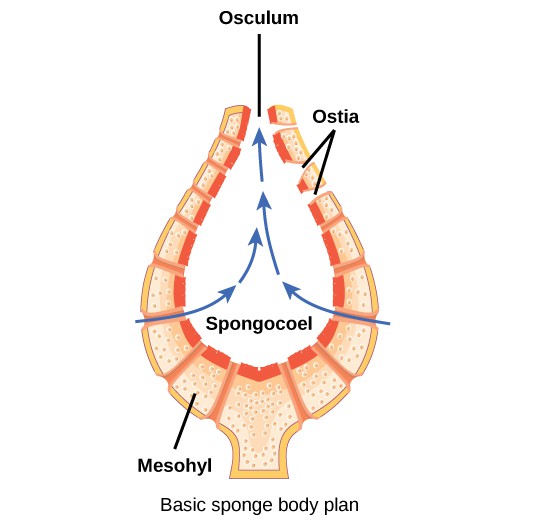
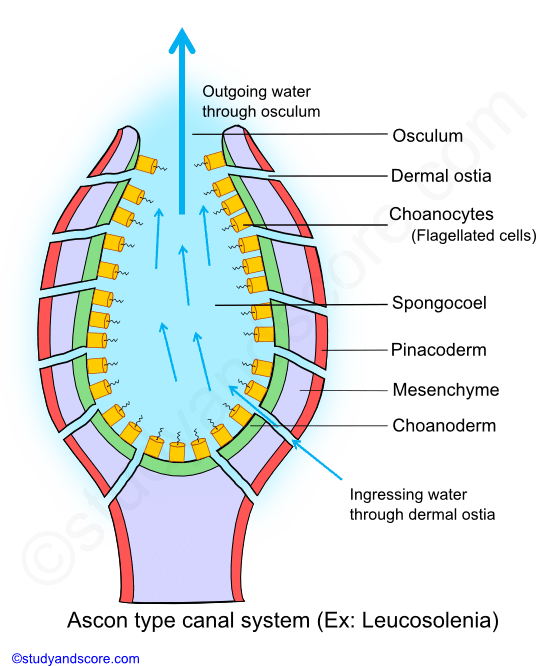
Jelly-like substance found between the two layers called Mesenchyme or Mesohyl.
Consists of Skeletal elements (Spicules), Collagen fibres, and Free Amoebocytes/ Wandering cells.
◉ Amoebocyte Cells:
S.N.
Amoebocyte cells
Features
1)
Archaeocytes
Largest amoebocytes
Can be converted into any other types of amoebocyte (totipotent cell)
Helps in regeneration called morphallaxis
Reproductive cells are also produced from archaeocytes
Helps in formation of internal bud called gemmule for asexual reproduction
2)
Thesocytes
Stores food in the form of Glycogen granules.
3)
Trophocytes
Provide food to developing cells (Nurse cells or Nutritive cells).
4)
Scleroblast
Multinucleated
Calcoblast = CaCO₃ (secretes the spicules)
Silicoblast = Silica
Spongioblasts = Spongin fibres
5)
Collencyte/ Connecting cells
Secretes Collagen fibres.
6)
Myocytes/ Contractile cells
Present at ostia and osculum (but mainly at osculum).
Helps in closing and opening of Osculum.
7)
Chromocytes/ Pigment cells
Gives color as well as excretory in nature.
8)
Phagocytes
Phagocytic in nature (engulf foreign particles).
9)
Germ cells
Reproduction.
10)
Gland cells
Serve for attachment by secreting slimy substance (mucus).
❖ Inner layer/ Choanoderm/ Gastral epithelium:
Choanocyte/ Collar cells/ Flagellated cells
Choanocytes or Collar cells are only present in Sponges.
Water current through the body of sponge is maintained by Choanocytes.
Choanocytes help in Nutrition by ingesting food through the incoming water (holozoically).
The cavity common to all sponges is Spongocoel or Paragastric cavity lined with flagellated choanocytes.
Q1.
Choanocyte cells are found in:
📅IOM 2007
Q2.
The sponge differs from other animals by the presence of:
📅IOM 2006
Q3.
Porocytes are a type of cells found exclusively in
Q4.
Mesohyll is found in
Q5.
Flagellated cells in sponges are called
Q6.
Reproductive cells in sponges probably are formed from
Q7.
Cells which create water current and ingest food in Leucosolenia and other sponges.
Q8.
Silicoblast is one of the
▢ Water Canal System/ Aquiferous System:
❖ Description:
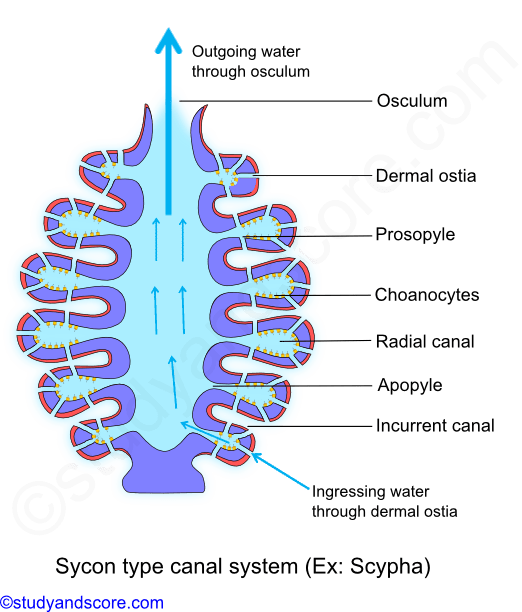
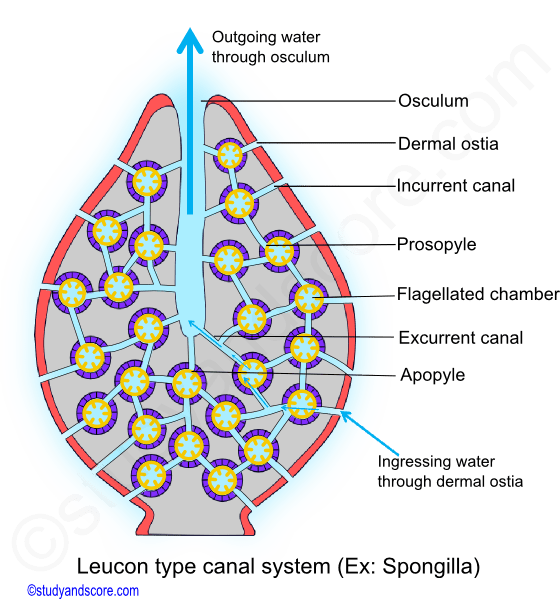
Sponges have a canal system also known as Water Canal System or Aquiferous system.
Canal system is a characteristic feature of Sponges.
Sponges need a continuous current of water flowing through their bodies for Nutrition, Respiration, Excretion, and Reproduction.
❖ Types:
1. Ascon type
2. Sycon type
3. Leucon type
4. Rhagon type
Flow of Water
Transformed to Leucon type during adulthood.
Notes
1. Incurrent canal is lined by Pinacocytes. 2. Prosopyle is lined by Porocyte. 3. Radial canals are lined by Choanocytes.
Examples
Leucosolenia
Sycon
Spongilla
Some larval stages
Q1.
Canal system is characteristic of
Q2.
The 'life-line' of sponges is
Q3.
The incurrent canals of sponges are lined by
Q4.
In most simple type of canal system of Porifera water flows through which one of the following ways ?
▢ Regeneration Capacity:
❖ Types:
Epimorphosis
Morpholaxis
Character
Regeneration of lost part.
Each cut piece grows into a new organism.
Examples
Sponges
Starfish
Porifera
Coelenterata
❖ General: All Porifera without exception show high power of Regeneration.
❖ Reasons: Due to archaeocytes which are highly totipotent cells.
Q1.
Regeneration of limbs of amphibian involves
▢ Metabolism:
❖ Digestion:
◉ Nutrition:
◈ General: All sponges are filter feeders.
◈ Other filter feeders:
Ciliates
Sponges
Mollusca ⟶ Bivalvia e.g., Unio
Hemichordata
Protochordata
◉ Key: Intracellular and holozoic. Takes place partially in choanocytes and partially in wandering amoebocytes. Digestion of food takes place in Food vacuoles.
❖ Respiration: Performed by both Choanoderm and Body surface, but mainly by Choanoderm.
❖ Circulation: Takes place by Wandering of Amoebocyte cells.
❖ Excretion and Gas Exchange: Primarily Ammonia; Simple diffusion occurs across the Choanoderm.
▢ Reproduction:
❖ General: Porifera reproduces by both Asexual and Sexual methods.
❖ Asexual Reproduction:
Internal Bud (Gemmule)
External Bud
Characters
Formed by the aggregation of Archaeocytes.
Gemmulation is the process of forming internal bud.
Formed during unfavorable conditions.
Formed during favorable conditions.
Examples
Spongilla
Sycon
Leucosolenia
❖ Sexual Reproduction:
◉ Key:
Porifera are Bisexual/Monoecious (⚤) and Protogynous (Female gametes mature first).
Cross-fertilization is the rule.
Cleavage of zygote is Holoblastic (Complete division) and Equal.
Larva is active and floating but adult is sedentary and sessile.
◉ Larval Stages:
Larva
Description
Comparable To
Amphiblastula
Larva of Sycon
N/A
Parenchymula
Larva of Leucosolenia
Planula of Obelia (Motile)
Stero-gastrula
Larva of Euplectela
N/A
Q1.
Parencymula of Leucosolenia is comparable to:
Q2.
Gemmule formation occurs in:
📅IOM 2002
◉ Olynthus:
Short-lived stages formed when the colony becomes attached to a Substrate.
Hypothetical ancestral stage of Sponge.
Q1.
Incurrent canal is associated with:
📅MOE 2063
Q2.
Which one of the following is classes of porifera?
📅MOE 2062
Q3.
Classification of porifera is on the basis of
📅MOE 2052
Q4.
Choanocyte cells are found in:
📅IOM 2007
Q5.
The sponge differs from other animals by the presence of:
📅IOM 2006
Q6.
Gemmule formation occurs in:
📅IOM 2002
Q7.
The invertebrate without neurons is:
📅BPKIHS 2006
Q8.
Sponges differ from other metazoans in having:
📅BPKIHS 2007
Q9.
Amphiblastula is larve of
📅IE 2003
Q10.
Gemmule formation is the means of reproduction in:
📅IOM 2015
Q11.
Which of the following is the fresh water sponge?
📅MOE 2012
Q12.
What are the main cells of which poriferans outer walls are made?
📅KU 2012
Q13.
Canal system is characteristic of
Q14.
What is left after a bath sponge disintegrates and dries are:
Q15.
Flagellated cells in sponges are called
Q16.
Skeleton of sponges is secreted by
Q17.
Porocytes are a type of cells found exclusively in
Q18.
Reproductive cells in sponges probably are formed from
Q19.
Cells which create water current and ingest food in Leucosolenia and other sponges.
Q20.
Bath sponges are found in
Q21.
Natural sponge is prepared from
Q22.
Locomotion is not known to occur in
Q23.
Muscles in sponges are
Q24.
The 'life - line' of sponges is
Q25.
Parenchymula is the larva of
Q26.
The incurrent canals of sponges are lined by
Q27.
Anrexample of the group which is considered as blind allay in animal kingdom is
Q28.
Spongin fibres are present in
Q29.
Olynthus is
Q30.
Most important character of all sponges
Q31.
Collar cells are characteristic of
Q32.
Animals devoid of respiratory, excretory and circulatory organs are
Q33.
Organization in sponges is
Q34.
Sponges are
Q35.
Mesohyll is found in
Q36.
Which of the following is not associated with Porifera?
Q37.
In most simple type of canal system of Porifera water flows through which one of the following ways ?
Q38.
Which of the following is called 'Republic of cells'?
Q39.
Flagellated cells in sponges are called
Q40.
The spongiocoel of the sponge is lined with
Q41.
Choanocytes are
Q42.
Endoskeleton of sponges is made up of
Q43.
Silicoblast is one of the
Q44.
The precious marriage gift in Japan is
Q45.
“Venus Flower Basket” belongs to the phylum
Q46.
An example of class Hexactinellida is
Q47.
Which of the following is a freshwater sponge ?
Q48.
A sponge harmful to oyster industry is
Q49.
Leucosolenia is
Q50.
The gemmules of sponges contain
Q51.
Totipotent cells of sponges are
Q52.
Canal system is characteristic of
Q53.
Gemmule formation in sponges is helpful in
Q54.
Monoaxon spicules are found in
Q55.
Reproductive cells in sponge probably form from
Q56.
Many sponges may be bigger than fishes, yet they have no respiratory organs because they
Q57.
Formation of canal system in sponges is due to
Q58.
Food is stored in Leucosolenia by
Q59.
Exogenous budding of asexual reproduction in sponges is known as
Q60.
Porocytes are specialized cells for the passage of
Q61.
Which one of the following animal phyla possesses spicules?
Q62.
Gemmules are formed by aggregation of
Q63.
Freshwater sponges form internal asexual products called
Q64.
The simplest type of canal system in porifera is
Q65.
The middle layer of body wall of porifera is
Q66.
One animal that does not perform locomotion is:
Q67.
Cells not found in sponges:
Q68.
Canal system in porifera is not concerned with:
Q69.
Sycon belongs to a group of animals, which are best described as:
📚
GRB QUESTION:
Q1.
Most important character of all sponges:
Q2.
Which of the following features is universally present in all sponges?
Q3.
Sponges possess:
Q4.
In sponges there is:
Q5.
Animals devoid of respiratory, excretory and circulatory organs are:
Q6.
Which of the following are 'multicellular grade' organisms?
Q7.
Organization in sponges is:
Q8.
Animal nature of sponge was established by:
Q9.
Most sponges are:
Q10.
A sponge is a:
Q11.
Sponges form a sideline of evolution, hence called:
Q12.
Sponges are:
Q13.
The phylum name 'Porifera' was given by:
Q14.
Which of the following is not associated with Porifera?
Q15.
One of the following is not a sponge:
Q16.
The non-cellular layer present between pinacoderm and choanoderm in body wall of poriferans is known as:
📅Odisha JEE 2012
Q17.
One of the following is not a sponge. Mark it:
Q18.
Flagellated cells in sponges are called:
Q19.
Cells which create water current and ingest food in Leucosolenia and other sponges:
Q20.
Choanocytes or collar cells occur only in:
📅VMMC-Safdarjung 2007
Q21.
The spongiocoel of the sponge is lined with:
📅Kerala PMT 2003
Q22.
Choanocytes are:
Q23.
Which of the following is a false statement?
Q24.
Endoskeleton of sponges is made up of:
Q25.
Spicules of sponges are named according to their
Q26.
In Leucosolenia spicules are formed by:
Q27.
The skeleton of sponges is secreted by
Q28.
Solitary, hypothetical ancestral stage of sponge is:
Q29.
Classification of phylum Porifera is primarily based on:
Q30.
The sponge showing commensalism with shrimps is:
Q31.
Euplectella is a:
Q32.
Which one of the following sponges is famous for the beauty of skeleton?
Q33.
Glassrope sponges belong to the class:
Q34.
'Till death we do not part' is symbolized by:
Q35.
Six-rayed spicules are found in:
Q36.
What is left after a bath sponge disintegrates and dries?
📅AIIMS 2002•JIPMER 2004•AMU 2007
Q37.
Which of the following is a freshwater sponge?
Q38.
Natural sponge is prepared from:
Q39.
Best commercial sponges are cultivated in:
Q40.
The costliest and finest 'Turkish Bath Sponge' is:
Q41.
Which of the following is detrimental to pearl industry?
Q42.
Boring sponge is:
Q43.
Leucosolenia is:
Q44.
Body of Leucosolenia is:
Q45.
Leucosolenia is found in:
Q46.
Which of the following is found in Porifera?
Q47.
Pinacocytes are present in the body of:
Q48.
Porocytes are special cells for the passage of:
Q49.
In sponge body, the mesenchyme contains:
Q50.
Cells not found in sponges:
📅CPMT 2006•Har. PMT 2006•CMC Vellore 2008
Q51.
Function of thesocytes in Leucosolenia is:
Q52.
Muscles in sponges are:
Q53.
Which type of cells are capable of giving rise to other types in sponges?
Which of the following cells in sponges catch food?
📅CPMT 2005
Q56.
Which of the following pairs is not correctly matched?
Q57.
In sponges, sperms and ova arise from:
Q58.
The power of regeneration in sponges is due to:
Q59.
Which cells of sponges contract?
Q60.
Canal system is characteristic of:
📅RPMT 2004•BCECE 2007•Odisha JEE 2007, 11
Q61.
Which is the correct sequence of the path of water current flowing through Leucosolenia?
Q62.
Sponges need a continuous current of water flowing through their bodies for:
Q63.
Type of canal system in Leucosolenia is:
📅BHU 2007
Q64.
A larval canal system of sponge is:
Q65.
Radial canals are lined by:
Q66.
In sponges, prosopyle is:
Q67.
The most natural concept of individuality of sponges, based on morphological and physiological aspect is:
Q68.
Digestion in Leucosolenia and other sponges is:
Q69.
In Leucosolenia, digestion takes place in:
Q70.
Many sponges may be bigger than fishes but have no respiratory organs because they:
Q71.
The chief nitrogenous waste of the sponges is:
Q72.
All are hermaphrodites in:
Q73.
Which of the following is not true for reproduction in sponges?
Q74.
Budding as a normal mode of asexual reproduction is found in:
Q75.
Main process of asexual reproduction in Leucosolenia is:
Q76.
Exogenous budding of asexual reproduction in sponges is known as:
Q77.
Gemmule formation in sponges is helpful in:
📅HPPMT 2006•Uttarakhand PMT 2007•BV Pune 2008
Q78.
Freshwater sponges form internal asexual products called:
📅Kerala PMT 2006
Q79.
The gemmules of sponges contain:
📅PCS 2000
Q80.
Internal fertilization occurs in:
Q81.
Cleavage in Leucosolenia is:
Q82.
Parenchymula is the larva of
Q83.
Larva of sponge is:
Q84.
Which is not a larva of sponge?
Q85.
The larva of Sycon is:
Q86.
Rhagon type of larva is found in
Q87.
Parenchymula is comparable to:
Q88.
Wilson's experiment in sponges is related with:
Q89.
Zoological name of common bath sponge is:
Q90.
Which one of these is referred to as 'Venus Flower Basket'?
📅Kerala PMT 2009
Q91.
The generic name of glass-rope sponge is:
Q92.
Phylogenetically, the sponges have evolved from:
Q93.
The correct sequence in which water flows into the body of Sycon and comes out of it is:
Q94.
Porifera is characterized by the presence of:
Q95.
Choanocytes form the lining of paragastric cavity in:
📅JKCMEE 2009
Q96.
Which of the following statements is without exception for sponges?
Q97.
In sponges, the diameter of ostia is regulated by:
Q98.
Choanocytes are found in:
Q99.
The incurrent canals of sponges are lined by:
📅PCS 20
Q100.
The free-swimming larva of sponges is known as:
Q101.
Match Column I with Column II and select the correct answer:
Q102.
Leucon type of canal system is found in:
Q103.
An example of the group which is considered as blind in animal kingdom is:
Q104.
Spicules are found in:
📅JKCMEE 2011
Q105.
Spongin fibres are present in:
📅CPMT 2001
Q106.
Sponge cells that store reserve food material in the form of glycogen are:
📅PCS 2002
Q107.
Which of the following cells of Leucosolenia sponge is self-replicating and capable of giving rise to all other types of cells?
📅AMU
Q108.
Sycon belongs to a group of animals, which are best described as:
📅AIPMT
Q109.
Canal system in Porifera is not concerned with:
📅AFMC 2005
Q110.
From the following statements select the wrong one:
📅AIPMT 2005
Q111.
Members of phylum Porifera are:
📅VMMC-Safdarjung 2004
Q112.
Without tissue organization is called:
📅Pb. PMT 2004
Q113.
The sponges were classified with plants till the discovery of:
Q114.
Food storage in Leucosolenia occurs by:
📅JIPMER 2006
Q115.
The phenomenon of regeneration in sponges was observed and explained by:
📅Uttarakhand PMT 2006
Q116.
Assertion (A): In sponges, archaeocytes are totipotent. Reason (R): They give rise to all types of amoebocytes and are self-replicating.
📅VMMC-Safdarjung 2007
Q117.
Which is not correct for sponges?
📅Odisha JEE 2009
Q118.
One of the following is not a characteristic feature of sponges:
📅Kerala PMT 2010
Q119.
Match the following and select the correct answer:
📅Kerala PMT 2010
Q120.
Choanocytes are found in:
📅CPMT 2010•HPPMT 2010•MPPMT 2011
Q121.
One animal that does not perform locomotion is:
📅JKCMEE 2011
Q122.
Which one of the following animal phyla possesses spicules?
📅WB-JEE 2012
Q123.
In most simple type of canal system of Porifera, water flows through which one of the following ways?
📅WB-JEE 2012
Q124.
Cellular organization of body is present in:
📅MH-CET 2014
Q125.
Which one of the following statements is wrong?
📅WB-JEE 2015
Q126.
Body having meshwork of cells, internal cavities lined with food-filtering flagellated cells and indirect development are the characteristics of phylum:
📅Re-AIPMT 2015
Q127.
What is the range of length of sponges?
📅BCECE 2015
Q128.
Poterion is an example of:
📅BCECE 2015
Q129.
In case of poriferans, the spongocoel is lined with flagellated cells called: