18Growth and Growth hormone

📚
GROWTH
Definition/Concept:
  • Growth = quantitative change
  • Development = qualitative + quantitative change
  • ↑ dry weight + permanent ↑ size/volume/cell number
Sequence: Cell division → Cell enlargement → Cell differentiation
Maximum Cell Elongation: Region behind root/shoot apex
Major Climatic Factors:
  • Light
  • Temperature
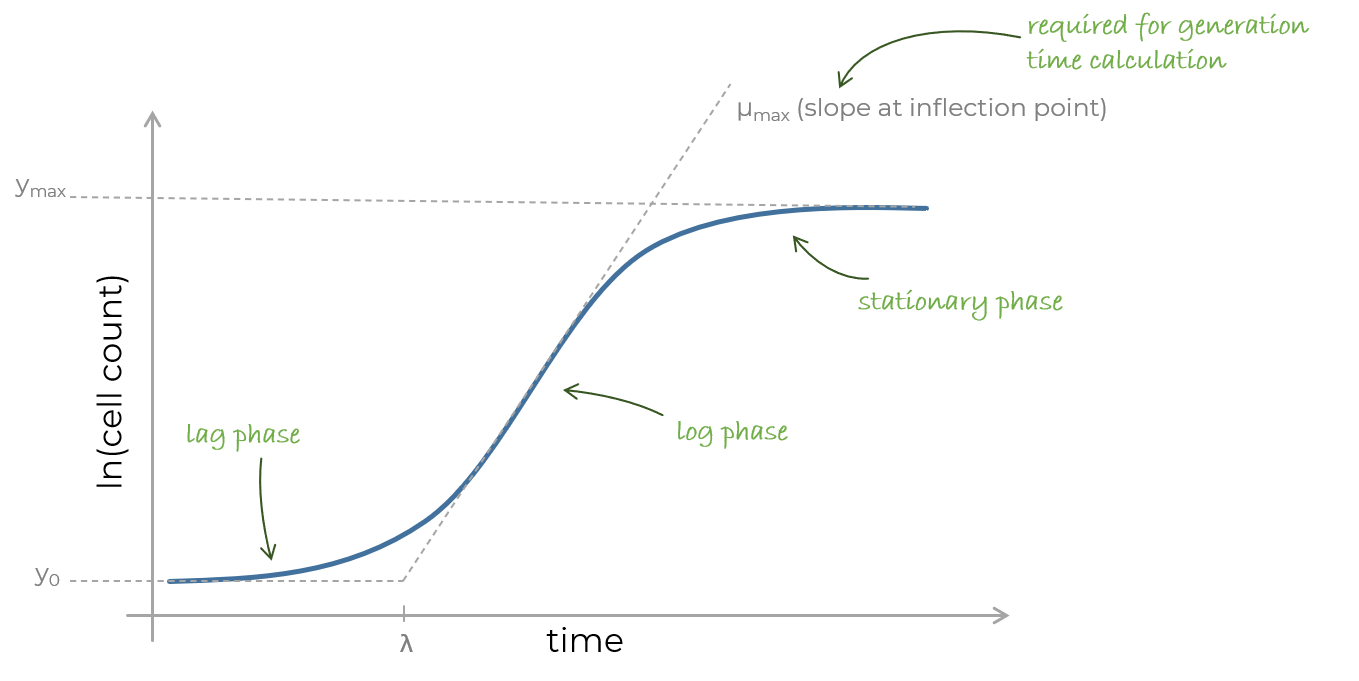
Growth Curve:
Shape: S-shaped sigmoid curve
Image 1
Seen In:
  • Plant growth
  • Bacterial growth in lab
Measurement:
  • Auxanometer
  • Horizontal microscope
  • Crescograph
Classical Experiments:
  • Boysen-Jensen
  • Darwin
Phases of Growth:

Table 1: Growth Phases

Phase
Keyword
Cell Activity
Lag phase
Initiating phase
Slow cell division
Log phase / Exponential phase
Maximum growth
Fast cell division
Decelerating phase
↓ growth rate
Slowing growth
Stationary phase
Constant growth
No net increase
Plant Growth Nature:
  • Limited
  • Unlimited
  • Unlocalized
  • Diffused
📚
GROWTH PROMOTER PHYTOHORMONES
Growth Regulators:
  • Organic substances → required for growth
  • Called hormones
  • Term hormone → Starling
Darwin Observation:
Concept: Existence of growth-promoting substance
Plant: Canary grass = Phalaris canariensis
Nature of Hormone:
  • Naturally produced organic substance
  • Active in minute amount
  • Produced at one site → transported → action at remote site
  • Promotory / inhibitory role
  • Used up after biochemical reaction
  • Enzymes → unchanged after biochemical reaction
  • Synthesized mainly in meristematic region
Measurement:
  • Earlier → bioassay
  • Now → gas chromatography + immunoassay
Tissue Culture: Auxin + Gibberellin + Cytokinin required
Major Growth Promoters:

Table 1: Growth Promoter Phytohormones

Feature
Auxin
Gibberellin
Cytokinin / Kinetin
Main Action
Cell enlargement + differentiation
Cell division
History
  • Discovered by F.W. Went
  • Test → Avena coleoptile curvature test
  • First observed by Charles Darwin in Phalaris canariensis
  • First isolated from human urine
  • Discovered by Yabuta + Hayashi
  • Yabuta + Suniki → isolated Gibberellin A + B
  • First isolated from fungus Gibberella fujikuroi / Fusarium moniliforme
  • Fungus group → Deuteromycetes
  • Disease → Bakanae / foolish seedling disease of rice
  • Effect → abnormally tall rice seedling
  • First isolated by Miller + Skoog
  • Source → old stock yeast DNA / denatured DNA
  • Accidental isolation
Bioassay / Test
  • Avena / oat coleoptile curvature test
  • Bioassay = living tissue used to study biologically active substance
  • Amylase test
  • Dwarf maize / dwarf pea test
  • Cereal endosperm test
  • Carrot root phloem test
  • Richmond-Lang test → ageing test
  • Excised leaves remain fresh in \(H_2O\) + cytokinin
Examples / Source / Structure
Natural Site: Apical meristem
Natural Auxins:
  • Auxin A / Auxientriolic acid → human urine
  • Auxin B / Auxienolonic acid → corn grain oil
  • Heteroauxin → re-examined human urine by Kogl et al.; also from Rhizopus culture by Thimann
  • True natural auxin = IAA = Indole-3-acetic acid
  • Heteroauxin ≈ IAA
  • Natural auxin synthesis → tryptophan
  • Zinc → important for auxin synthesis
  • Transport → basipetal polar transport: shoot apex → base
Synthetic Auxins:
Adventitious Root Formation:
  • NAA = Naphthalene acetic acid
  • IPA = Indole-3-propionic acid
  • IBA = Indole-3-butyric acid
Weed Killers:
  • 2,4-D = 2,4-dichlorophenoxy acetic acid
  • 2,4,5-T = 2,4,5-trichlorophenoxy acetic acid
Synthesis Sites:
  • Young leaves
  • Buds
  • Seeds
  • Root tips
Important Form: \(GA_3\) = Gibberellic acid
Chemical Identity: Kinetin = 6-furfuryl amino purine
Natural Cytokinin:
Zeatin / Coconut milk factor:
  • Pure natural cytokinin
  • Most active cytokinin
  • Isolated from immature maize grain by Letham
Synthesis Sites:
  • Endodermis
  • Root tips
  • Shoot tips
Function
  1. Cell elongation
  2. Rooting
    1. High auxin in root → lateral roots ↑ + main root elongation ↓
    2. IBA → most potent root initiator
  3. Apical dominance → lateral bud suppression by apical bud
    1. Terminal bud IAA → apical dominance
    2. Cutting lawn grass top → profuse lateral growth
  4. Cell wall material synthesis
  5. 2,4-D + 2,4,5-T → weed killers
    1. Agent orange = 2,4-D + 2,4,5-T + dioxin; Vietnam war defoliant
  6. Usually inhibits flowering
    1. Litchi + pineapple → flowering by 2,4-D / NAA
    2. Pineapple flowering also promoted by ethylene
  7. Parthenocarpy → seedless fruit production
  8. Controls abscission of leaves/fruits, especially fruits
    1. Abscission mainly by ABA + ethylene
  9. Maintains dormancy of potato tubers, corms, rhizomes
  10. Maleic hydrazide methyl ester → prevents potato sprouting
  11. Seasonal cambium activity + cell division ↑
  12. Phototropism + geotropism
  13. IAA →photoperiodism
  14. Nodule formation in legumes
  1. Internode elongation and Leaf expansion
    1. Genetically dwarf plant → tall after gibberellin
    2. Dwarf pea/maize → normal size by intermodal growth stimulation
    3. Sugarcane → sugar yield ↑ by internode length ↑
  2. Bolting + flowering in rosette plants, e.g., cabbage
    1. Bolting = promoted suppressed growth
  3. Parthenocarpy when auxin fails
    1. Pome fruits → apple, pear
    2. More effective than auxin for parthenocarpy
  4. No effect on roots
  5. Long-day plants → flowering under short-day condition
    1. Short-day plants → flowering inhibited
  6. Seed germination
    1. Breaks dormancy of potato tuber + tree buds
    2. Dormancy maintained by ABA
  7. Monoecious cucumber → male flower induction
    1. Ethylene → female flower induction
  8. Fruit number + size ↑, e.g., grapes
  1. Primary function → cell division
    1. Vascular cambium cell division → by auxin
  2. Cell enlargement + cotyledon/foliage leaf expansion
  3. Morphogenesis → shoot initiation
    1. Auxin = cytokinin → callus formation
    2. Auxin high + cytokinin low → root initiation
    3. Auxin low + cytokinin high → shoot initiation
  4. Lateral bud growth ↑
    1. Counteracts apical dominance
  5. Interfascicular cambium formation ↑
    1. Delays senescence / ageing
    2. Prevents leaf fall
    3. Storage of leafy vegetables, flowers, fruits
  6. Short-day plants → flowering under long-day condition
  7. Chlorophyll retention
📚
GROWTH INHIBITOR PHYTOHORMONES
Major Growth Inhibitors:

Table 1: Growth Inhibitor Phytohormones

Feature
ABA
Ethylene
Full Name / Synonyms
Abscisic acid / Abscisin II / Dormin / Dormant hormone / Stress hormone
Ethylene / Ripening hormone
Main Role
Bud dormancy + resting stage
Senescence / ageing + fruit ripening
Examples / Structure / Source
  1. Mildly acidic hormone
  2. Formed from xanthophyll + mevalonic acid
  3. Produced in mature stem, leaf, fruit, seed
  4. Most abundant formation → chloroplast
  5. Can be produced from isolated chloroplast
  6. Transport → diffusion to all plant parts
  1. Precursor → methionine
  2. Only gaseous hormone
  3. Synthesis promoted by \(O_2\)
  4. Synthesis inhibited by \(CO_2\)
  5. Produced in root + shoot meristem
  6. Large amount in senescing tissues + ripening fruits
  7. Connected with climacteric respiration
Functions
  1. Natural growth inhibitor
  2. Senescence hastened
  3. Leaf fall / abscission
  4. Maintains bud + seed dormancy
  5. Stomatal closure → anti-transpirant
  6. Functionally antagonistic to gibberellins
    1. Blocks gibberellin action → starch to sugar conversion inhibited
  7. Cambium activity inhibited
  8. Protection from frost, injury, desiccation
  1. Fruit ripening + dehiscence
  2. Generally inhibits flowering
    1. Pineapple + litchi → flowering
  3. Monoecious cucumber → female🚺 flower induction
  4. Abscission promoted; prevented by auxin
  5. Epinasty → downward bending of leaves
  6. Senescence promoted; prevented by cytokinin
  7. Transverse stem growth ↑
    1. Node swelling
    2. Longitudinal growth ↓
  8. Adventitious root formation
  9. Breaks dormancy of different organs but not lateral buds
📚
OTHER PLANT HORMONES
Caline / Formative Hormone:
Definition: Hormone responsible for root, shoot, leaf formation

Table 1: Calines

Hormone
Function
Rhizocaline
Root formation
Caulocaline
Shoot formation
Phyllocaline
Leaf formation
Traumatic Acid / Wound Hormone: Injured part → callus formation
Florigen:
  • Flowering hormone
  • Produced in leaves
Vernalin: Flowering under cold condition
📚
IMPORTANT TERMS
Vernalization:
  • Low temperature treatment: \(0-4^\circ C\)
  • Chilling → early flowering
  • Seen in winter annuals, e.g., wheat
  • Cold stimulus perceived by shoot meristem
  • Photoperiodism light stimulus perceived by leaf
Senescence:
  • Ageing process
  • ↑ entropy
  • Cellular breakdown
  • ↓ homeostasis
  • ↑ metabolic failure
  • Replication + transcription errors
Etiolation: Green plant in dark → yellow
Phytochrome System:
  • Photomorphogenetic pigment
  • Light detection
Phytotron: Device for growing plants under controlled condition/environment
Q1.
Cytokinin stimulates cell  [IE 2009]
📅IE 2009
Q2.
Gibberellic acid/ Gibberellin was detected from: [MOE 2063]
📅MOE 2063
Q3.
Which one of the following plant growth hormone was extracted from a fungus by a team of Japanese scientist?
Q4.
Rooting hormone is:  [MOE 2003]
📅MOE 2003
Q5.
Auxins are:  [MOE 2057]
📅MOE 2057
Q6.
Level auxanometer is used to measure [MOE 2055]
📅MOE 2055
Q7.
Plant apex produces growth-promoting factor called [MOE 2054, 2055]
📅MOE 2054, 2055
Q8.
Which hormone is primarily responsible for cell division in plants?  [IOM 2006, 2055]
📅IOM 2006, 2055
Q9.
Genetically dwarf plant can be made long by the application of:  [IOM 1999]
📅IOM 1999
Q10.
Lawn grass are cut at the top because: [IOM 1999]
📅IOM 1999
Q11.
Food mobilization in germinating seed is due to:  [BPKIHS 2000]
📅BPKIHS 2000
Q12.
Seed dormancy is due to:  [BPKIHS 2006]
📅BPKIHS 2006
Q13.
Organ formation in callus tissue is controlled by  [BPKIHS 1996]
📅BPKIHS 1996
Q14.
Hormone for flowering is  [BPKIHS 1996]
📅BPKIHS 1996
Q15.
Auxin is a       [BPKIHS 1997]
📅BPKIHS 1997
Q16.
The elongation of plant is caused by:  [IE 2001]
📅IE 2001
Q17.
A plant detects the direction of light by means of:  [IE 2007]
📅IE 2007
Q18.
Flowering in short day plant is induced in
Q19.
Which of the following is an example of cytokinin?  [BPKIHS 2015]
📅BPKIHS 2015
Q20.
Hormone for flowering [BPKIHS 2013]
📅BPKIHS 2013
Q21.
Sprouting of potato during storage can be prevented by  [BPKIHS 2012]
📅BPKIHS 2012
Q22.
Light has no direct role in  [BPKIHS 2012]
📅BPKIHS 2012
Q23.
Which induces male flowers in place of female flowers?  [IOM]
📅IOM
Q24.
Stomata closure in plant is induced by  [MOE 2014]
📅MOE 2014
Q25.
Bioassay for auxin is done with  [MOE 2010]
📅MOE 2010