📚
LINKAGE
▢ Definition: Linkage is the tendency of genes located on the same chromosome to be inherited together.
▢ Cause: Genes present on the same chromosome are physically associated and therefore do not assort independently in all cases.
▢ Linkage Group:
❖ Definition: All genes present on one chromosome constitute one linkage group.
❖ Important Point: Number of linkage groups generally equals the haploid chromosome number of an organism.
▢ Types of Linkage:
Table 1: Types of linkage
Type | Meaning |
|---|---|
Complete linkage |
|
Incomplete linkage |
|
▢ Crossing Over:
❖ Effect: Crossing over can break linkage and produce recombinant offspring.
❖ Site: Occurs between non-sister chromatids of homologous chromosomes during pachytene of prophase I of meiosis.
▢ Important Points:
- •Linked genes are present on the same chromosome.
- •Linked genes tend to move together during inheritance.
- •Linkage reduces the production of recombinant combinations.
- •Recombination frequency is used to estimate the distance between genes.
▢ MCQ Points:
Q1.
Linkage refers to:
Q2.
The number of linkage groups in an organism is generally equal to:
Q3.
Strength of linkage between two genes is greatest when they are:
📚
SEX LINKED INHERITANCE
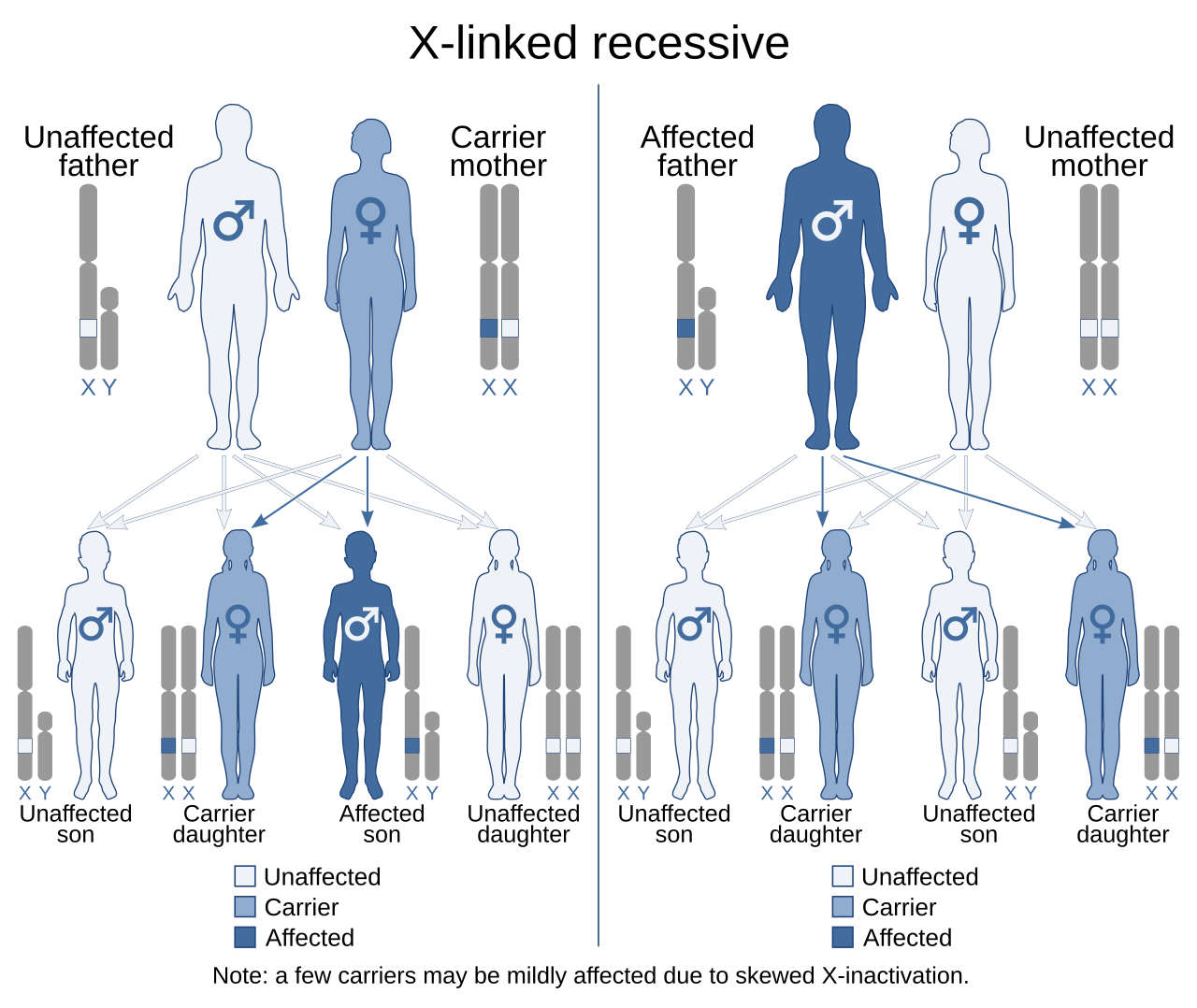
▢ Definition: Inheritance of traits present on sex chromosomes
▢ Discovery:
Table 1: Sex-linked inheritance facts
Point | Data |
|---|---|
First X-linked trait observed by | T. H. Morgan |
Organism | Drosophila |
Observation | White-eyed fly among red-eyed flies |
Inheritance pattern | Criss-cross inheritance |
Transmission | Father → daughter → grandson |
▢ Key Rule:
- •X-linked gene transmitted from father to grandson through daughter
- •Pattern → criss-cross inheritance
▢ Human Sex-linked Inheritance:
❖ X-linked Inheritance:
◉ Colour Blindness / Red-Green Blindness / Daltonism:
▢ Cause: Defective recessive gene on X-chromosome
▢ Defect: Absence of colour-sensitive cells in retina
▢ Feature: Unable to distinguish red + green colour; appear grey
▢ Transmission: Colour-blind man → daughter → half of next generation
◉ Haemophilia / Bleeder's Disease / Royal Disease:
▢ Cause: Recessive gene on X-chromosome
▢ Defect: Lack of clotting factor in blood; Factor VIII
▢ Clotting Time:
Table 1: Blood clotting time
Condition | Clotting time |
|---|---|
Normal | |
Haemophilia | 30 minutes–24 hours |
▢ Special Points:
- •Common in royal families of England + Russia
- •Inheritance pattern described by Nasse → Nasse’s law
- •Haemophilic son → non-viable / does not attain sexual maturity
- •Males → sufferers
- •Females → carriers
◉ Muscular Dystrophy: Listed only
📚
CROSSING OVER
▢ Definition: Exchange of genetic material between non-sister chromatids of homologous chromosomes → new combination
▢ Key Points:
- •Crossing over ∝ distance between linked genes
- •Single/double/multiple crossing over → depends on number of chiasmata
- •Reported in Drosophila by T. H. Morgan
- •Most accepted theory → precocity/strain theory by Darlington
- •More in females than males
- •Increases at high + low temperature
- •Occurs at tetrad stage of pachytene
- •Well demonstrated in Neurospora
▢ Types:
Table 1: Types of crossing over
Type | Site | Occurrence / Examples |
|---|---|---|
Germinal crossing over | Germinal cells | During gamete formation |
Somatic crossing over | Somatic cells | Maize, Aspergillus, Drosophila / MAD |
▢ Significance:
- •Basis of linkage maps / genetic maps
- •Produces recombination
- •Strong proof for linear arrangement of genes on chromosome
▢ Recombination Frequency:
Q1.
When two genes are very close to each other and tend to inherit together, it is called
📅CEE MBBS 2025
Q2.
A man whose father was colour blind and mother is normal marries a woman who had a colour blind mother and normal father. What percentage of male children of this couple will be colour blind?
📅CEE MBBS 2024B
Q3.
Which of the following doesn't cause variation?
📅CEE MBBS 2024B
Q4.
Crossing over takes place in:
📅CEE MBBS 2024B
Q5.
A colorblind man marries a normal woman whose father was colorblind. The probability of their son being colorblind is:
📅CEE MBBS 2024a
Q6.
If the number of chromosomes in Pisum sativum is 2n = 14, then the number of linkage groups is:
📅CEE MBBS 2024a
Q7.
Haemophilia is caused by:
📅CEE MBBS 2022
Q8.
A haemophilic woman marries a normal man. The resulting progeny will have:
📅CEE MBBS 2022
Q9.
Unit of crossing over is:
📅CEE MBBS 2022
Q10.
The inheritance of characters from father to grandson through daughter is called:
📅CEE MBBS 2021
Q11.
In human male, the number of linkage groups is equal to:
📅CEE MBBS 2021
Q12.
If hemophilic man is married to heterozygous normal woman, then probability of having hemophilic son is:
📅CEE Nursing 2024
Q13.
If a dihybrid cross fails to give 9:3:3:1 phenotypic ratio and shows 1:1:1:1 phenotypic ratio, then it shows:
📅CEE Nursing 2024
Q14.
In the process of crossing over, the separated chromatid segments are united by: [BPKIHS 1994]
📅BPKIHS 1994
Q15.
Genetic recombination is due to [BPKIHS - 2010]
📅BPKIHS - 2010
Q16.
An exception of Mendel's law is [MOE 2060]
📅MOE 2060