▢ Definition: Increase in thickness of plant body due to addition of secondary tissues by vascular cambium + cork cambium
▢ Cambium Activity:
Table 1: Cambium involved in secondary growth
Cambium | Region | Secondary tissue formed |
|---|---|---|
Vascular cambium | Stelar region | Secondary xylem + secondary phloem |
Cork cambium / phellogen | Extrastelar region | Cork / phellem + secondary cortex / phelloderm |
▢ Occurrence: Mainly dicots
📚
SECONDARY GROWTH IN DICOT STEM
📖
Intrastellar secondary growth
Occurs by vascular cambium
▢ Cambium Ring Formation:
- •Intrafascicular cambium is already present
- •Medullary ray cells become meristematic
- •Interfascicular cambium formed
- •Interfascicular cambium joins intrafascicular cambium
- •Complete cambium ring formed
▢ Cambium Ring Cells:
Table 1: Cells of cambium ring
Cell type | Forms |
|---|---|
Fusiform initials | Secondary phloem externally + secondary xylem internally |
Ray initials | Parenchymatous medullary rays |
▢ Secondary Rays:
Table 1: Secondary rays
Location | Name |
|---|---|
In secondary xylem | Wood ray / xylem ray |
In secondary phloem | Phloem ray |
▢ Seasonal Activity of Cambium: 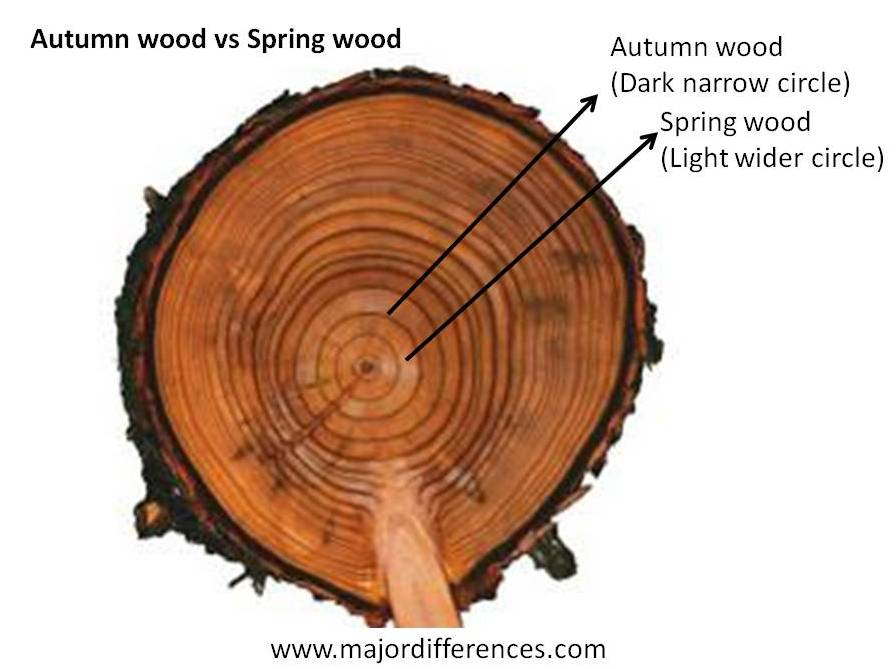
Table 1: Spring wood vs autumn wood
Feature | Spring wood / Early wood | Autumn wood / Late wood |
|---|---|---|
Season | Spring / favourable season | Winter / unfavourable season |
Cambial activity | High | Low / dormant |
Conducting elements | Wider diameter | Narrow diameter |
Vessel lumen | Wide lumen | Narrow lumen |
▢ Annual Rings / Growth Rings:
❖ Definition: Concentric rings representing total wood formed in one year
❖ Cause:
- •Unequal cambial activity in spring and autumn
- •Sudden transition from autumn wood → next spring wood
- •Spring wood → autumn wood transition is gradual
❖ Important Points:
- •Annual rings absent in plants growing in uniform climate
- •Annual rings used to study climate → dendroclimatology
- •Age determination by counting annual rings → dendrochronology
▢ Types of Wood:
❖ Hard Wood / Porous Wood vs Soft Wood / Non-porous Wood:
Table 1: Hard wood vs soft wood
Feature | Hard wood / porous wood | Soft wood / non-porous wood |
|---|---|---|
Pores | Present due to vessels | Absent; vessels absent |
Vessels | Present | Absent |
Example | Dicots | Gymnosperms |
❖ Ring Porous Wood vs Diffuse Porous Wood: 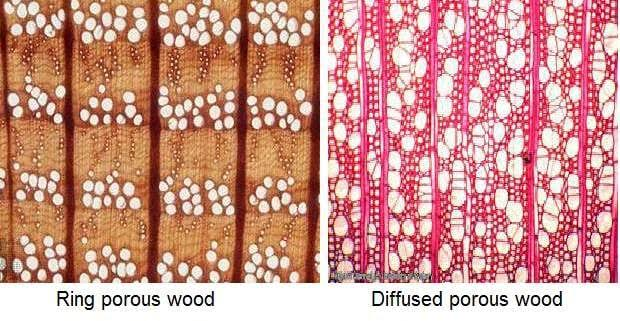
Table 1: Porous wood types
Feature | Ring porous wood | Diffuse porous wood |
|---|---|---|
Vessel distribution | Vessels concentrated in spring wood | Vessels evenly distributed |
Cause | Seasonal climatic variation | No marked climatic variation |
Occurrence | Seasonal regions | Evergreen tropics |
❖ Heart Wood / Duramen vs Sap Wood / Alburnum: 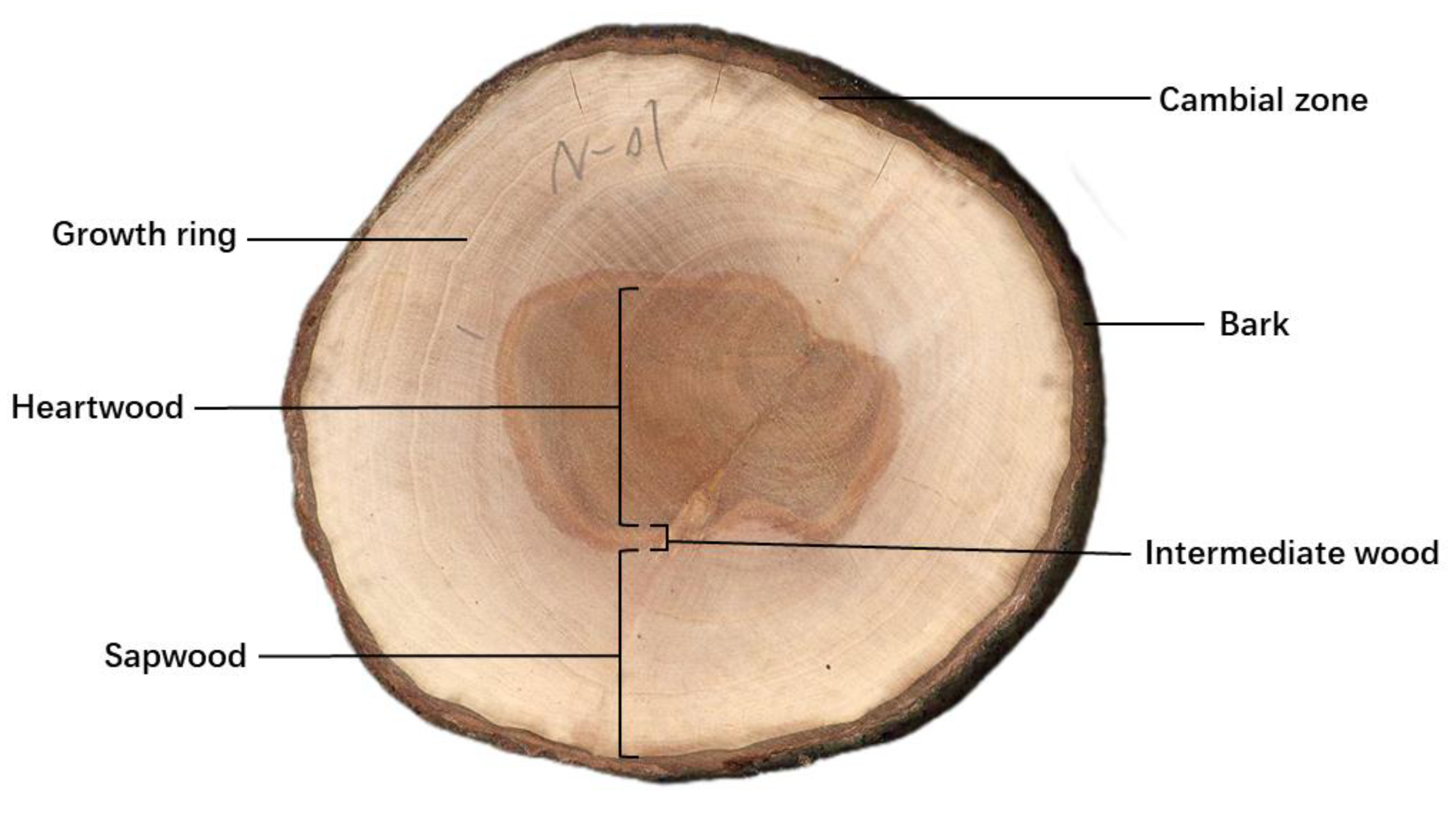
Table 1: Heart wood vs sap wood
Feature | Heart wood / duramen | Sap wood / alburnum |
|---|---|---|
Position | Inner central wood | Outer peripheral wood |
Colour | Dark | Light |
Function | Mechanical support | Water conduction |
Status | Dead + non-functional | Living/functional xylem |
Water content | Dry | Wetter |
Durability | More durable; resistant to microbes, insects, pests | Less durable; decays faster |
Deposits | Oil, aromatic substances, gums, resins, tannins | Less deposits |
Collective name of deposits | Extractives | |
Diameter during secondary growth | Increases | May gradually convert into heart wood |
Vessels | Plugged by tyloses | Functional vessels |
Older stems e.g., Dalbergia show outer sapwood + inner heartwood
▢ Tyloses:
- •Balloon-like ingrowths of adjacent parenchyma into vessel cavities
- •Plug vessels of heart wood
- •Found in secondary xylem
▢ Knots: Stumps of broken branches embedded in secondary xylem
▢ Lignification: Process by which plant becomes woody
📖
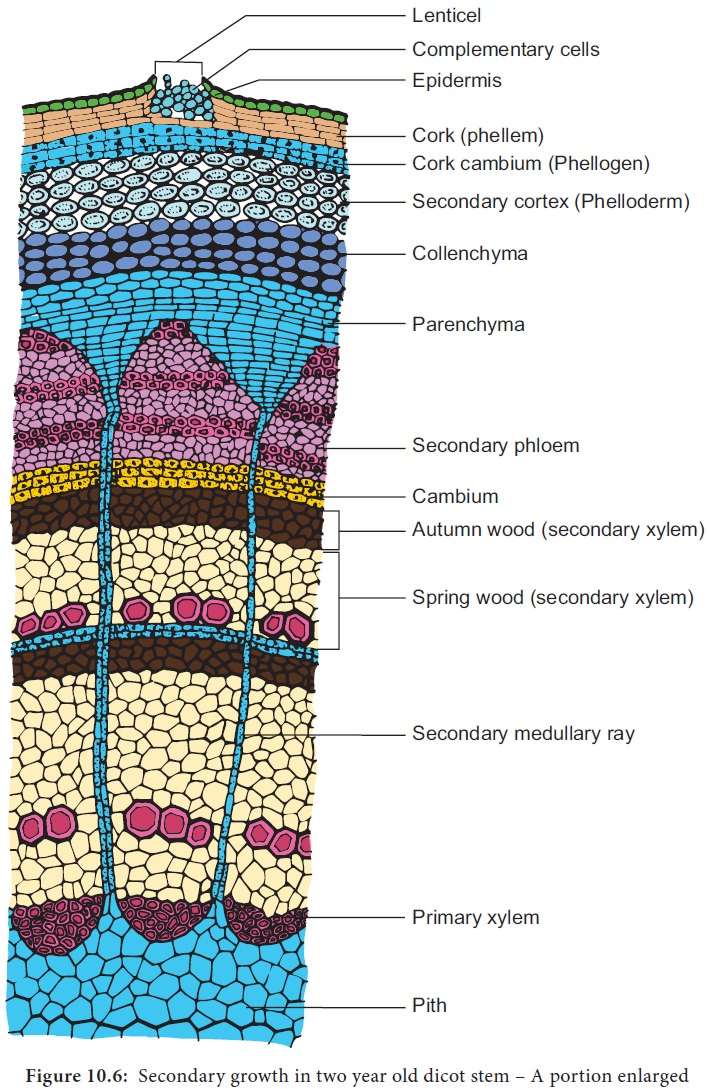
Extrastellar secondary growth
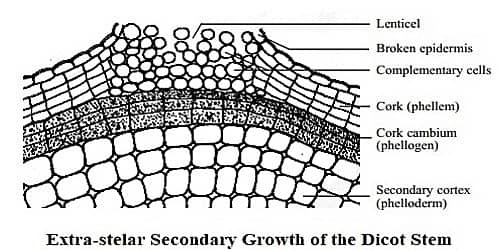
Occurs by Cork cambium
▢ Cork Cambium / Phellogen:
- •Formed due to pressure by addition of secondary tissues
- •Meristematic zone in outer extrastelar region
- •Origin → outer cortical cells / collenchyma / epidermis
▢ Products of Cork Cambium:
Table 1: Phellogen products
Side | Tissue formed | Other name |
|---|---|---|
Inner side | Secondary cortex | Phelloderm |
Outer side | Cork | Phellem |
▢ Periderm:
Table 1: Periderm components
Component | Position / Nature |
|---|---|
Phellem / cork | Outer protective tissue |
Phellogen / cork cambium | Meristematic layer |
Phelloderm / secondary cortex | Inner living tissue |
Periderm = phellem + phellogen + phelloderm
▢ Bark:
- •All tissues outside vascular cambium
- •Mostly dead outer tissues
- •Contains lenticels for gaseous exchange
▢ Lenticels: Openings in periderm/bark for gaseous exchange
▢ Cork Cells: Major component → suberin
📚
MCQ POINTS
Q1.
Which decays faster if exposed freely to air?
Q2.
Tyloses are found in
Q3.
Callose is found in
Q4.
Periderm is formed from
Q5.
Periderm includes
Q6.
Cork cells have a major component of