📚
CHEMICAL EQUATION OF RESPIRATION
▢ Equations:
▢ Water Balance:
Table 1: Water use and production
Point | Number |
|---|---|
10 molecules | |
In glycolysis | 2 molecules |
In Krebs cycle | 8 molecules |
16 molecules |
▢ Energy:
Table 1: Energy yield
Point | Value |
|---|---|
Energy from glucose | 686 kcal / earlier 673 kcal |
Energy from 1 ATP | 8.15 kcal |
Earlier value of 1 ATP | 7.3 kcal |
Efficiency |
▢ Nature: Respiration = oxidative process
▢ MCQ Point:
Q1.
Amount of energy given by 1 ATP molecule is
📚
TYPES OF RESPIRATION
▢ Based on Substrate:
Table 1: Respiration by substrate
Type | Substrate used |
|---|---|
Floating / superficial respiration | Carbohydrate |
Protoplasmic respiration | Lipid / fat / protein |
▢ Based on Reactant:
Table 1: Aerobic vs anaerobic respiration
Feature | Aerobic respiration | Anaerobic respiration |
|---|---|---|
Oxygen | Used | Not used |
Water | Evolved; oxygen of water from atmospheric oxygen | Not evolved because oxygen not taken |
Oxidation | Complete oxidation of substrate | Incomplete oxidation of substrate |
Energy | More; 36/38 ATP | Less; 2 ATP |
▢ ATP Ratio:
📚
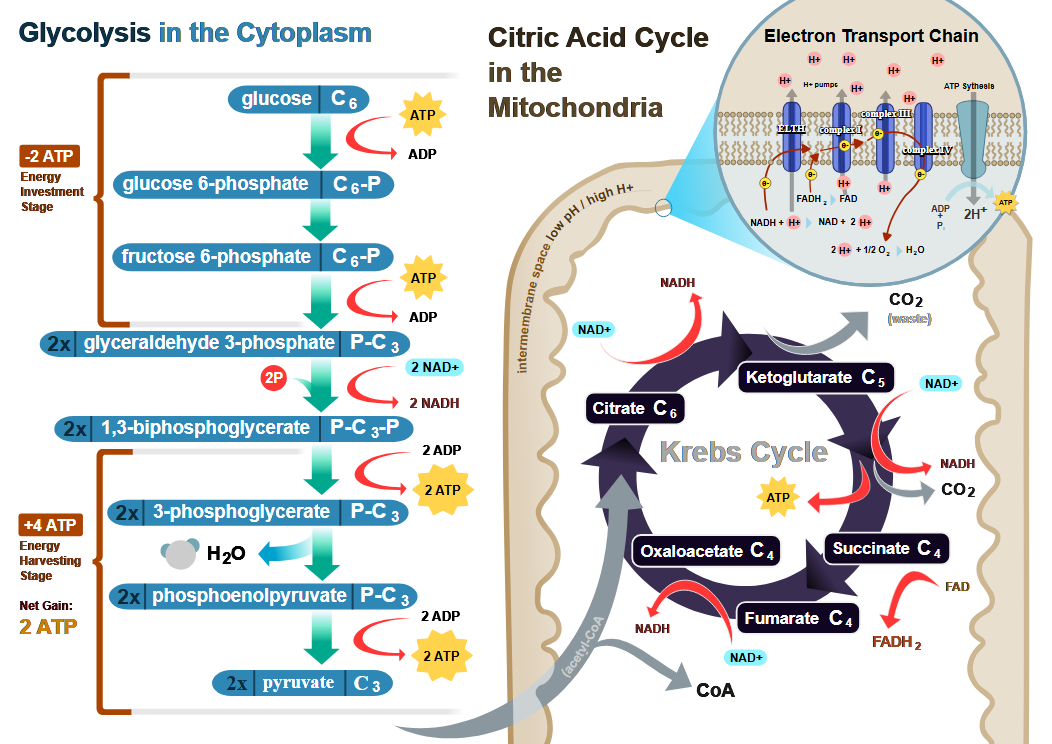
MECHANISM OF RESPIRATION
▢ Overview:
Table 1: Respiration overview
Parameter | Number |
|---|---|
Total steps | 30 |
Total phases | 4 |
Total sites | 4 |
Rule | Each phase occurs at different site |
▢ Phases:
- Glycolysis / EMP pathway
- Oxidative decarboxylation / link reaction
- TCA cycle / Krebs cycle / citric acid cycle
- Oxidative phosphorylation / ETS / terminal oxidation
📚
GLYCOLYSIS / EMP PATHWAY
▢ Site: Cytoplasm
▢ Shortcut:
▢ Net Reaction:
▢ Steps: 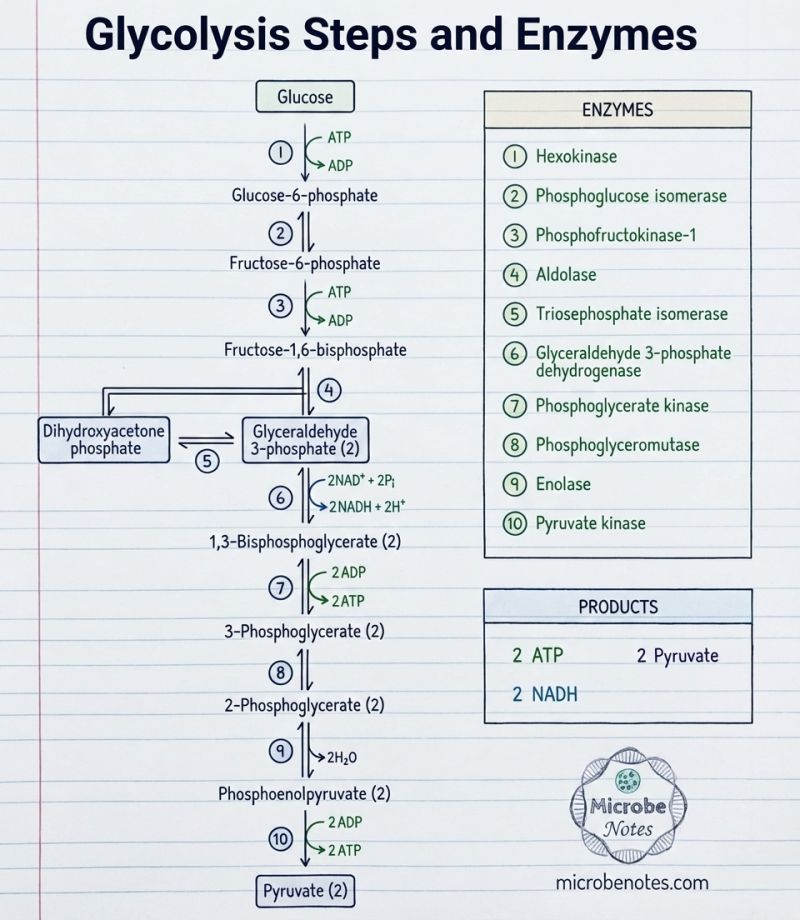
Table 1: Glycolysis steps
Step | Reaction / Product | Enzyme / Note |
|---|---|---|
1 | Glucose → Glucose-6-phosphate | |
2 | Glucose-6-phosphate → Fructose-6-phosphate | Phosphohexoisomerase |
3 | Fructose-6-phosphate → Fructose-1,6-bisphosphate | Phosphofructokinase; phosphorylation; ATP used; rate-limiting step |
4 | Fructose-1,6-bisphosphate → 3-PGAl + DHAP | Aldolase; irreversible splitting |
5 | DHAP ⇌ 3-PGAl | Non-enzymatic / isomerisation step |
6 | 3-PGAl → 1,3-diPGAl / 1,3-BPG | |
7 | 1,3-diPGA → 3-PGA | Phosphoglycerate kinase; ATP formed |
8 | 3-PGA → 2-PGA | Phosphoglyceromutase |
9 | 2-PGA → PEP | |
10 | PEP → Pyruvic acid |
▢ Step Classification:
Table 1: Glycolysis step types
Type | Step(s) | Note |
|---|---|---|
Phosphorylation | 1, 3 | 2 ATP consumed |
Irreversible | 1, 3, 10 | regulatory checkpoints |
Non-enzymatic | 5 | Isomerisation |
Oxidative | 6 | |
Dephosphorylation / ATP generation | 7, 10 | 4 ATP produced |
Rate-limiting | 3 | Enzyme: phosphofructokinase |
Total steps = 10; total enzymes = 9
▢ Molecules Consumed:
Table 1: Glycolysis consumption
Molecule | Number |
|---|---|
0 | |
ATP | 2 |
Used in pathway as given in full equation |
If oxygen is used, it enters Pasteur effect.
▢ Gross Molecules Produced:
Table 1: Glycolysis gross production
Molecule | Number |
|---|---|
0 | |
2 | |
ATP | 4 |
2 | |
0 |
▢ Net Gain:
Table 1: Glycolysis net gain
Molecule | Number |
|---|---|
0 | |
ATP | 2 |
2 | |
0 |
▢ Special Points:
- •Isomerism + phosphorylation → steps 1, 2, 3
- •Splitting → step 4
- •ATP generation → steps 7, 10
- •Glucose-6-phosphate = Robinson’s ester
- •
- •Plants can convert fatty acid to sugars via glyoxylate cycle; animals cannot
📚
HEXOSE MONOPHOSPHATE SHUNT / PENTOSE PHOSPHATE PATHWAY
▢ Definition: Alternative pathway of glycolysis
▢ Use: Glucose utilization when glycolysis is inhibited
▢ Main Change: Direct oxidation of glucose-6-phosphate → 6-phosphogluconic acid → ribulose-5-phosphate
▢ Common Enzyme with Glycolysis: Hexokinase
▢ Energy:
Table 1: HMP shunt energy
Point | Value |
|---|---|
12 | |
ATP equivalent | 36 ATP |
ATP used | 1 |
Net gain | 35 ATP |
▢ Site: Cytoplasm + chloroplast; not mitochondria
▢ Special Point: Resistant to cyanide
📚
OXIDATIVE DECARBOXYLATION / LINK REACTION

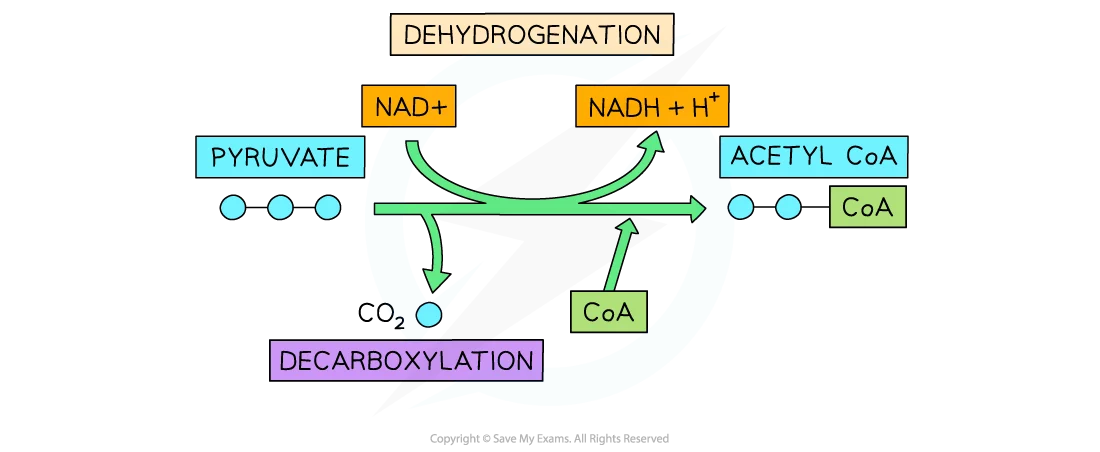
▢ Site: Outer mitochondrial membrane
▢ Reaction:
▢ Flow: Pyruvic acid → acetaldehyde → acetyl coenzyme A
▢ Steps:
Table 1: Link reaction steps
Step | Process | Result |
|---|---|---|
11 | Decarboxylation | |
12 | Oxidation + CoA addition |
▢ Molecules Consumed:
Table 1: Link reaction consumption
Molecule | Number |
|---|---|
0 | |
0 |
▢ Molecules Produced / Net Gain:
Table 1: Link reaction products
Molecule | Number |
|---|---|
2 | |
2 | |
📚
TRICARBOXYLIC ACID CYCLE / KREBS CYCLE / CITRIC ACID CYCLE
▢ Site: Matrix of mitochondria
▢ Exception: Succinic dehydrogenase / succinate dehydrogenase found in inner mitochondrial membrane
▢ Nature: Amphibolic pathway
▢ Entry Reaction:
▢ Cycle Steps: 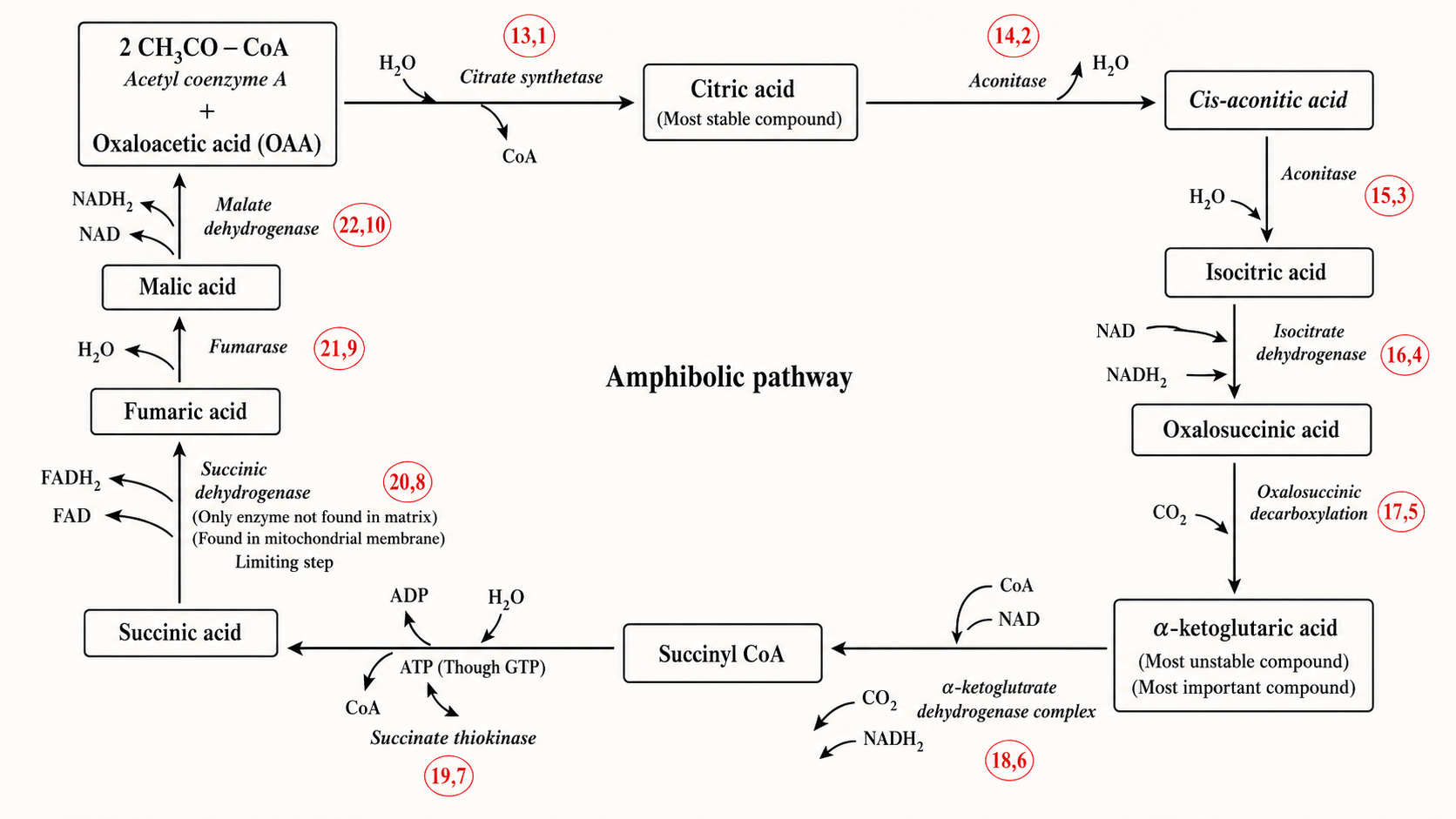
Table 1: Krebs cycle steps
Step | Reaction / Product | Enzyme / Note |
|---|---|---|
1 / 13 | Acetyl-CoA + OAA → Citric acid | |
2 / 14 | Citric acid → Cis-aconitic acid | |
3 / 15 | Cis-aconitic acid → Isocitric acid | |
4 / 16 | Isocitric acid → Oxalosuccinic acid | |
5 / 17 | ||
6 / 18 | ||
7 / 19 | Succinyl-CoA → Succinic acid | |
8 / 20 | Succinic acid → Fumaric acid | |
9 / 21 | Fumaric acid → Malic acid | |
10 / 22 | Malic acid → Oxaloacetic acid |
▢ Important Compounds:
Table 1: Important Krebs compounds
Compound | Point |
|---|---|
Citric acid | Most stable compound |
Most unstable + most important compound | |
Oxaloacetic acid / OAA | Regenerated at end of cycle |
▢ Step Classification:
Table 1: Krebs cycle step types
Type | Step(s) | Result |
|---|---|---|
1, 3, 7, 9 | Total 4 steps | |
2 | Total 1 step | |
Oxidative steps | 4, 6, 8, 10 | Total 4 steps |
4, 6, 10 | 3 per cycle | |
8 | 1 per cycle | |
ATP production | 7 | ATP through GTP |
Decarboxylation | 5, 6 |
▢ Molecules Consumed per Glucose:
Table 1: Krebs cycle consumption
Molecule | Number |
|---|---|
0 | |
8 |
▢ Gross Molecules Produced per Glucose:
Table 1: Krebs cycle gross production
Molecule | Number |
|---|---|
4 | |
2 | |
ATP | 2 through GTP |
6 | |
2 |
▢ Net Gain per Glucose:
Table 1: Krebs cycle net gain
Molecule | Number |
|---|---|
4 | |
-6 consumed | |
ATP | 2 |
6 | |
2 |
📚
OXIDATIVE PHOSPHORYLATION / ETS / TERMINAL OXIDATION
▢ Site:
▢ Total Steps: 8
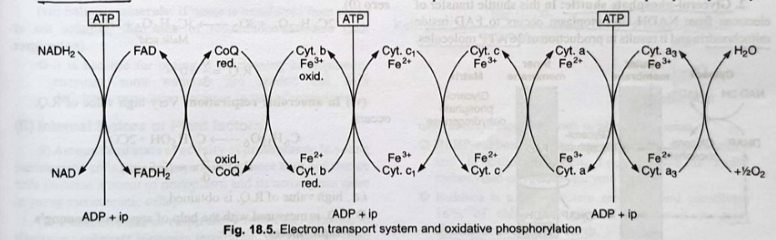
▢ Phosphorylation:
❖ Definition: Formation of ATP from ADP + inorganic phosphate by using energy
❖ Energy: 7.6 kcal
▢ Types of Phosphorylation:
Table 1: Phosphorylation types
Type | Meaning |
|---|---|
Substrate-level phosphorylation | Direct ATP production at respiration site; no carrier needed |
Chemiosmotic ATP formation | |
Oxidative phosphorylation | ATP formation with carriers |
▢ Carriers:
- •
- •Cytochromes
▢ Cytochrome Sequence:
▢ Cytochrome Ion: Fe
▢ Cyanide: Kills organism by inhibiting cytochrome oxidase
▢ Shuttle System:
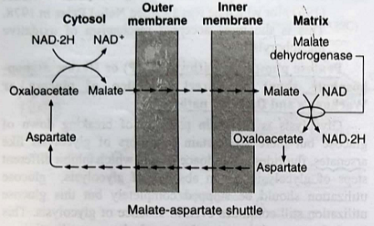
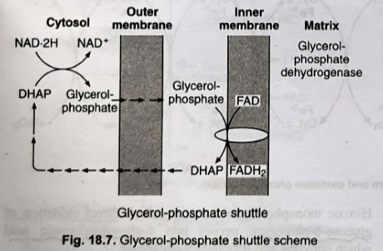
Table 1: Shuttle systems
Shuttle | Electron transfer | ATP yield |
|---|---|---|
Malate-aspartate shuttle | 38 ATP; more efficient | |
Glycerol-phosphate shuttle | 36 ATP |
📚
ENERGY CALCULATION
▢ Total ATP:
Table 1: ATP yield
Respiration / Cell type | ATP |
|---|---|
Anaerobic respiration | 2 |
Aerobic respiration | 38 |
Aerobic respiration in prokaryotes | 38 |
Examples of prokaryotes | Mycoplasma, bacteria |
Aerobic respiration in eukaryotes | 36 |
Muscles + neurons | 36 |
Heart / myocardial tissue, lungs, kidney | 38 |
▢ Stepwise ATP Calculation:
Table 1: ATP calculation from 1 glucose
Step | Substrate ATP | Total ATP | ||
|---|---|---|---|---|
Glycolysis | 2 | 0 | 8 / 6 | |
Oxidative decarboxylation | 0 | 0 | 6 | |
Krebs cycle | 2 through GTP | 24 | ||
ETS | 0 | 36 in eukaryotes / 38 in prokaryotes, heart, lungs, kidney |
▢ Special Points:
- •Aerobic glycolysis → 8 ATP
- •Anaerobic glycolysis → 2 ATP
- •1 glucose → 2 pyruvic acid
- •Each pyruvic acid after complete aerobic metabolism → 15 ATP
- •Each acetyl-CoA after aerobic metabolism → 12 ATP
- •1 glucose → 1 glycolysis + 2 Krebs cycles
- •2 Krebs cycles per glucose → 24 ATP
- •Out of 4 ETS structural complexes, ATP produced at 3 complexes only
📚
ANAEROBIC RESPIRATION
▢ Basic Flow:
▢ ATP Yield: 2 ATP
▢ Pathways:
Table 1: Anaerobic pathways
Organism / Condition | Enzyme / Agent | End product |
|---|---|---|
Yeast | Zymase | |
Lactobacillus + muscles | Lactic acid fermentation | Lactic acid |
Acetobacter | Acetaldehyde oxidation | Acetic acid |
Clostridium butyricum | Butyric fermentation | Butyric acid |
▢ Alcoholic Fermentation:
▢ Lactic Acid Fermentation:
▢ MCQ Point:
📚
RESPIRATORY QUOTIENT
▢ Definition:
▢ Formula:
▢ Measurement: Ganong’s respirometer
▢ Depends On: Respiratory substrate
▢ RQ Values:
Table 1: Respiratory quotient values
Substrate / Condition | RQ | Example / Note |
|---|---|---|
Carbohydrates | 1 | Floating respiration |
Lipids / fats | <1; about 0.7 | Protoplasmic respiration |
Proteins | <1; about 0.8–0.9 | Protoplasmic respiration |
Organic acids | >1 | Malic acid, oxalic acid |
Succulent plants | 0 | Bryophyllum, Opuntia, Agave, Aloe |
Anaerobic respiration | Oxygen not used; e.g., yeast |
Q1.
During anaerobic respiration, Yeast converts glucose into: [IOM 2004, 2001]
📅IOM 2004, 2001
Q2.
Glycolysis takes place in:
Q3.
Respiration and Photosynthesis both require: [IOM 2002]
📅IOM 2002
Q4.
For anaerobic respiration, respiratory quotient is: [IOM 1996]
📅IOM 1996
Q5.
Fermentation is an………process: [IOM 1996]
📅IOM 1996
Q6.
The common phase between aerobic and anaerobic reaction is: [BPKIHS 2004]
📅BPKIHS 2004
Q7.
The following is an example of competitive inhibition of enzyme: [BPKIHS 2005]
📅BPKIHS 2005
Q8.
In aerobic respiration, respiratory quotient or respiratory ratio of 1 occurs with: [BPKIHS 2006]
📅BPKIHS 2006
Q9.
All of the following are features of glycolysis EXCEPT: [BPKIHS 2006]
📅BPKIHS 2006
Q10.
Kreb's cycle begins with: [BPKIHS 2006]
📅BPKIHS 2006
Q11.
The end products of fermentation are: [BPKIHS 2006]
📅BPKIHS 2006
Q12.
When the fats are the respiratory substrate the Respiratory Quotient (R.Q.) will be: [BPKIHS 2007]
📅BPKIHS 2007
Q13.
The end product of Kreb's cycle is: [BPKIHS 2007]
📅BPKIHS 2007
Q14.
Cyanide kill an organism by inhibiting: [BPKIHS 2007]
📅BPKIHS 2007
Q15.
The link between glycolysis and Kreb's cycle is: [MOE 2062]
📅MOE 2062
Q16.
Number of ATP from complete oxidation of 1 molecule of pyruvic acid is: [MOE 2062]
📅MOE 2062
Q17.
Which of the following leads to wastage of energy? [MOE 2060]
📅MOE 2060
Q18.
Pyruvic acid is
Q19.
The process in which CO_2 is released is: [MOE 2060]
📅MOE 2060
Q20.
The process in which protoplasm is constructed and destructed: [MOE-2003]
📅MOE-2003
Q21.
The end product of glycolysis is pyruvic acid having: [MOE 2058]
📅MOE 2058
Q22.
ATP is not released in: [MOE 2056, 2055]
📅MOE 2056, 2055
Q23.
Aerobic respiration inside the cell occurs in: [MOE 2052]
📅MOE 2052
Q24.
Respiratory opening of the plant is: [MOE 2052]
📅MOE 2052
Q25.
ADP differs from ATP in having
Q26.
The plant which performs Crassulacean Acid Metabolism is
Q27.
The production of ATP by oxidative phosphorylation is driven by energy from: [IE 2006]
📅IE 2006
Q28.
Photorespiration occurs in: [IOM 2014]
📅IOM 2014
Q29.
The electron transfer system is present in [IOM 2014]
📅IOM 2014
Q30.
In prokaryotes the total number of ATP produced in aerobic respiration is [IOM 2014]
📅IOM 2014
Q31.
Alcohol fermentation takes place in the presence of: [IOM 2013]
📅IOM 2013
Q32.
Pyruvic acid is changed into CO_2 and H_2 O in [IOM 2013]
📅IOM 2013
Q33.
Glycolysis occurs in
Q34.
Kreb's cycle occurs in [MOE 2013]
📅MOE 2013
Q35.
Respiration is performed by all the living cells of the plant [MOE 2068]
📅MOE 2068
Q36.
Glycolysis takes place in [MOE 2068]
📅MOE 2068
Q37.
Kreb's cycle is involved in [MOE 2010]
📅MOE 2010
Q38.
Oxidation of glucose takes place in [MOE 2010]
📅MOE 2010
Q39.
In cyclic phosphorylation, main product is [MOE 2010]
📅MOE 2010