📚
PHOTOSYNTHESIS
▢ Definition:
▢ Overall Reaction:
▢ Reaction Components:
Table 1: Photosynthesis reaction components
Component | Role |
|---|---|
Raw material | |
Raw material | |
Required product | |
By-product | |
By-product | |
Sunlight | Main / ultimate energy source |
▢ Light Spectrum:
Table 1: Light and photosynthesis
Point | Order |
|---|---|
Maximum photosynthesis | White light / sunlight |
Best effective spectrum | White light > Red > Blue > Green |
Best absorption spectrum | White light > Blue > Red > Green |
▢ Oxygen Source:
- •
- •Experimentally proved by Ruben and Kamen
- •Material used → Chlorella
- •
- •
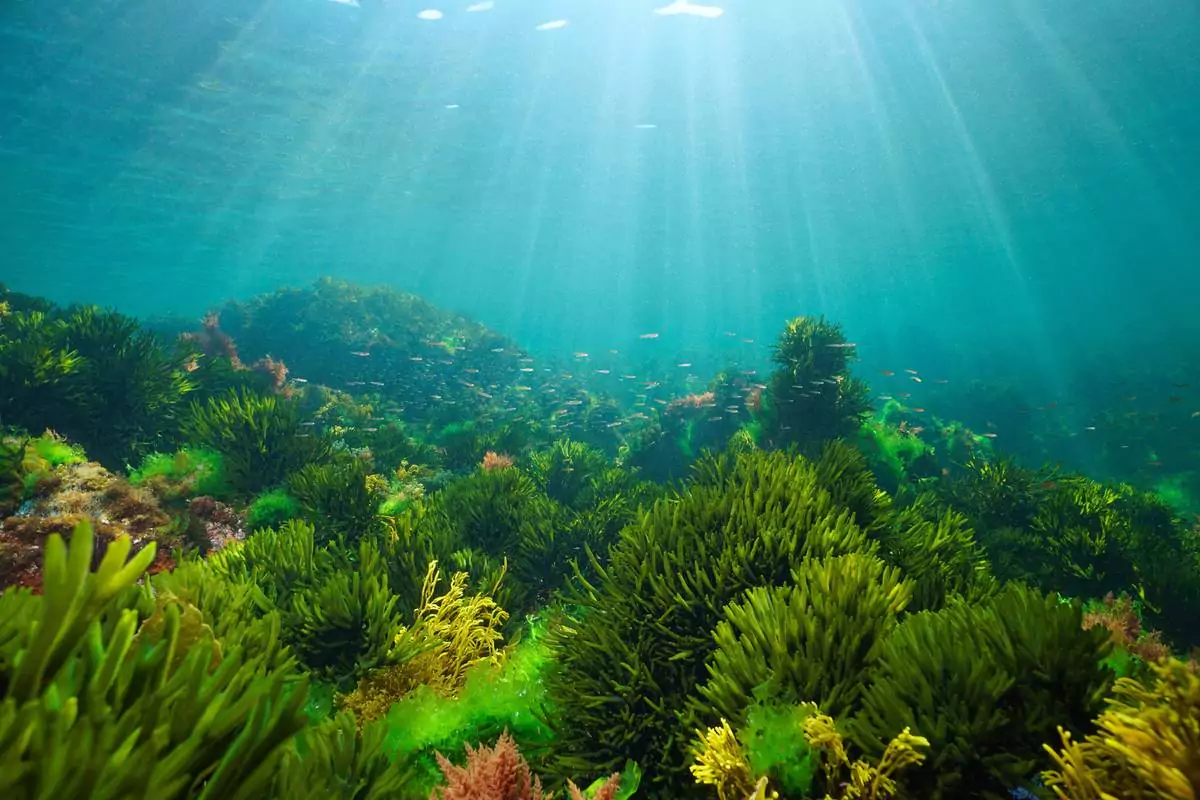
▢ Global Photosynthesis:
- •
- •
📚
NATURE OF PHOTOSYNTHESIS
▢ Process Type:
- •Reductive
- •Oxidation-reduction / redox process
- •Endergonic / energy requiring
- •Anabolic
- •Photochemical process
▢ Best Answer Point:
▢ Energy Conversion: Light energy → chemical energy in presence of chloroplast
▢ MCQ Point:
Q1.
Photosynthesis is best described as
📚
CHLOROPLAST AND PHOTOSYNTHETIC SITE
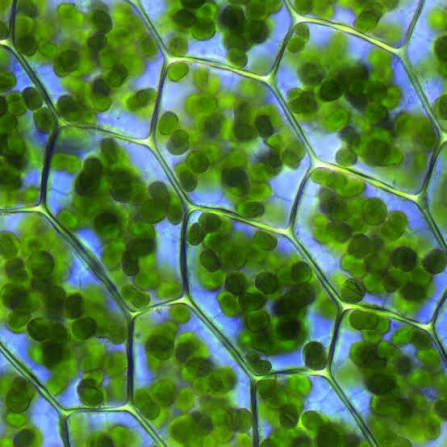
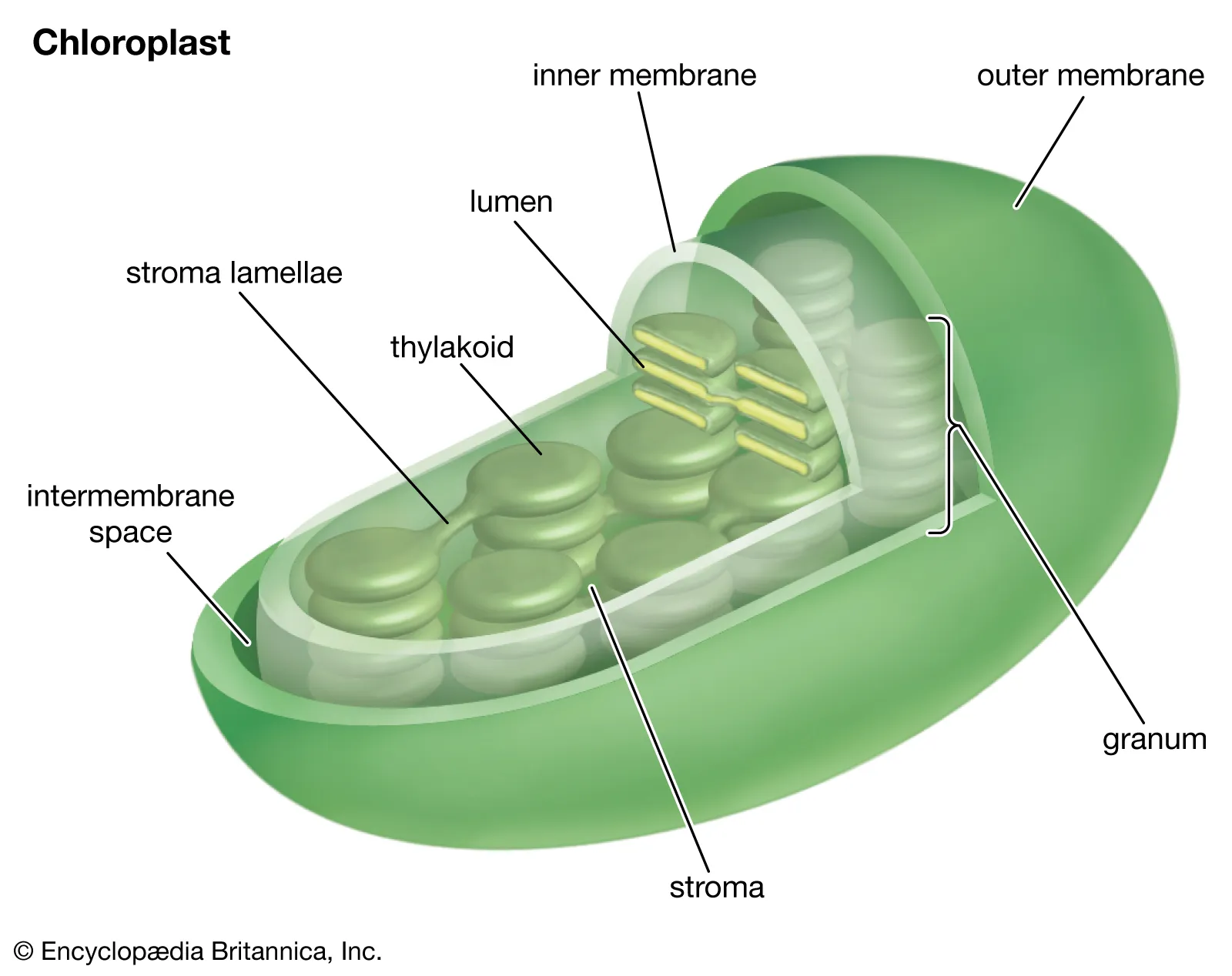
▢ Chloroplast Number: Leaf parenchyma cell contains about 25–50 chloroplasts
▢ Pigment Site: Photosynthetic pigments mostly in grana, associated with thylakoid membrane
▢ Light and Dark Reaction:
Table 1: Main reactions of photosynthesis
Reaction | Process | Site / Time |
|---|---|---|
Light reaction | In light | |
Dark reaction | In light or dark |
▢ Bacterial Photosynthesis:
- •
- •
- •
- •No oxygen liberation
📚
PHOTOSYNTHETIC PIGMENTS
📖
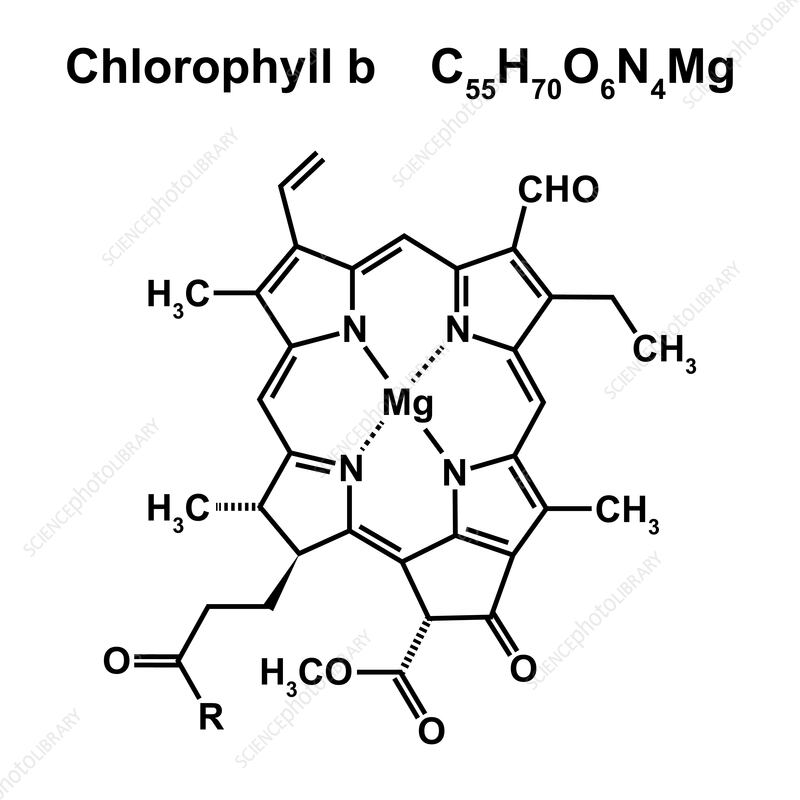
Chlorophyll
▢ Types:
- Chlorophyll-a
- Chlorophyll-b
- Chlorophyll-c
- Chlorophyll-d
- Chlorophyll-e
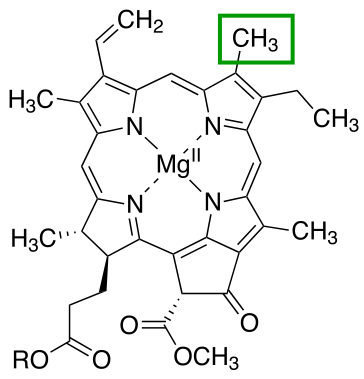
▢ Structure:
- •Magnesium porphyrin compound
- •Hydrophilic porphyrin head
- •Lipophilic phytol tail
- •Whole structure resembles tadpole larva
▢ Special Points:
- •Burnt chlorophyll leaves Mg
- •Mg-porphyrin head contains 4 pyrrole rings
- •Phytol tail located at 7th carbon of 4th pyrrole ring
- •Bacteriochlorophyll has 1 pyrrole ring with 2 hydrogen compared to chlorophyll-a
- •Bacterial photosynthesis does not liberate oxygen
▢ Chlorophyll-a vs Chlorophyll-b:
Table 1: Chlorophyll-a vs Chlorophyll-b
Feature | Chlorophyll-a | Chlorophyll-b |
|---|---|---|
Formula | ||
Group at 3rd carbon of 2nd pyrrole ring | ||
Role | Primary / universal photosynthetic pigment | Accessory pigment |
▢ Universal Pigment:
- •Chlorophyll-a found in all photosynthesizing plants except bacteria
- •Primary / universal photosynthetic pigment
- •All algae contain chlorophyll-a + carotene
📖
Photosynthetic unit / quantasome
📝
Quantasome
- •Photosynthetic pigments present in thylakoid membrane at quantasomes
- •One quantasome has about 280 pigments
- •Eukaryotic quantasome: 230 chlorophyll molecules + 50 carotenoids
- •230 chlorophyll = 160 chlorophyll-a + 70 chlorophyll-b
- •Prokaryotic quantasome: about 50 chlorophyll molecules
Table 1: Photosystem II vs Photosystem I
Feature | PS-II | PS-I |
|---|---|---|
Location | Only on grana lamella | Grana + stroma lamella |
Reaction centre | ||
Pigment dominance | Chlorophyll-b > Chlorophyll-a | Chlorophyll-a > Chlorophyll-b |
Function | Receives electrons from photolysis of water; non-cyclic photophosphorylation | Performs cyclic photophosphorylation independently |
Fluorescence | More strongly fluorescent | Less fluorescent |
📖
Other pigments
Table 1: Other photosynthetic pigments
Pigment | Formula / Type | Colour / Solubility |
|---|---|---|
Bacteriochlorophyll | Bacterial photosynthesis | |
Carotene | Carotenoid | Orange; organic solvent soluble |
Xanthophyll / carotenol | Yellow; organic solvent soluble | |
Phycoerythrin | Phycobilin | Red; water soluble |
Phycocyanin | Phycobilin | Blue; water soluble |
Allophycocyanin | Phycobilin | Bluish green; water soluble |
Anthocyanin | Vacuolar pigment | Water soluble; bacterial chameleon |
📝
Solubility
- •Chlorophyll + carotenoids → soluble in organic solvents like acetone
- •Phycobilins → water soluble
- •Anthocyanin → water soluble; found in vacuole
📝
Accessory Pigments
- •All pigments except chlorophyll-a
- •Carotenoids protect chlorophyll from photo-oxidation
- •Carotenoids transfer light energy to chlorophyll
📚
LIGHT REACTION / LIGHT DEPENDENT REACTION / HILL REACTION / OXIDATION REACTION
▢ Photolysis of Water:
❖ Equation:
❖ Water Molecules:
Table 1: Water in photolysis
Point | Number |
|---|---|
Water molecules required | 4 |
Water molecules used | 2 |
▢ Non-cyclic vs Cyclic Photophosphorylation:
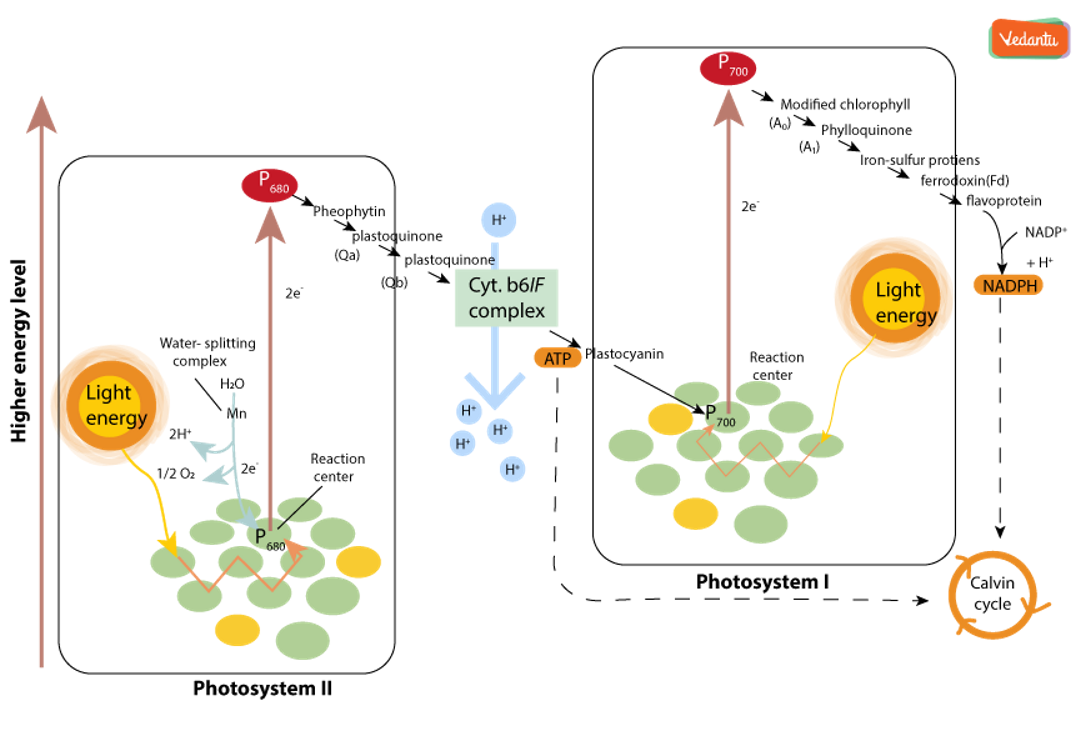
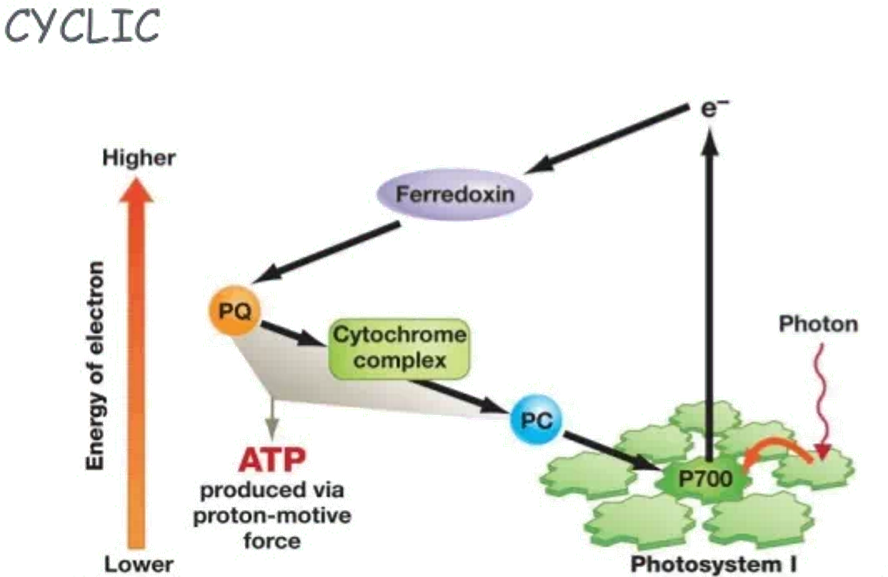
Table 1: Non-cyclic vs cyclic photophosphorylation
Feature | Non-cyclic photophosphorylation | Cyclic photophosphorylation |
|---|---|---|
Found in | Higher plants + BGA / cyanobacteria | Bacteria + few red algae |
Wavelength | Common visible rays | Infrared / IR |
Primary acceptor | 2 | 1 |
Pigment system | PS-I + PS-II | PS-I only |
Source of electrons + protons | PS-I | |
Terminal acceptor of proton | NADP | PS-I |
Water production | 2 | 0 |
Oxygen production | 1; oxygenic | 0; anoxygenic |
ATP production | 1 | 2 |
2 | 0 | |
Significance | ATP |
Universal H acceptor = NAD; natural H acceptor in photosynthesis = NADP
▢ Oxygen Contribution:
- •
- •
▢ Quantum Requirement and Quantum Yield:
Table 1: Quantum terms
Term | Meaning / Value |
|---|---|
Quantum yield | |
Quantum requirement | |
Quantum requirement value | 8 quanta |
Quantum yield value |
📚
DARK REACTION / LIGHT INDEPENDENT REACTION / BLACKMAN REACTION / REDUCTION REACTION
📖
Photorespiration / c2 cycle / warburg effect
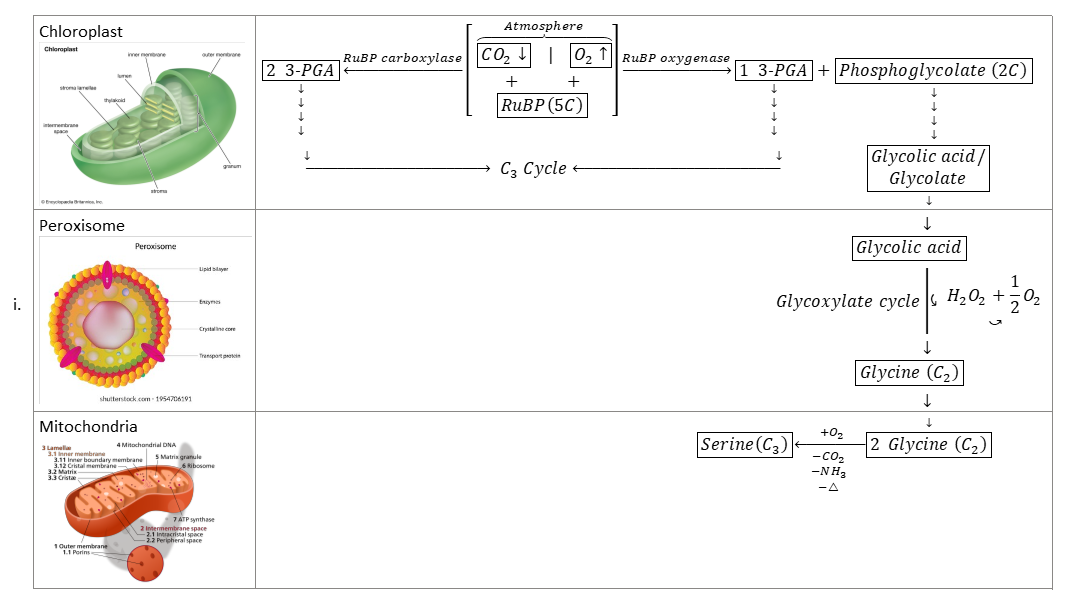
▢ Definition:
▢ Key Enzyme: RuBisCO acts as carboxylase or oxygenase
▢ Chloroplast Events:
- •
- •
- •
- •Phosphoglycolate → glycolate / glycolic acid
▢ Peroxisome Events:
- •Glycolic acid → glyoxylate
- •Glyoxylate → glycine
- •
▢ Mitochondria Events:
- •
- •
▢ Result:
- •Photosynthetic efficiency decreases
- •
- •
- •No sugar/ATP production
📖
C3 cycle / calvin cycle
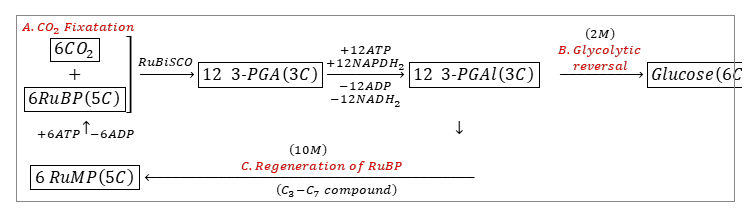
▢ Discovery:
- •Discovered by Melvin Calvin
- •Nobel Prize awarded
- •Method used → autoradiography
- •Plant used → Chlorella
▢ Occurrence:
▢ Main Reaction Flow:
▢ Phases:
Table 1: Calvin cycle phases
Phase | Event |
|---|---|
CO₂ fixation | |
Reduction | |
Glycolytic reversal | 2 molecules of PGAL → glucose |
Regeneration |
▢ Requirement per Glucose:
📖
C4 cycle / hatch and slack pathway
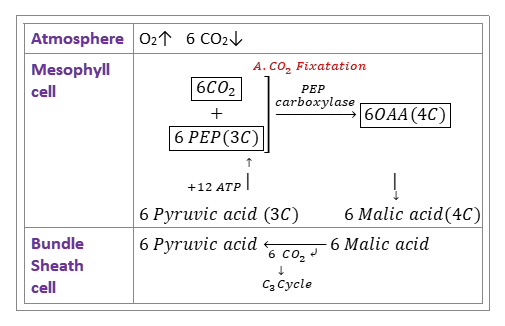
▢ Occurrence:
▢ Nature: Additive pathway
▢ Special Point:
▢ Cellular Separation:
Table 1: C4 pathway cells
Cell | Event |
|---|---|
Mesophyll cell | |
Bundle sheath cell |
▢ Main Flow:
▢ Energy:
▢ Requirement per Glucose:
📖
Cam cycle
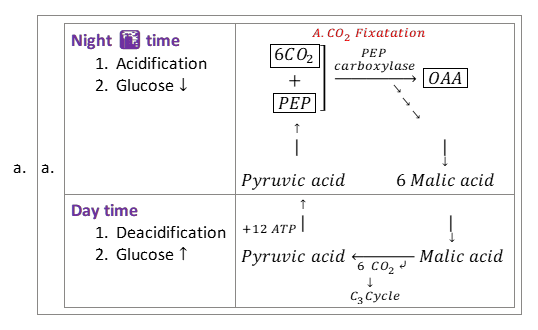
▢ Occurrence:
▢ Night:
- •Acidification
- •
- •Malic acid accumulates
- •Glucose decreases
▢ Day:
- •Deacidification
- •
- •
- •Glucose increases
▢ Requirement per Glucose:
📚
COMPARISON OF C3, C4 AND CAM PLANTS
Table 1: C3, C4 and CAM plants
Character | C3 plants / Calvin cycle | C4 plants / Hatch-Slack pathway | CAM plants |
|---|---|---|---|
Percentage of plants | |||
CO₂ acceptor | Primary: PEP in mesophyll; secondary: RuBP in bundle sheath | Primary: PEP at night; secondary: RuBP at day | |
First enzyme | RuBisCO | PEP carboxylase | PEP carboxylase |
First stable compound | |||
CO₂ compensation point | 45–100 ppm | 15–25 ppm | 5–10 ppm |
Leaf anatomy | Kranz anatomy absent | Kranz anatomy present | Kranz anatomy absent |
Types of chloroplast | Single type | Two types: granal + agranal chloroplast | Single type |
C3 cycle occurs in | All photosynthetic cells | Bundle sheath cells | All photosynthetic cells |
Requirement per glucose | |||
Optimum temperature | |||
Photorespiration | May occur | No chance | May occur |
Common plant group | Common in dicots; also algae, bryophytes, pteridophytes, gymnosperms | Common in monocots + tropical plants | Succulents + desert plants |
📚
EXAMPLES OF C3, C4 AND CAM PLANTS
Table 1: Examples
Type | Examples |
|---|---|
C3 plants | Algae e.g., Chlorella; bryophytes; pteridophytes; gymnosperms; common dicots; rare monocots e.g., rice, wheat, barley, oat |
C4 plants | Maize, sugarcane, grasses, tropical plants; rare dicots e.g., Amaranthus, Alternaria, Atriplex, Chenopodium, Euphorbia |
Both C3 and C4 | Atriplex |
CAM plants | Bryophyllum, Crassulaceae, Orchidaceae, desert plants, Agave, Aloe, cactus, Opuntia, Sedum, Kalanchoe, Portulaca, pineapple |
Q1.
Energy for the ATP formation in PS-II comes directly from: [IOM 2007]
📅IOM 2007
Q2.
Volume of CO_2 absorbed in photosynthesis is almost: [IOM 2006]
📅IOM 2006
Q3.
In some grasses C_4 pathway occurs. It is: [BPKIHS 2000]
📅BPKIHS 2000
Q4.
Herbicide kills grasses (weeds) by: [BPKIHS 2000]
📅BPKIHS 2000
Q5.
Which of the following induces photo-respiration? [BPKIHS 2001]
📅BPKIHS 2001
Q6.
The no. of ATP and NADPH2 required to fix 3CO_2 molecules in Calvin cycle: [BPKIHS 2001]
📅BPKIHS 2001
Q7.
Which is wrong? [BPKIHS 2002]
📅BPKIHS 2002
Q8.
In Photo-respiration, CO_2 loss takes place in [BPKIHS 2002]
📅BPKIHS 2002
Q9.
In C_4 cycle, in mesophyll cells, CO_2 is picked up by: [BPKIHS 2002]
📅BPKIHS 2002
Q10.
In C_4 plants, Calvin cycle takes place in: [BPKIHS 2002]
📅BPKIHS 2002
Q11.
Which is correct about C_4 plants? [BPKIHS 2002]
📅BPKIHS 2002
Q12.
Photosynthesis is:
Q13.
Light break reaction means: [BPKIHS 2004]
📅BPKIHS 2004
Q14.
Chemical formula of 'chlorophyll' is:
📅BPKIHS 2005
Q15.
In chlorophyll-b, −CHO (aldehyde) group is attached to the 3^rd carbon atom of:
Q16.
The first acceptor of CO_2 in C_4 pathway is: [MOE]
📅MOE
Q17.
Light reaction of photosynthesis occurs in: [BPKIHS 1994]
📅BPKIHS 1994
Q18.
The electron acceptor during photosynthesis is: [BPKIHS 1995]
📅BPKIHS 1995
Q19.
Dark reaction of photosynthesis occurs in [BPKIHS 1996]
📅BPKIHS 1996
Q20.
Universal hydrogen acceptor [BPKIHS 1996]
📅BPKIHS 1996
Q21.
A cell devoid of chlorophyll will not [BPKIHS 1997]
📅BPKIHS 1997
Q22.
Photorespiration is due to: [BPKIHS 1997]
📅BPKIHS 1997
Q23.
The rate of photosynthesis is independent of [BPKIHS 1997]
📅BPKIHS 1997
Q24.
Phosphoenol pyruvate acts as CO_2 acceptor in: [BPKIHS 1998]
📅BPKIHS 1998
Q25.
Light energy is converted into chemical energy in: [MOE 2008]
📅MOE 2008
Q26.
Moll's half leaf experiment can prove: [MOE 2063]
📅MOE 2063
Q27.
Chemoautotrophs obtain energy for photosynthesis by the oxidation of: [MOE 2063]
📅MOE 2063
Q28.
Which of the following represent photosynthetic equation: [MOE 2063]
📅MOE 2063
Q29.
The % of sunlight utilized by the green plant in the net plant productivity during photosynthesis? [MOE 2062]
📅MOE 2062
Q30.
HSK pathway is also called as [MOE]
📅MOE
Q31.
To demonstrate there is no starch formation in leaves of a green plant kept in dark for 1 or 2 days the leaves are tested by: [MOE 2062]
📅MOE 2062
Q32.
During photosynthesis to trace out the path of carbon fixation, the isotope used is:
Q33.
Thylakoids are associated with: [MOE 2002]
📅MOE 2002
Q34.
In photosynthesis O2 is liberated due to: [MOE 2000]
📅MOE 2000
Q35.
Photosynthetic plants are: [MOE 2056]
📅MOE 2056
Q36.
The 1^st stable product in carbon assimilation is: [MOE 2056]
📅MOE 2056
Q37.
Which wavelength of light carries out photosynthesis in bacteria? [MOE 1997]
📅MOE 1997
Q38.
During photosynthesis the product of the light reaction is:
Q39.
The core metal of chlorophyll molecule is: [IE-2001]
📅IE-2001
Q40.
In plant food is stored in the form of: [IE-2002]
📅IE-2002
Q41.
ATP formation during photosynthesis is [IE-2003]
📅IE-2003
Q42.
Hill reaction occurs in [IE-2004]
📅IE-2004
Q43.
Photosynthesis occurs in [IE-2005]
📅IE-2005
Q44.
Plants don't store carbohydrate as glucose because: [IE-2006]
📅IE-2006
Q45.
📅BPKIHS 2014
Q46.
The effect of excess O_2 concentration causing decrease in photosynthsis is known as: [BPKIHS 2014]
📅BPKIHS 2014
Q47.
Rate of photosynthesis will be higher in
Q48.
Cytochrome is
Q49.
'Calvin cycle' is synonymous with [BPKIHS 2010]
📅BPKIHS 2010
Q50.
The first step involved in the photosynthesis [IOM 2016]
📅IOM 2016
Q51.
Cytochrome helps in
Q52.
Inhibition of photosynthesis with the increase in oxygen concentration is [IOM 2014]
📅IOM 2014
Q53.
The process of photolysis of water takes place during [IOM 2013]
📅IOM 2013
Q54.
ATP is formed in triphosphate in a large number during [IOM 2012]
📅IOM 2012
Q55.
📅MOE 2014
Q56.
Stomata open at nigh and close during day in [MOE 2013]
📅MOE 2013
Q57.
📅MOE 2013
Q58.
Kranz anatomy is found in [MOE 2012]
📅MOE 2012
Q59.
📅MOE 2068
Q60.
Which organelle in cell division consists of grana and stroma?