📚
MERISTEMATIC TISSUE
▢ Definition of Meristematic Tissue:
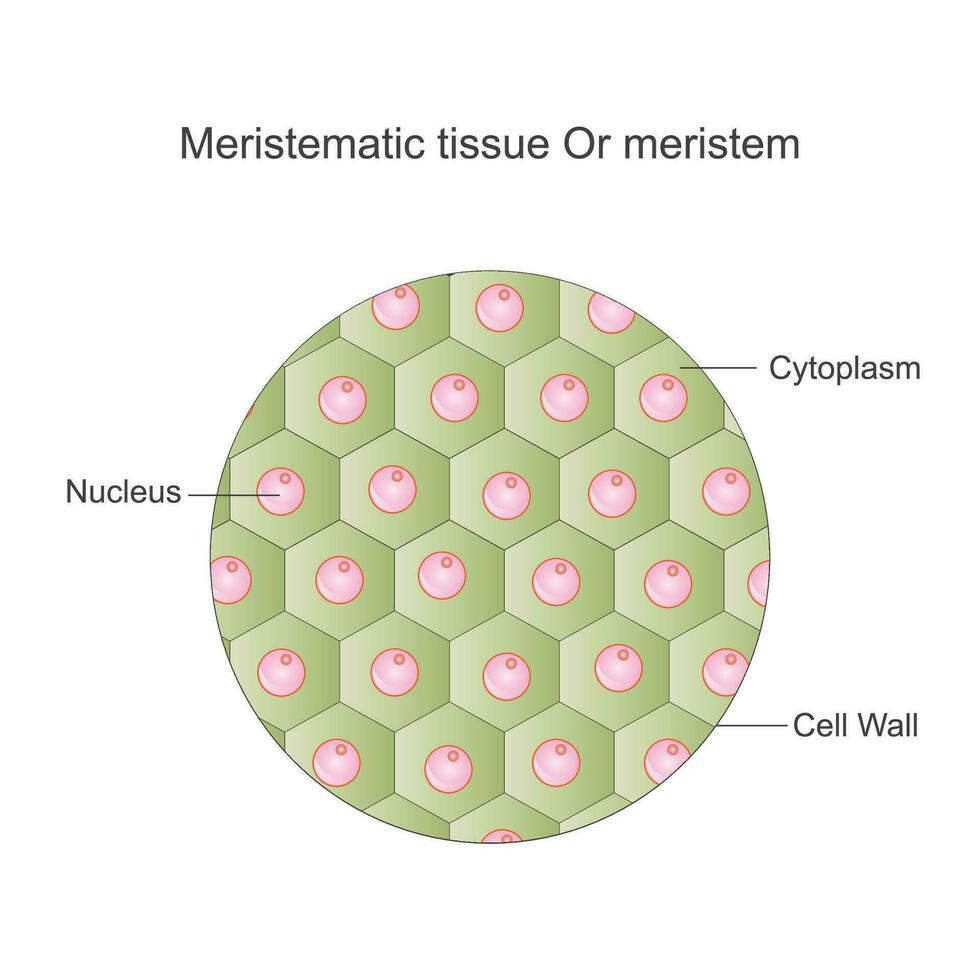
- •A group of young, immature, and undifferentiated cells that are actively dividing or retain the power of continuous cell division.
- •These cells are responsible for the growth and development of the plant body.
- •They are typically located at the growing regions of the plant, such as root and shoot apices.
▢ Features of Meristematic Tissue:
- Composed of immature, undifferentiated cells with continuous power of division
- Cells are small, isodiametric, spherical, oval, or polygonal in shape
- Cell wall is thin, elastic, and made up of cellulose
- Dense cytoplasm with a prominent, large nucleus
- Vacuoles are generally absent; if present, they are very small
- Intercellular spaces are absent; cells are compactly arranged
- High metabolic activity and rate of respiration
- Plastids are present in the form of proplastids
- Ergastic substances (non-living cell inclusions) are absent
▢ Types: 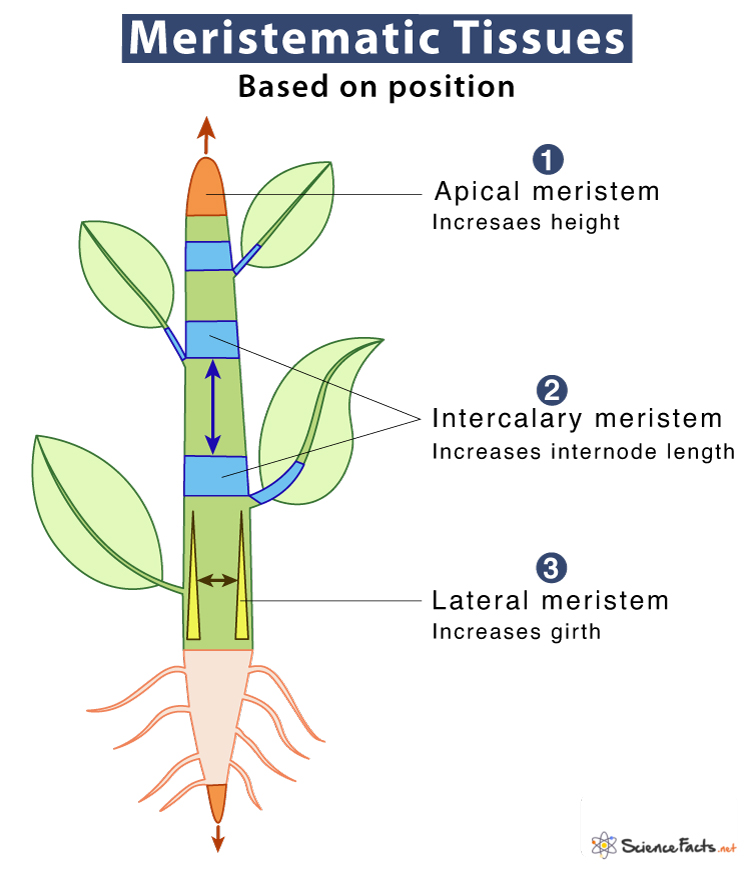
Fig.Types of meristematic tissue based on position
Table 1: Types of meristematic tissue
Feature | Apical meristem | Intercalary meristem | Lateral / Radial meristem |
|---|---|---|---|
Position | Apices of root + shoot | Between two permanent tissues; base of internode; base of leaves | Lateral sides |
Function | Increase in length | Increase in length | Increase in girth / diameter |
Consumption | Not consumed up | Consumed up | |
Examples / Notes | ◉ Points:
| Grasses → growth by intercalary meristem | Cambium-like activity → radial growth |
Special points | ◉ Points:
| ||
▢ Apical Meristem Division by Haberlandt: 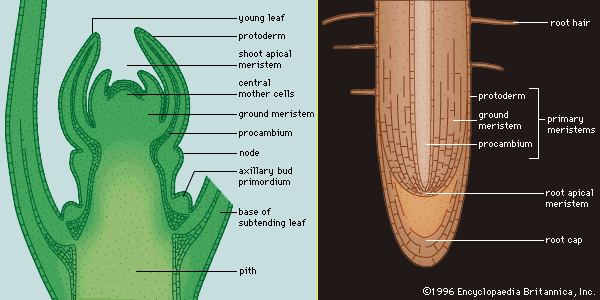
Table 1: Haberlandt’s zones
Zone | Tissue system formed |
|---|---|
Protoderm | Epidermal tissue system |
Ground meristem | Ground tissue system |
Procambium | Vascular tissue system |
▢ Shoot Apex Organization:
❖ Apical Cell Theory: 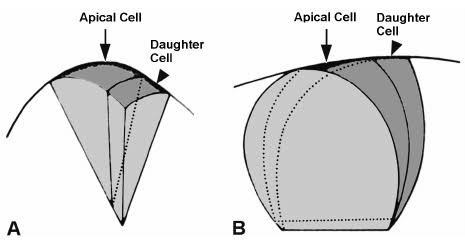
Table 1: Apical cell theory
Point | Data |
|---|---|
Proposed by | Nageli |
Concept | Single pyramidal cell → entire growth by division + redivision |
Applicable to | Bryophytes, vascular cryptogams / pteridophytes, some higher algae |
Not applicable to | Gymnosperms, angiosperms |
❖ Histogen Theory: 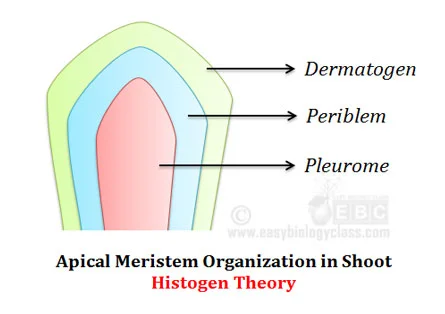
Table 1: Histogen theory of shoot apex
Histogen | Position | Gives rise to |
|---|---|---|
Dermatogen | Outermost | Epidermis |
Periblem | Middle | Cortex including endodermis |
Pleurome | Innermost | Vascular bundle including pith |
Proposed by Hanstein; 3 groups of initials in shoot apex
❖ Tunica-Corpus Theory: 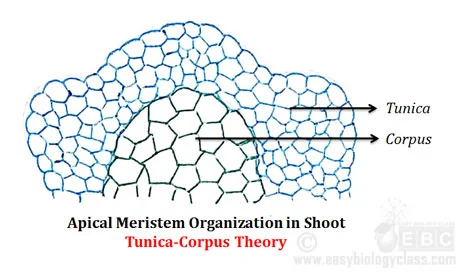
Table 1: Tunica-corpus theory
Region | Position | No. of layers | Division | Tissue formed |
|---|---|---|---|---|
Tunica | Outer region | Generally 1 | Anticlinal | Epidermis |
Corpus | Inner mass | Several | Anticlinal + periclinal | Bulk of adult plant |
Proposed by Schmidt; most accepted theory
◉ Anticlinal vs Periclinal Division:
Table 1: Division plane
Division | Plane | Effect |
|---|---|---|
Anticlinal division | Perpendicular to surface | Surface area increases |
Periclinal division | Parallel to surface / tangential cleavage | Layers increase → girth increases |
▢ Root Apex Organization:
❖ Apical Cell Theory:
Table 1: Apical cell theory of root apex
Point | Data |
|---|---|
Proposed by | Nageli |
Concept | Single apical cell in root apex → entire growth |
Applicable to | Pteridophytes, gymnosperms |
Not applicable to | Angiosperms |
❖ Histogen Concept: 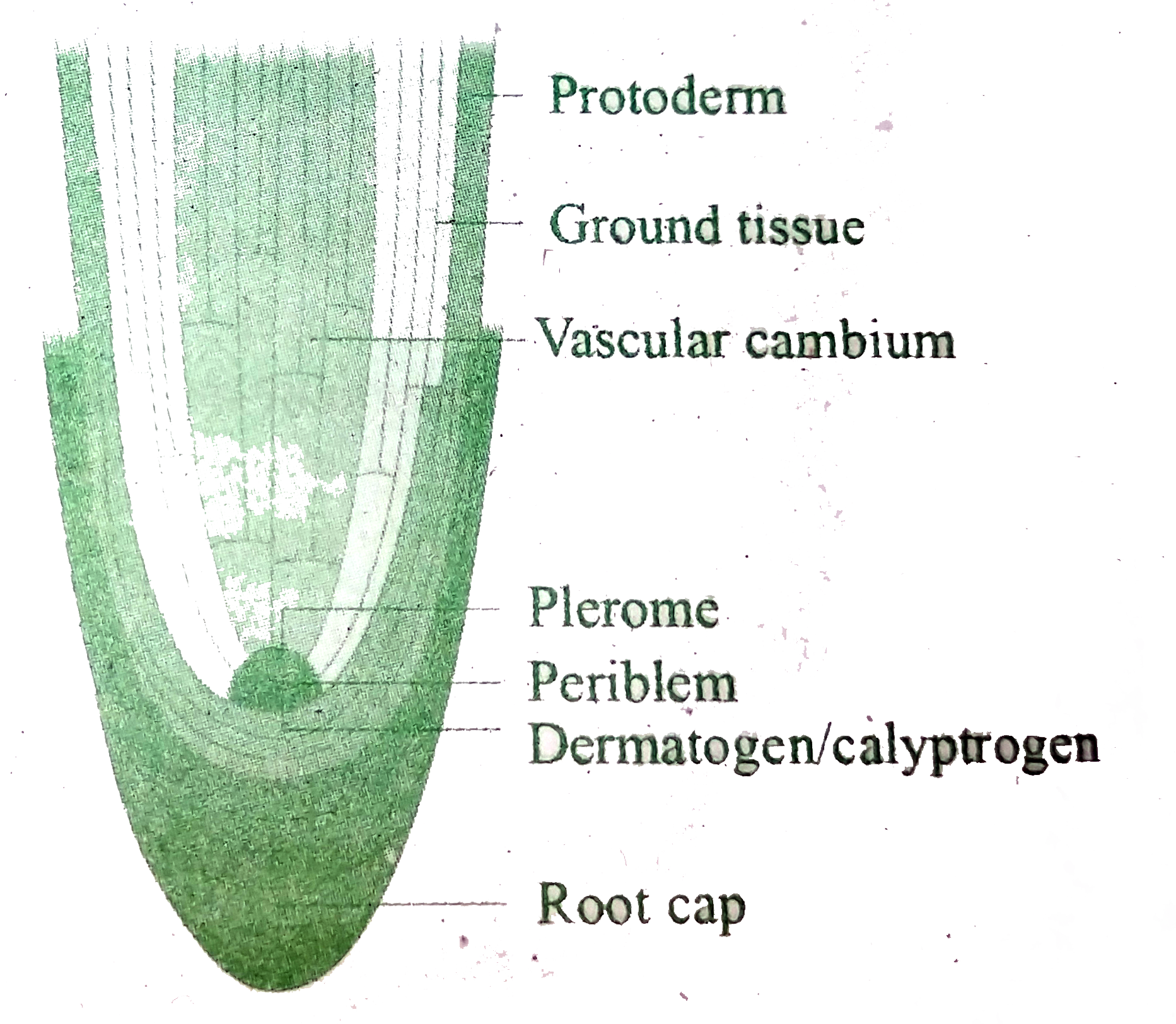
Table 1: Histogen concept of root apex
Histogen | Gives rise to |
|---|---|
Dermatogen | Epiblema / piliferous layer / rhizodermis + root cap in dicot |
Periblem | Cortex including endodermis |
Pleurome | Vascular tissue including pith |
Calyptrogen | Root cap in monocot |
Proposed by Hanstein; 4 groups of initials in root apex
❖ Quiescent Centre Concept: 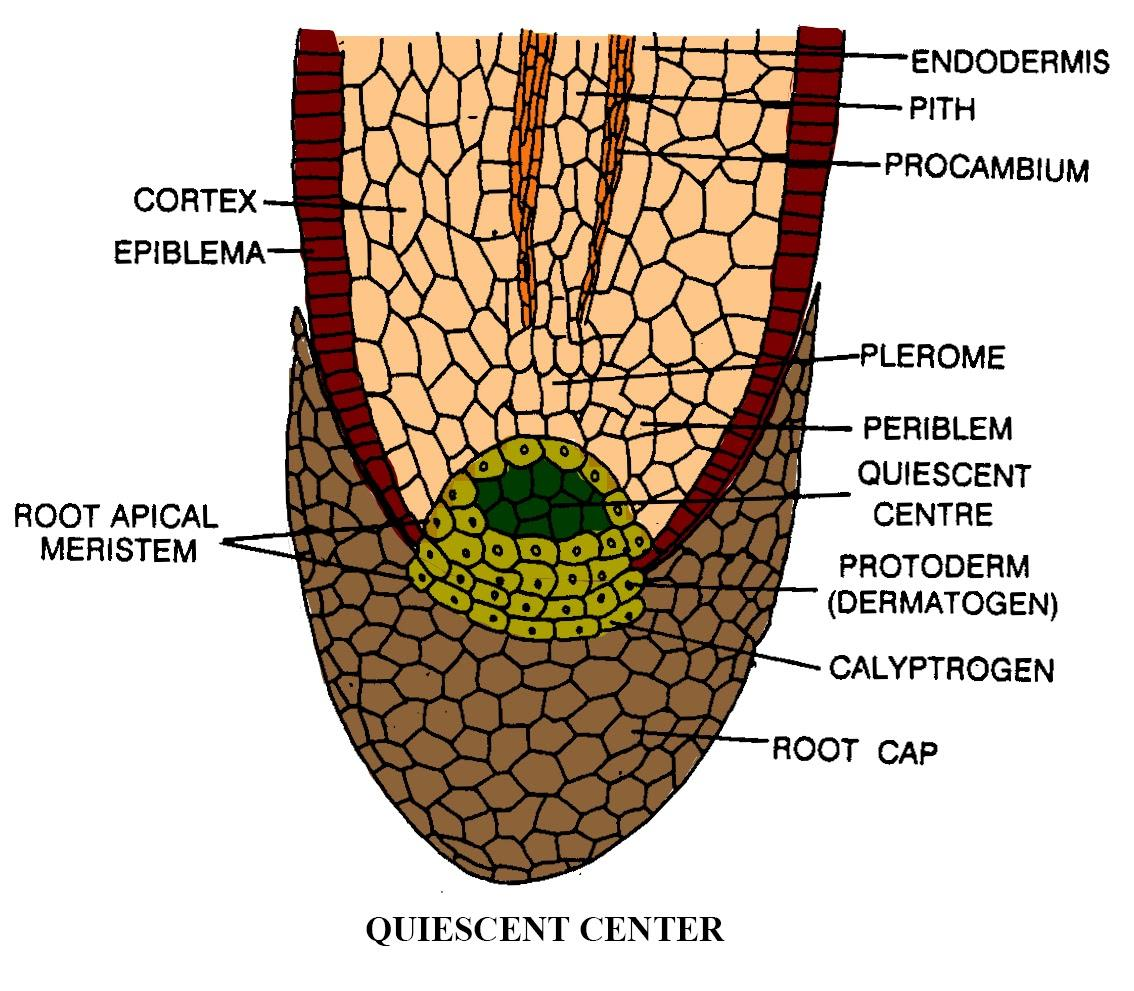
Table 1: Quiescent centre
Point | Data |
|---|---|
Given by | Clowes in maize |
Meaning | Inactive centre in root apex |
Biochemical status | Low DNA, RNA, protein |
Cell cycle status | G₀ phase |
Function | Reserve for replenishment of damaged meristem cells |
Hormonal note | Some auxin synthesis |
📚
PERMANENT TISSUE
▢ Definition:
- •Formed by division + differentiation of meristematic tissue
- •Fully mature + developed + differentiated cells
- •Lost power of division
- •May be living/dead
- •May be thin-walled/thick-walled
- •Generally thin-walled = living; thick-walled = dead
📖
Simple permanent tissue
▢ General Features:
- •Made up of one type of cells
- •Similar function
- •Homogeneous group
📝
Parenchyma
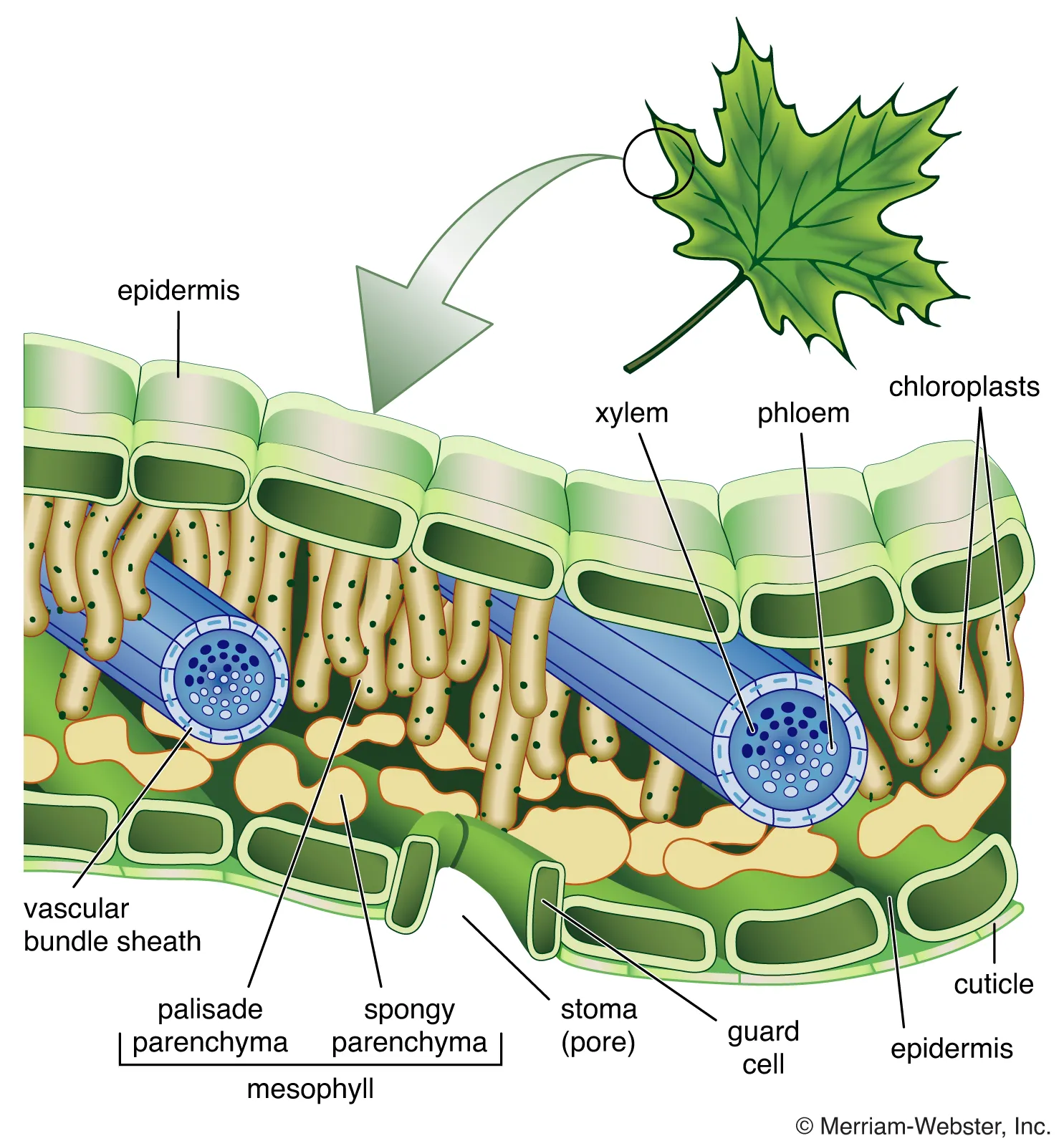
▢ Features:
- •Isodiametric cells
- •Thin-walled
- •Living
- •Abundant intercellular spaces
- •Most abundant permanent tissue
- •Evolved first
- •Fundamental tissue → other tissues evolved from it
- •Cell wall → cellulose + calcium pectate
- •Main function → food storage
▢ Special Types:
Table 1: Special types of parenchyma
Type | Occurrence | Function / Note |
|---|---|---|
Prosenchyma | Pericycle of some plants | Rigidity + strength |
Aerenchyma | Hydrophytes | Floating + buoyancy |
Chlorenchyma | Mesophyll of leaves | Photosynthesis |
Palisade + spongy parenchyma | Dicot leaves only | Mesophyll differentiation |
Idioblastic / storage parenchyma | Special storage cells | Contains enzymes, resin, ergastic substances |
📝
Collenchyma
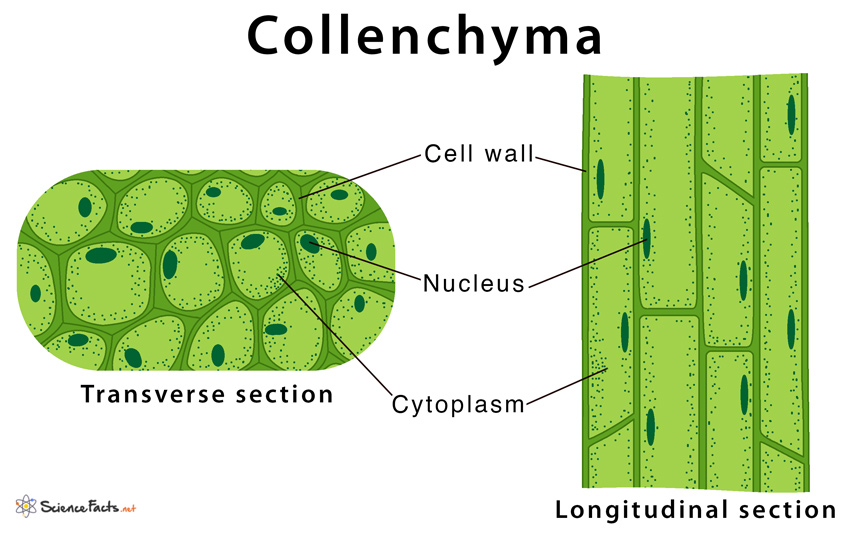
▢ Features:
- •Thick-walled but living cells
- •Living mechanical tissue
- •Cell wall thickening at corners/angles
- •Thickening due to pectin + cellulose; mainly pectin
- •Pectin → holds large amount of water
- •Simple pits between adjacent collenchyma cells
- •Absent in dicot roots + monocots
- •Forms hypodermis in herbaceous dicot stem + woody climber / liana
▢ Types: 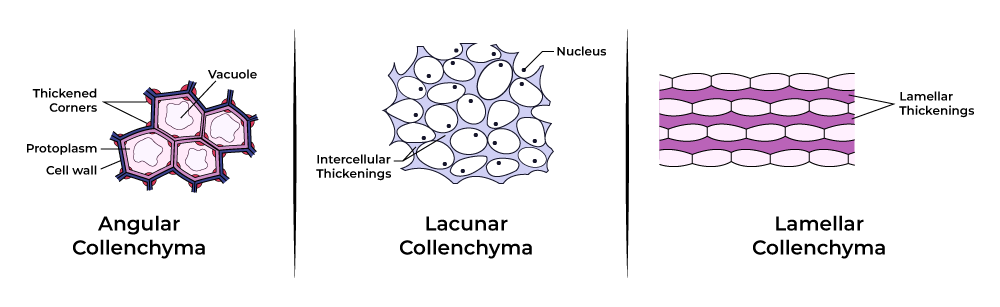
Table 1: Types of collenchyma
Type | Angular collenchyma | Lacunar / tubular collenchyma | Lamellar collenchyma |
|---|---|---|---|
Intercellular space | Absent | Present | Absent |
Special point | Most common + most abundant | Thickening around intercellular spaces | Wall thickening in layers |
📝
Sclerenchyma
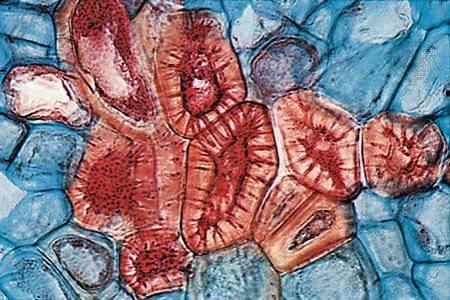
▢ Features:
- •Dead cells
- •No protoplasm
- •Thick-walled
- •Cell wall lignified
- •Lignin → hardest plant tissue; maximum rigidity
- •Bears compression, pull, bending, shearing forces
- •Simple + bordered pits in sclerenchyma fibres
▢ Fibre Note:
Table 1: Commercial fibre composition
Fibre | Rich in |
|---|---|
Cotton | Cellulose |
Flax | Cellulose |
Jute | Lignin |
Coir | Lignin |
▢ Common Occurrence:
- •Hypodermis of monocot stem
- •Pericycle
- •Xylem
- •Phloem
▢ Types:
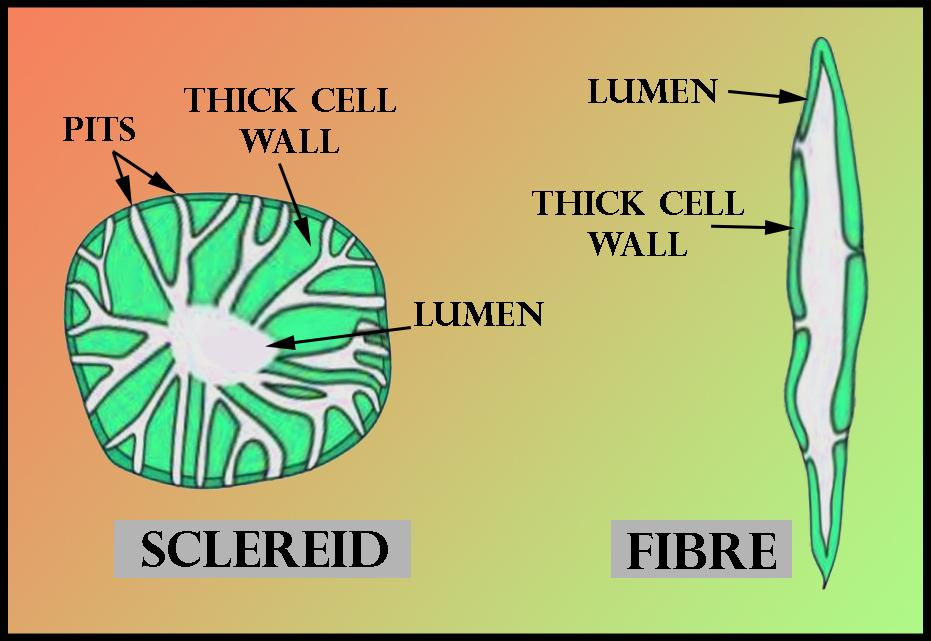
- Sclerenchyma Fibres
- Sclereids / Stone Cells / Grit Cells
📄
Sclerenchyma Fibres
- •Elongated
- •Tapering at both ends
- •Spindle-shaped
- •Commercial fibres = sclerenchyma fibres
- •Directly derived from meristematic cells
📄
Sclereids / Stone Cells / Grit Cells
▢ Features:
- •Derived by secondary thickening of parenchymal cells
- •Shorter
- •Highly thickened
- •Narrow cavities
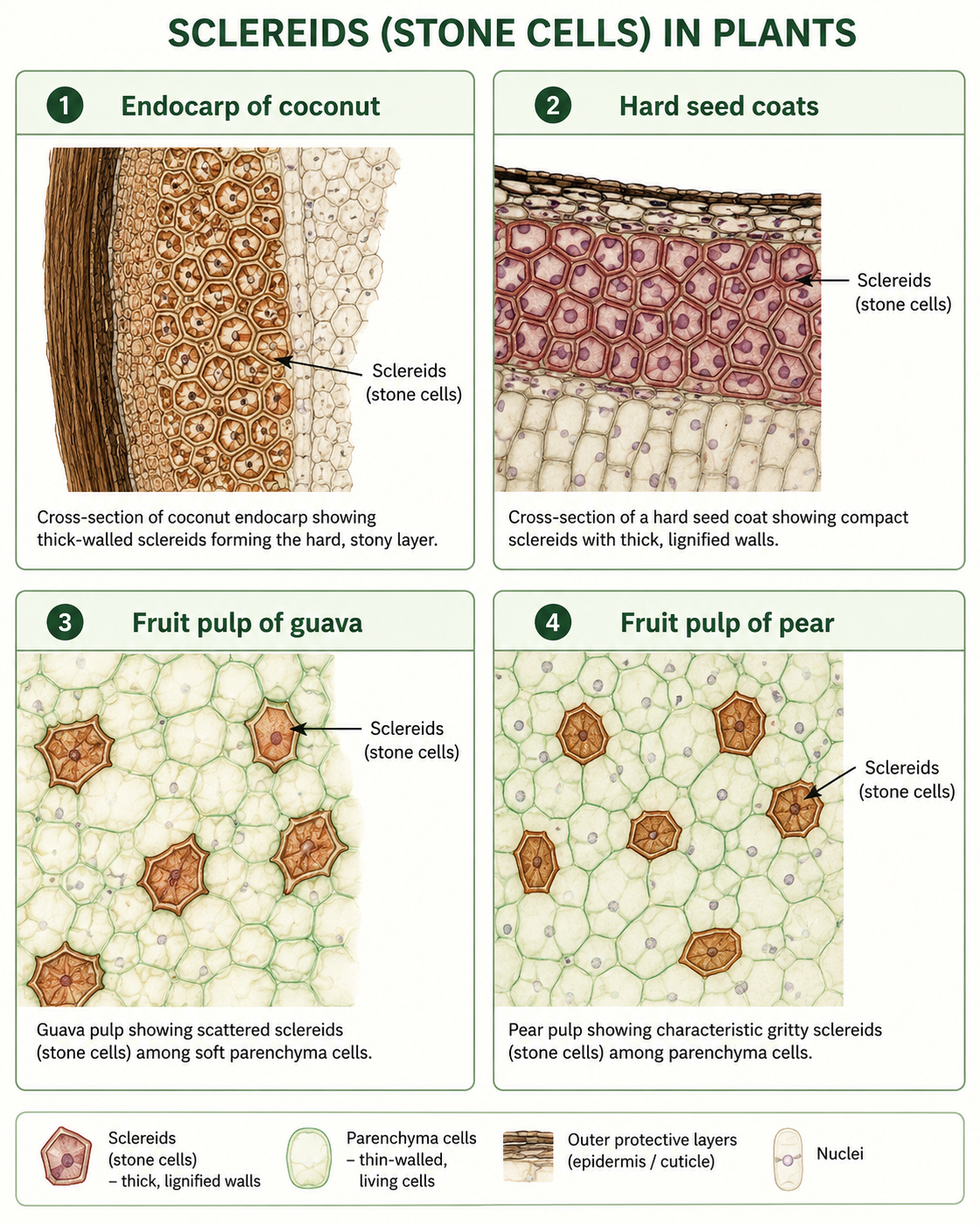
- •Hard seed coat due to stone cells
- •Stone cells in fruit pulp of Pyrus
▢ Occurrence:
- Endocarp of coconut
- Hard seed coats
- Fruit pulp of guava
- Fruit pulp of pear
▢ Types by Shape:
Table 1: Types of sclereids
Type | Shape | Occurrence |
|---|---|---|
Brachysclereids / stone cells | Irregular | Pulp of pear, guava; endocarp of coconut fruit |
Macrosclereids | Rod-shaped | Hard seed coat of Leguminosae |
Osteosclereids | Bone-shaped | Subepidermis of legume seeds |
Astrosclereids | Star-shaped | Tea leaves; petiole of lotus |
📖
Complex permanent tissue
Secondary xylem = wood
📝
Xylem / Hadrome
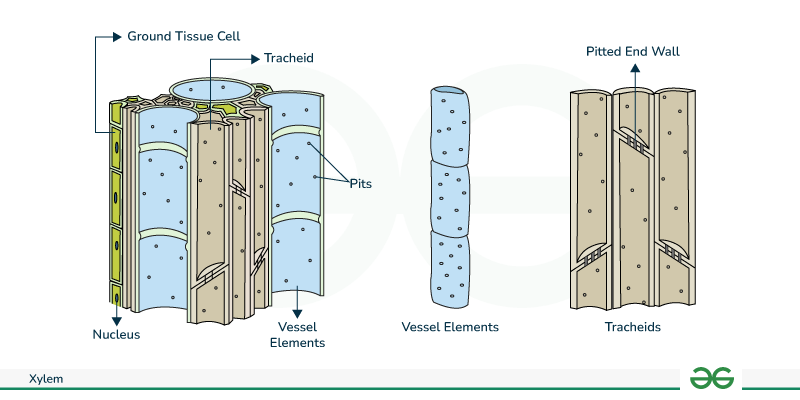
▢ Definition: Complex tissue made up of more than one type of cells/elements
▢ Elements:
Table 1: Xylem elements
Element | Special point |
|---|---|
Vessels / trachea | Absent in pteridophytes + gymnosperms |
Tracheids | Water conduction + support |
Xylem parenchyma | Living storage element |
Xylem fibres / wood fibres | Mechanical support |
📝
Phloem / Leptome
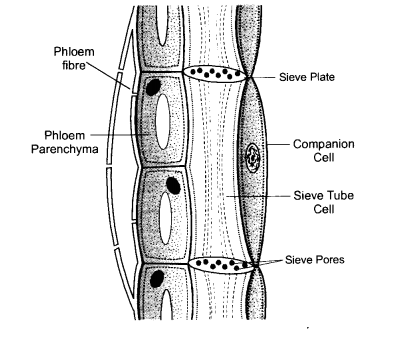
▢ Elements:
Table 1: Phloem elements
Element | Occurrence / Note |
|---|---|
Sieve elements | Sieve cells + sieve tubes |
Sieve cells | Pteridophytes + gymnosperms |
Sieve tubes | Angiosperms |
Albuminous cells | Pteridophytes + gymnosperms |
Companion cells | Angiosperms |
Phloem parenchyma | Storage + lateral conduction |
Phloem fibres / bast fibres | Mechanical support |
Q1.
Vessels in plants are generally blocked by: [IOM 2005]
📅IOM 2005
Q2.
The vascular bundle having phloem in the centre and surrounded by xylem is termed as: [IOM 2004]
📅IOM 2004
Q3.
Which of the following shows the secondary growth: [IOM 2003]
📅IOM 2003
Q4.
Stele in monocot stem is: [IOM 1998]
📅IOM 1998
Q5.
Intercalary meristem is a portion of: [IOM 1997]
📅IOM 1997
Q6.
Which one of the following is a living component of xylem system? [IOM 1997]
📅IOM 1997
Q7.
Lateral roots originate from: [IOM 1996]
📅IOM 1996
Q8.
The xylem in root is: [IOM 1999]
📅IOM 1999
Q9.
The leaves of grasses roll because: [BPKIHS 2001]
📅BPKIHS 2001
Q10.
Exarch xylem has: [BPKIHS 2001]
📅BPKIHS 2001
Q11.
A meristem responsible for extra-stellar secondary growth in dicot stem is
Q12.
Food is transported to different parts of plant through: [BPKIHS 2004]
📅BPKIHS 2004
Q13.
Secondary growth in thickness of plants is brought about initially by division of the: [BPKIHS 2005]
📅BPKIHS 2005
Q14.
Bidirectional translocation of mineral takes place in: [BPKIHS 2006]
📅BPKIHS 2006
Q15.
Cambium helps in [MOE 2063]
📅MOE 2063
Q16.
Function of sclerenchyma tissue is to [MOE 2063]
📅MOE 2063
Q17.
The hypodermis in monocotyledonous stem is [MOE 2062]
📅MOE 2062
Q18.
Which of the following is an example of primary meristematic tissue? [MOE 2062]
📅MOE 2062
Q19.
Bicollateral vascular bundles are found in [MOE 2060]
📅MOE 2060
Q20.
The vascular bundle is scattered in [MOE 2003]
📅MOE 2003
Q21.
Lateral roots arise from [MOE 2002]
📅MOE 2002
Q22.
Vascular bundle in maize is [MOE 2058]
📅MOE 2058
Q23.
The youngest layer of secondary xylem in a woody stem is located just [MOE 2000, 2055]
📅MOE 2000, 2055
Q24.
Cambium of dicot root is formed by [MOE 2000]
📅MOE 2000
Q25.
If metaxylem faces towards pith, the xylem is [MOE 2059]
📅MOE 2059
Q26.
Vascular bundle of dicot stem is [MOE 2055]
📅MOE 2055
Q27.
Periderm consists of [MOE 2054]
📅MOE 2054
Q28.
Net-like thickening of xylem vessel is called [MOE 2054]
📅MOE 2054
Q29.
Pith is well developed in [BPKIHS 1994]
📅BPKIHS 1994
Q30.
In grafting, stock and scion following ought to be joined [BPKIHS 1994]
📅BPKIHS 1994
Q31.
Chlorenchyma and aerenchyma are modified forms of [BPKIHS 1995]
📅BPKIHS 1995
Q32.
With increasing secondary growth in trees which will increase in diameter? [BPKIHS 1995]
📅BPKIHS 1995
Q33.
Amyloplast is [BPKIHS 1990]
📅BPKIHS 1990
Q34.
Pith is developed by the activity of [BPKIHS 1997]
📅BPKIHS 1997
Q35.
Mesophyll tissue found in leaves are actually the [BPKIHS 1997)
📅BPKIHS 1997)
Q36.
Atactostele is present in [BPKIHS 1998)
📅BPKIHS 1998)
Q37.
Jute is a [BPKIHS 1998, IOM 2059]
📅BPKIHS 1998, IOM 2059
Q38.
Suberin in a dead cork cell [BPKIHS 2004]
📅BPKIHS 2004
Q39.
Name the condition in which xylem is surrounded in both outer and inner sides by phloem. [IOM 2007]
📅IOM 2007
Q40.
Hypodermis in monocotyledonous stem is [IE 2003]
📅IE 2003
Q41.
Casparian strip is found in [IE 2004)
📅IE 2004)
Q42.
Cork & secondary cortex is formed due to [IE 2005)
📅IE 2005)
Q43.
Most common ground tissue [IE 2005)
📅IE 2005)
Q44.
Both the palisade & spongy mesophylls of leaf function to: [IE 2007]
📅IE 2007
Q45.
Cork tissue is known as: [IE 2008]
📅IE 2008
Q46.
The pericycle which gives rise to lateral roots consist of: [IE 2009]
📅IE 2009
Q47.
A phellogen originates from [IE 2009]
📅IE 2009
Q48.
B. The protoxylem is largely composed of [IE 2009]
📅IE 2009
Q49.
Primary growth involves activity of the [IE 2009]
📅IE 2009
Q50.
Protoxylem and stomata in a dorsiventral leaf are present, respectively [I.E.]
📅I.E.
Q51.
When the bark of a tree is removed, the plant die due to [BPKIHS - 2016]
📅BPKIHS - 2016
Q52.
In plant, phloem helps in [BPKIHS - 2015]
📅BPKIHS - 2015
Q53.
Histogen theory was proposed by [BPKIHS - 2014]
📅BPKIHS - 2014
Q54.
Collateral vascular bundle is [BPKIHS - 2014]
📅BPKIHS - 2014
Q55.
Which layer gives rise to stele? [BPKIHS - 2013]
📅BPKIHS - 2013
Q56.
Cambium is not found in [BPKIHS - 2013]
📅BPKIHS - 2013
Q57.
Phloem helps in [BPKIHS - 2012]
📅BPKIHS - 2012
Q58.
The study of determining age of studying annual ring [BPKIHS - 2012]
📅BPKIHS - 2012
Q59.
Which is responsible for the growth in circumference of stem or root? [BPKIHS - 2011]
📅BPKIHS - 2011
Q60.
The ballon like growth of parenchyma in lumen of a vessel is known as [BPKIHS - 2011]
📅BPKIHS - 2011
Q61.
Cohesion and tension theory in transpiration of plant was given by [BPKIHS - 2011]
📅BPKIHS - 2011
Q62.
Cricket ball is made from [BPKIHS - 2011]
📅BPKIHS - 2011
Q63.
Grafting will be possible in monocot plant if only it has [BPKIHS - 2011]
📅BPKIHS - 2011
Q64.
Protoderm is a part of [IOM-2014]
📅IOM-2014
Q65.
The study of growth rings of tree in relation to climate is called [IOM-2014]
📅IOM-2014
Q66.
Jute fibre is obtained from [IOM-2016]
📅IOM-2016
Q67.
Annual rings helps in determining [IOM-2016]
📅IOM-2016
Q68.
Which of the following is a dual complex tissue? [IOM-2012]
📅IOM-2012
Q69.
Trachea, tracheids, wood parenchyma and vessels are present in [IOM-2012]
📅IOM-2012
Q70.
Jute fibre is obtained from [IOM-2012]
📅IOM-2012
Q71.
Which of the following monocot shows secondary growth? [MOE 2014]
📅MOE 2014
Q72.
What type of vascular bundle is found in dicot stem? [MOE 2014]
📅MOE 2014
Q73.
Growth rings in dicot stem are formed due to the activity of [MOE 2013)
📅MOE 2013)
Q74.
Which one of the following tissue is found only on dicot plants? [MOE 2010)
📅MOE 2010)
Q75.
Casparian stripes is found in [MOE 2010)
📅MOE 2010)