📚
MOVEMENT
▢ Definition: Living plants → positional change due to environmental/endogenous causes
▢ Cause: Sensitivity / irritability of protoplasm
▢ Level:
- •Whole organism
- •Organ level
- •Cellular level
▢ Cellular Example: Cyclosis = cytoplasmic streaming; cytoplasm flows like river inside living cell
📚
STIMULUS & RESPONSE
▢ Stimulus: External environmental change → reaction in plant/organ
▢ Threshold Intensity: Minimum stimulus intensity → response induction
▢ Response: Visible change/reaction of plant/organ due to stimulus
▢ Reaction Time / Presentation Time: Interval: stimulus presentation → actual response development
▢ Stimulus-Based Movement:
Table 1: Nature of Stimulus
Type | Cause | Also Called |
|---|---|---|
Autonomous | Internal stimulus | Spontaneous |
Paratonic | External stimulus | Induced |
▢ Stimuli Prefixes:
Table 1: Stimulus → Prefix
Stimulus | Prefix |
|---|---|
Light | Photo |
Temperature | Thermo |
Water | Hydro |
Chemical | Chemo |
Water current | Rheo |
Gravity | Geo |
Touch / Contact | Thigmo / Hapto |
Shock | Seismo |
📚
HYGROSCOPIC MOVEMENT
▢ Occurrence:
- •Bryophytes
- •Pteridophytes
▢ Examples:
- •Twisting movement of elater
- •Sporangial wall of fern
📚
TYPES OF MOVEMENT
Table 1: Major Types
Feature | Movement of Locomotion | Movement of Curvature |
|---|---|---|
Common In | Lower plants | Higher plants |
Change | Position of whole body | Position of body parts only |
Main Types | Autonomic + Paratonic | Movement of variation + Movement of growth |
📖
Movement of locomotion
▢ Autonomic / Self Movement:
Table 1: Autonomic Locomotory Movements
Type | Mechanism | Examples |
|---|---|---|
Amoeboid | Pseudopodia-like structure | Synchytrium / slime mould |
Ciliary | Cilia / flagella | Chlamydomonas, Volvox |
Cyclosis / Streaming | Protoplasmic streaming | Chloroplast movement in Elodea |
▢ Cyclosis Types:
Table 1: Cyclosis
Type | Movement Direction | Example |
|---|---|---|
Rotation | Clockwise OR anticlockwise; single direction | Leaf of Hydrilla, Vallisneria |
Circular | Clockwise + anticlockwise; all possible directions | Staminal hairs of Tradescantia |
▢ Paratonic / Induced Movement:
❖ Name: Tactic / Taxis movement
Table 1: Tactic Movements
Type | Stimulus | Key Points | Examples |
|---|---|---|---|
Phototactic | Light | Movement: dark → diffused light; intense light ↔ diffused light | Zoospores of Chlamydomonas, Volvox |
Thermotactic | Temperature | Cold water ↔ warm water | Chlamydomonas, bacteria |
Chemotactic | Chemical, e.g., malic acid | Antherozoid movement: antheridium → archegonium | Bryophytes, pteridophytes |
Rheotactic | Water current | Movement due to water current | Aquatic algae |
📖
Movement of curvature
▢ Movement of Variation:
- •Change in position without growth
- •Mostly turgor/osmotic change
▢ Movement of Growth:
- •Change in position due to growth
- •Growth differential → curvature
📝
Movement of Variation
▢ Autonomic:
❖ Example: Leaves of Desmodium gyrans = Indian telegraph plant
❖ Key Point: Lateral leaflets → continuous up-down movement
▢ Paratonic / Induced / Nastic Movement:
Table 1: Nastic Movements
Type | Stimulus | Key Point | Examples |
|---|---|---|---|
Photonasty | Light | Response to light intensity | Head of sunflower → helionasty |
Thermonasty | Temperature | Flowering/opening at higher temperature | Tulip, crocus flower |
Nyctinasty / Sleep movement | Light + temperature | ↓ light intensity → sleep movement of leaves | Oxalis + Albizzia: open day, close night; Oenothera: open night, close day |
Seismonasty / Osmotic / Turgor movement | Shock / touch | Water loss from pulvinus + pulvinules → drooping | Leaves of Mimosa pudica |
Thigmonasty / Haptonasty | Touch / contact | Touch-induced movement | Insectivorous plants; hairs of Drosera |
📝
Movement of Growth
▢ Autonomic Growth Movement:
Table 1: Autonomic Growth Movements
Type | Growth Pattern | Movement | Examples |
|---|---|---|---|
Hyponasty | More growth of lower surface / abaxial side | Part moves upward | Closed flower petal; young fern leaf / circinately coiled leaf |
Epinasty | More growth of upper surface / adaxial side | Part moves downward | Opening of flower; erect fern leaf / mature frond |
Nutational movement | Alternate growth on either surface | Zig-zag / forward curvature | Zig-zag shoot apex; forward growth of branches |
Hyponasty + epinasty → common in bifacial structures: leaf, sepal, petal
▢ Paratonic Growth Movement: 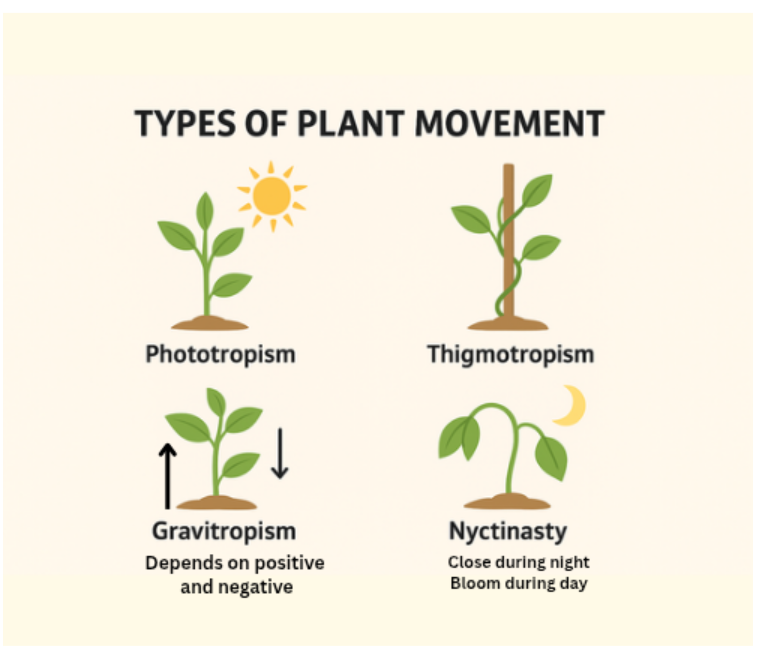
❖ Also Called: Tropic movement; process = tropism
Table 1: Tropic Movements
Type | Stimulus | Positive Response | Negative Response | Examples / Notes |
|---|---|---|---|---|
Phototropic | Light | Shoots | Roots | Differential hormonal effect; auxin accumulates on shaded side; coleoptile bends toward light due to greater elongation on shaded side |
Geotropic | Gravity | Roots | Shoots | Main root = +ve geotropic; main shoot = -ve geotropic |
Hydrotropic | Water | Roots | Shoots | Important for young roots |
Thigmotropic / Haptotropic | Touch / contact | Contact side response | Tendrils bending on support; haustoria in Cuscuta | |
Chemotropic | Chemical, e.g., malic acid | Growth toward chemical source | Pollen tube growth toward embryo sac | |
📄
Geotropism Types
Table 1: Types of Geotropic Growth
Type | Growth Direction vs Gravity | Examples |
|---|---|---|
Orthogeotropic | Parallel to gravity | Main roots → +ve orthogeotropic; main shoot → -ve orthogeotropic |
Diageotropic | Right angle to gravity | Tertiary root; rhizome; prostrate plants; leaves |
Plagiogeotropic | Secondary/lateral roots → +ve plagiogeotropic; stem branches → -ve plagiogeotropic | |
Apogeotropic / Ageotropic | No effect of gravity | Respiratory roots/pneumatophores of mangroves; coralloid root of Cycas |
📚
INSTRUMENTS & SPECIAL TROPISMS
▢ Clinostat: Instrument → eliminates effect of gravity on plant
▢ Traumatotropism: Movement induced by injury
📚
READ & DIGEST
▢ Bulliform Cells:
- •Grass leaves → folding + unfolding
- •Specialized bulliform cells
- •Bulliform cells → turgor movements
▢ Nastic vs Tropic: Nastic movements = non-directional; tropic movements = directional
▢ Scototropic Movement: Induced by night
▢ Xerochasy: Peristome teeth of moss
▢ Earthworm: Moves down soil → +ve geotropism
▢ Telotaxis: Honey bee drawn toward flower