📚
HISTORY
Table 1: Virus: Important Discoveries
Event / Term | Scientist / Key Point |
|---|---|
Term 'virus' | Louis Pasteur |
First evidence of filterable virus | Dmitri Ivanovsky → tobacco mosaic disease |
Contagium vivum fluidum | Martinus Beijerinck |
Crystallization of virus | Wendell M. Stanley → Tobacco mosaic virus |
Bacteriophage discovery | Frederick Twort + Félix d'Hérelle |
Retrovirus + reverse transcriptase | Howard Temin + David Baltimore |
📚
MAIN CHARACTERS
Table 1: Living vs Non-living Characters
Character | Feature |
|---|---|
Non-living |
|
Living |
|
Core Definition
Virus = obligate intracellular acellular infectious agent containing either DNA or RNA inside a protein coat ± envelope
📚
MORPHOLOGY
▢ Size:
Table 1: Virus Size
Type | Virus / Point |
|---|---|
Usual range | 20–300 nm |
Smallest | Foot-and-mouth disease virus |
Among smallest animal DNA viruses | Parvovirus |
Largest classical virus | Poxvirus / Variola virus |
▢ Shape:
Table 1: Virus Shape
Shape | Example |
|---|---|
Brick-shaped | ◉ Poxvirus / Smallpox virus: 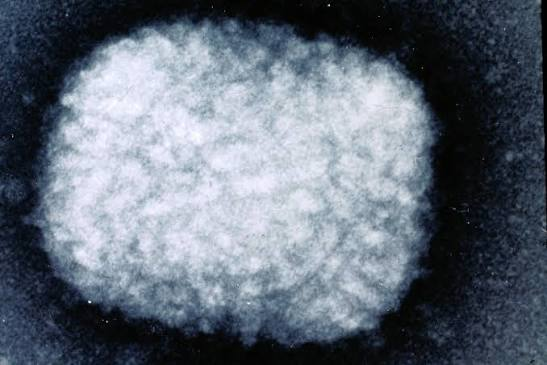 |
Spherical / pleomorphic | ◉ Influenza virus: 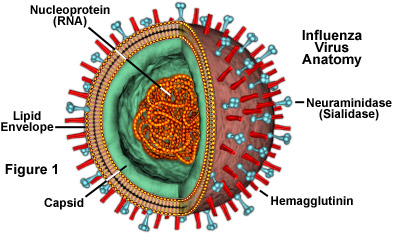 |
Bullet-shaped | ◉ Rabies virus: 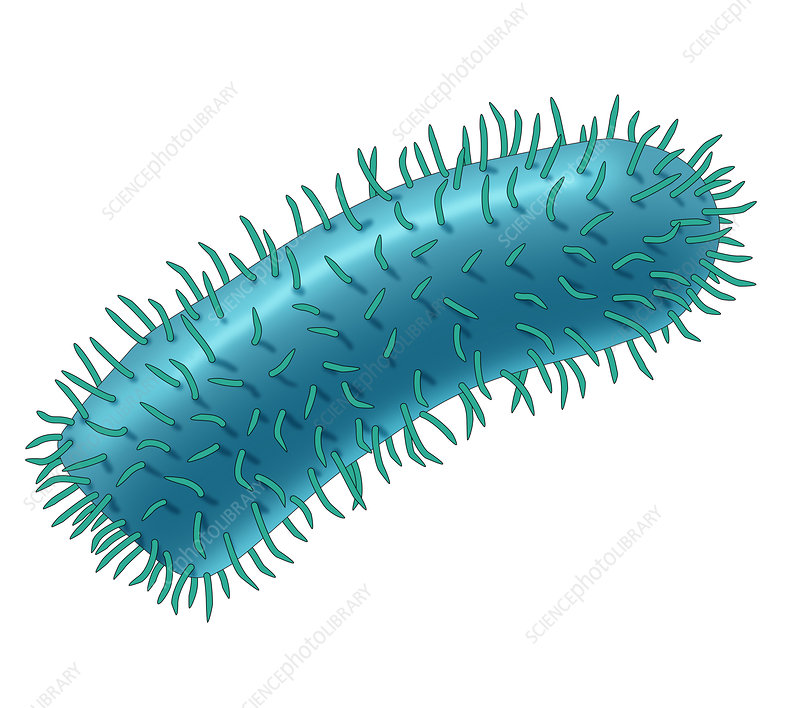 |
Rod-shaped / helical | ◉ Tobacco mosaic virus: 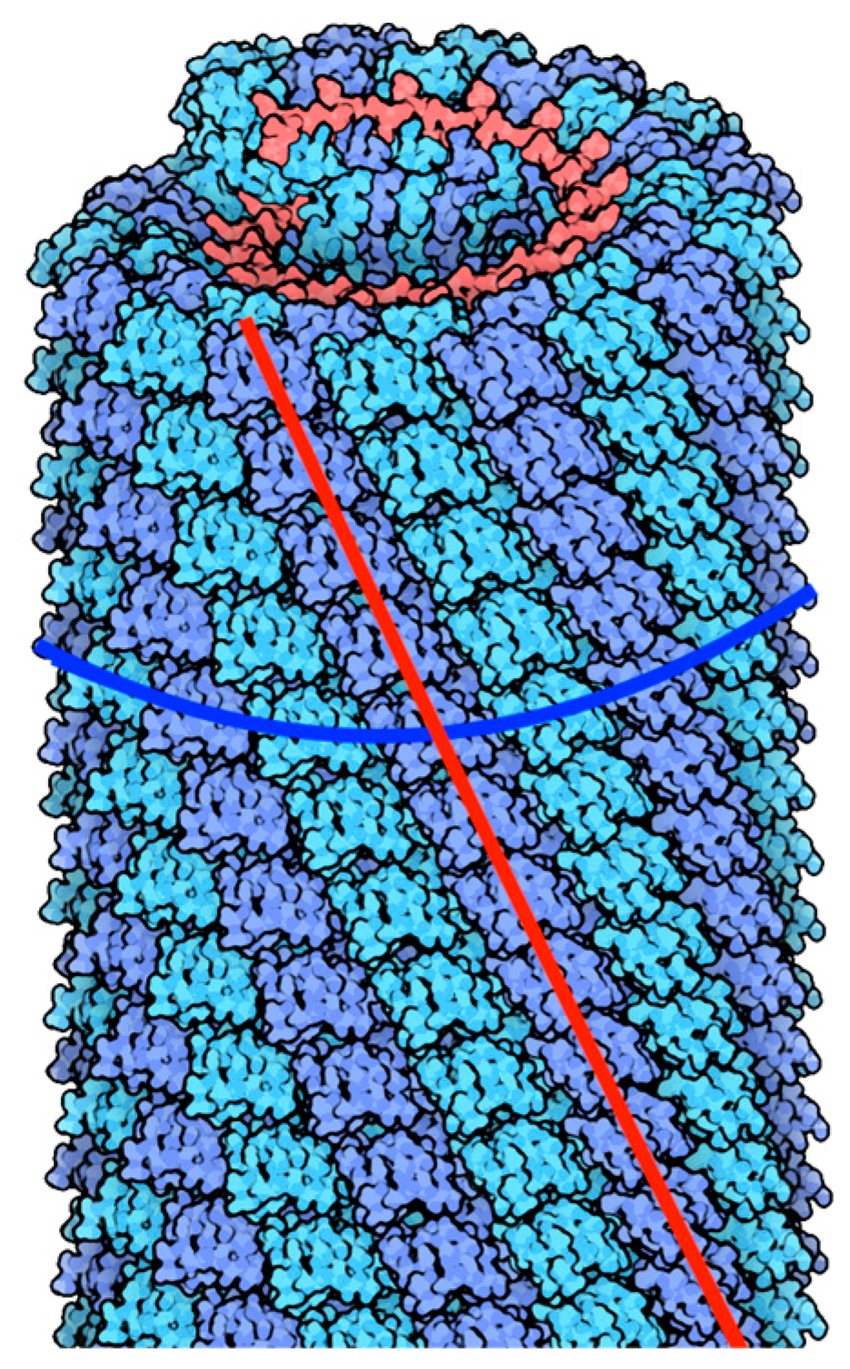 |
Polyhedral / icosahedral | ◉ Adenovirus: 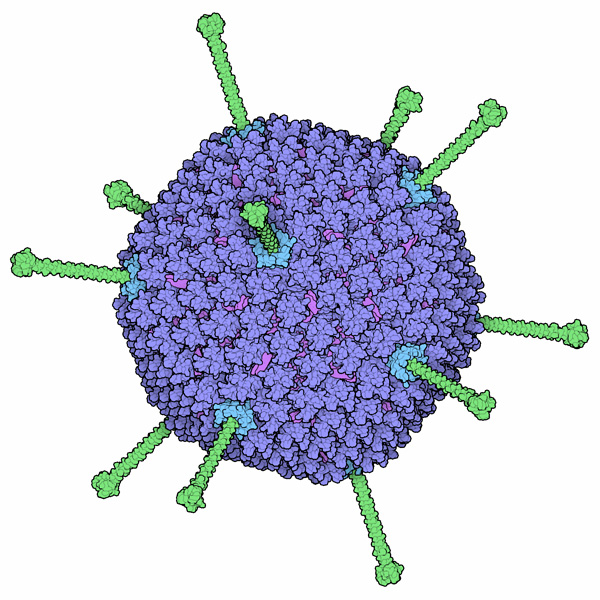 |
Tadpole-like / complex | ◉ Bacteriophage: 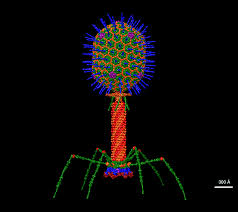 |
📚
STRUCTURE OF VIRION
▢ Basic Plan:
- •Virion = complete mature infective virus particle
- •Genome + capsid = nucleocapsid
- •Nucleocapsid ± envelope ± matrix / tegument ± enzymes
- •No cell membrane, cytoplasm, nucleus, mitochondria or ribosome
▢ Envelope:
Table 1: Viral Envelope
Feature | Detail |
|---|---|
Presence | Only in enveloped viruses; absent in naked viruses |
Origin | Host-cell lipid membrane acquired during budding |
Components | Lipid bilayer + viral glycoprotein spikes / peplomers |
Functions |
|
Sensitivity | Heat, drying, ether, alcohol, detergents, bile |
Transmission tendency | Usually close contact, droplets, blood, sexual route; poor environmental survival |
Examples | Influenza, HIV, Herpes, Hepatitis-B, Rabies, Coronavirus |
Naked Viruses
No lipid envelope → relatively resistant to drying, acid, detergents and environmental conditions; examples: Adenovirus, Poliovirus, Papillomavirus, Parvovirus, Reovirus
▢ Capsid:
Table 1: Capsid
Feature | Detail |
|---|---|
Definition | Protein shell surrounding viral genome |
Subunits | Capsomeres |
Functions |
|
Symmetry | Helical / Icosahedral / Complex |
▢ Nucleic Acid:
Table 1: Viral Genome: General Features
Feature | Detail |
|---|---|
Type | Either DNA or RNA; never both in one virion |
Strands | Single-stranded or double-stranded |
Form | Linear or circular |
Segmentation | Segmented or non-segmented |
RNA polarity | Positive-sense, negative-sense or ambisense |
Function | Carries genetic information + controls replication and synthesis of viral proteins |
▢ Additional Components:
Table 1: Other Viral Components
Component | Function / Example |
|---|---|
Matrix protein | Links nucleocapsid with envelope; supports assembly |
Tegument | Protein layer between capsid and envelope in herpesviruses |
Spikes / peplomers | Attachment + antigenicity; e.g., influenza HA and NA |
Viral enzymes | Needed when host cell cannot supply them; e.g., reverse transcriptase, RNA-dependent RNA polymerase, neuraminidase |
📚
CAPSID SYMMETRY
Table 1: Types of Viral Symmetry
Type | Arrangement | Examples |
|---|---|---|
Helical | Capsomeres arranged spirally around nucleic acid | TMV, Rabies, Influenza nucleocapsid |
Icosahedral / Cubic | 20 triangular faces + 12 vertices | Adenovirus, Poliovirus, Herpesvirus |
Complex | Neither purely helical nor icosahedral | Bacteriophage, Poxvirus |
📚
NUCLEIC ACID TYPES
Table 1: Viral Nucleic Acid Types
Type | Examples / Special Point |
|---|---|
dsDNA |
|
Partially dsDNA |
|
ssDNA |
|
dsRNA |
|
+ssRNA |
|
−ssRNA |
|
Diploid +ssRNA with reverse transcriptase |
|
Circular −ssRNA defective virus |
|
Exam Rule
Most DNA viruses replicate in nucleus; Poxvirus replicates in cytoplasm. Most RNA viruses replicate in cytoplasm; Influenza and Retrovirus require nuclear phase.
📚
BACTERIOPHAGE
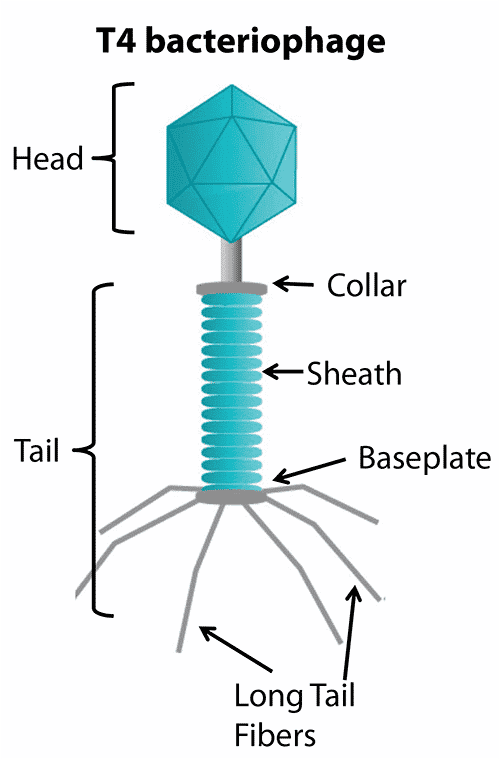
▢ Definition: Virus infecting bacteria
▢ Example: T-even phage / T4 bacteriophage infecting Escherichia coli
▢ General Features:
- •Complex symmetry
- •Head contains genome
- •Tail apparatus attaches to bacterium + injects genome
- •T4 phage genome = linear dsDNA
- •Protein coat remains outside bacterial cell during penetration
▢ Structure:
Table 1: T4 Bacteriophage Structure
Part | Structure / Function |
|---|---|
Head / Capsid | Icosahedral protein coat enclosing dsDNA |
Genome | Linear double-stranded DNA |
Neck / Collar | Connects head with tail |
Tail sheath | Contractile protein sheath |
Tail core / tube | Passage for injection of phage DNA |
Base plate | Anchors phage to bacterial surface |
Tail fibres | Recognize specific bacterial receptors + adsorption |
Tail pins / spikes | Pierce bacterial cell wall |
▢ Types:
Table 1: Types of Bacteriophages
Type | Also Called | Outcome |
|---|---|---|
Virulent phage | Lytic phage | Immediate replication → host-cell lysis |
Temperate phage | Lysogenic phage | Genome integrates as prophage; may later enter lytic cycle |
Specificity
Tail fibres determine host specificity by binding receptors on bacterial surface.
📚
LIFE CYCLE OF VIRUS
▢ General Viral Replication:
Table 1: General Steps
Step | Process |
|---|---|
1. Attachment / Adsorption | Viral attachment protein binds specific host-cell receptor |
2. Penetration / Entry | Fusion, endocytosis or genome injection |
3. Uncoating | Capsid removed → viral genome released; absent in bacteriophage because capsid remains outside |
4. Biosynthesis / Eclipse | Early proteins + genome replication + late structural proteins |
5. Assembly / Maturation | Genome packaged into capsid → new virions |
6. Release | Cell lysis in many naked viruses / bacteriophages; budding or exocytosis in many enveloped viruses |
▢ Lytic Cycle of Bacteriophage: 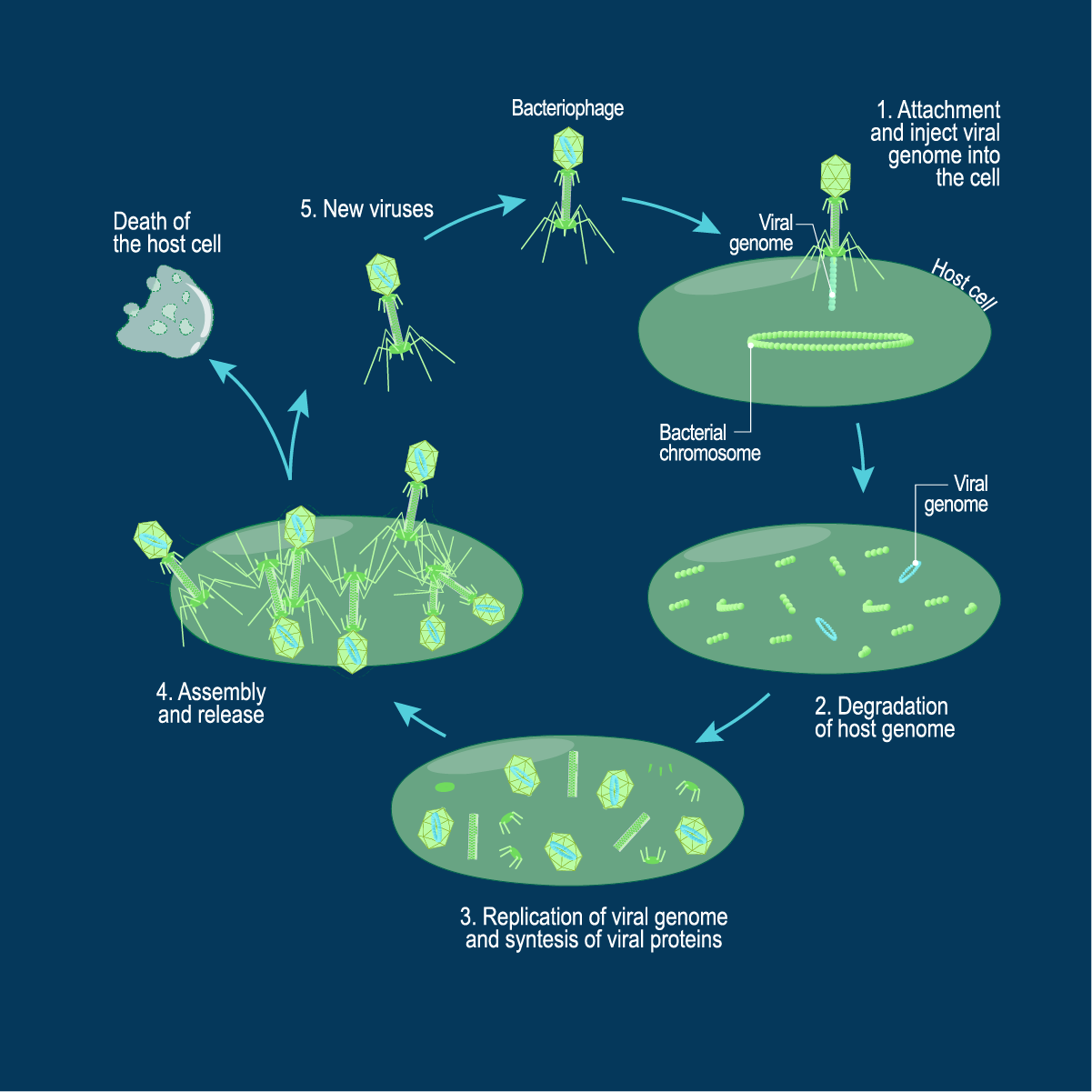
Table 1: Lytic Cycle
Step | Key Event |
|---|---|
Adsorption | Tail fibres attach to specific receptors on bacterial cell wall |
Penetration | Tail sheath contracts; phage DNA injected; capsid remains outside |
Host takeover | Host DNA may be degraded; host machinery redirected |
Biosynthesis | Phage DNA replicates + phage proteins synthesized |
Assembly / Maturation | Head, tail and fibres assembled; DNA packed into head |
Lysis / Release | Phage lysozyme breaks bacterial wall → progeny phages released |
Terms
❖ Eclipse period: No complete infective virion detectable inside host
❖ Latent period: Time from adsorption to release of new virions
❖ Burst size: Number of phages released from one infected bacterium
▢ Lysogenic Cycle of Bacteriophage: 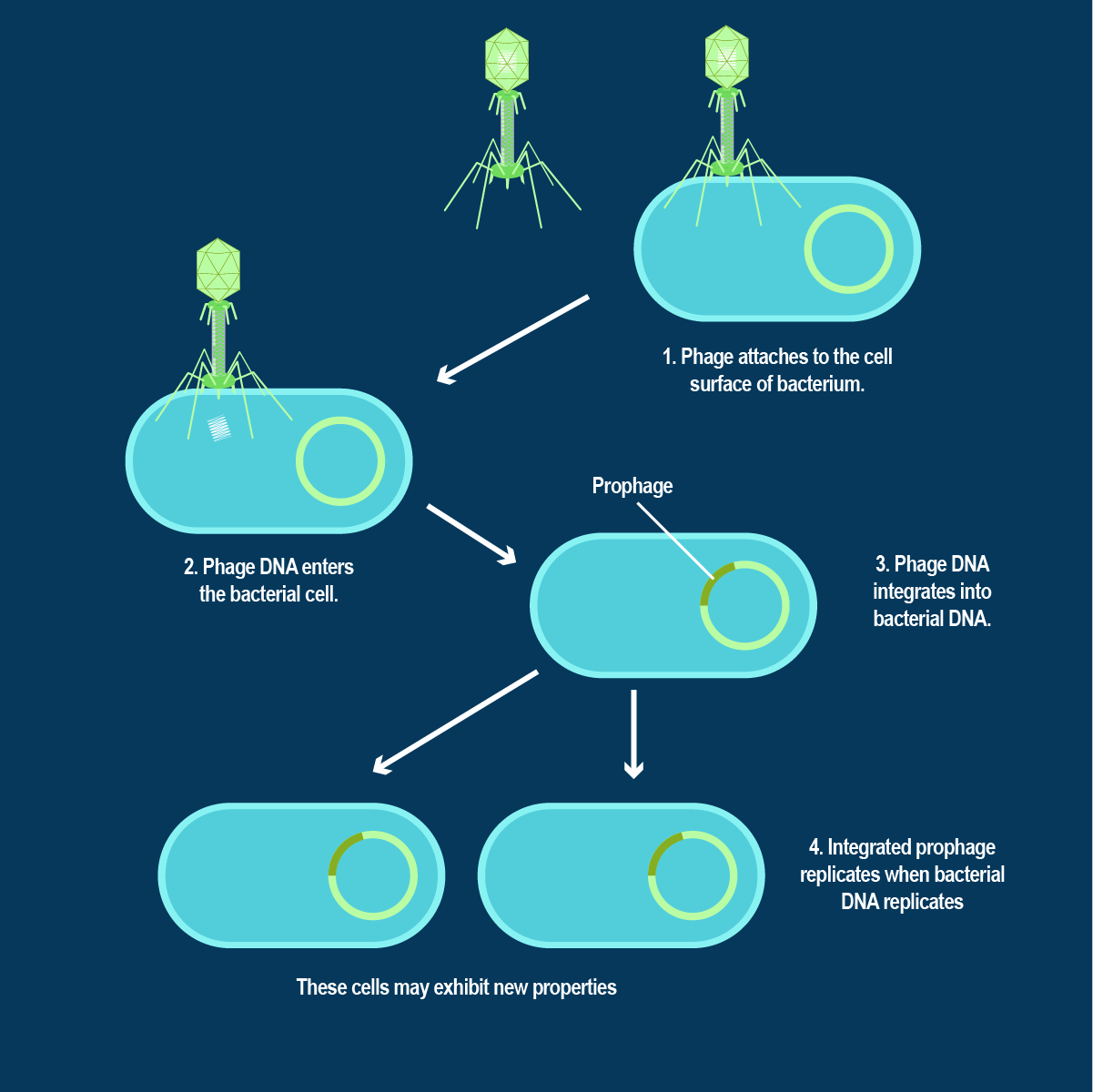
Table 1: Lysogenic Cycle
Step | Key Event |
|---|---|
Adsorption + penetration | Temperate phage injects genome |
Integration | Phage DNA integrates into bacterial chromosome |
Prophage formation | Integrated phage DNA = prophage |
Replication with host | Prophage copied during bacterial cell division without lysis |
Induction | UV light, chemicals or stress activate prophage |
Entry into lytic cycle | Phage DNA excises → biosynthesis → assembly → lysis |
Lysogenic Conversion
Prophage genes may give new properties / toxin production to bacteria; examples: diphtheria toxin, cholera toxin, erythrogenic toxin.
▢ Lytic vs Lysogenic:
Table 1: Lytic vs Lysogenic Cycle
Feature | Lytic Cycle | Lysogenic Cycle |
|---|---|---|
Phage type | Virulent | Temperate |
Genome integration | Absent | Present as prophage |
Host-cell lysis | Rapid | Absent initially |
Progeny virions | Produced immediately | Produced after induction |
Host survival | Cell dies | Cell survives and divides |
▢ Flowchart: Attachment → Penetration → Uncoating → Biosynthesis → Assembly → Release
📚
TERMS
📖
Prion
▢ Definition: Proteinaceous infectious particle lacking nucleic acid
▢ Key Point: Abnormally folded protein inducing misfolding of normal host protein
▢ Properties:
- •Smallest known infectious agent
- •Resistant to routine sterilization, heat and nucleases
- •Causes slowly progressive fatal neurodegeneration
▢ Diseases:
Table 1: Prion Diseases
Disease | Host / Key Point |
|---|---|
Creutzfeldt-Jakob disease | Human → rapidly progressive dementia |
Kuru / laughing disease | Human |
Fatal familial insomnia | Human |
Bovine spongiform encephalopathy / Mad cow disease | Cattle |
Scrapie | Sheep + goats |
📖
Viroid
▢ Definition: Small circular naked single-stranded RNA without capsid
▢ Host: Plants
▢ Diseases:
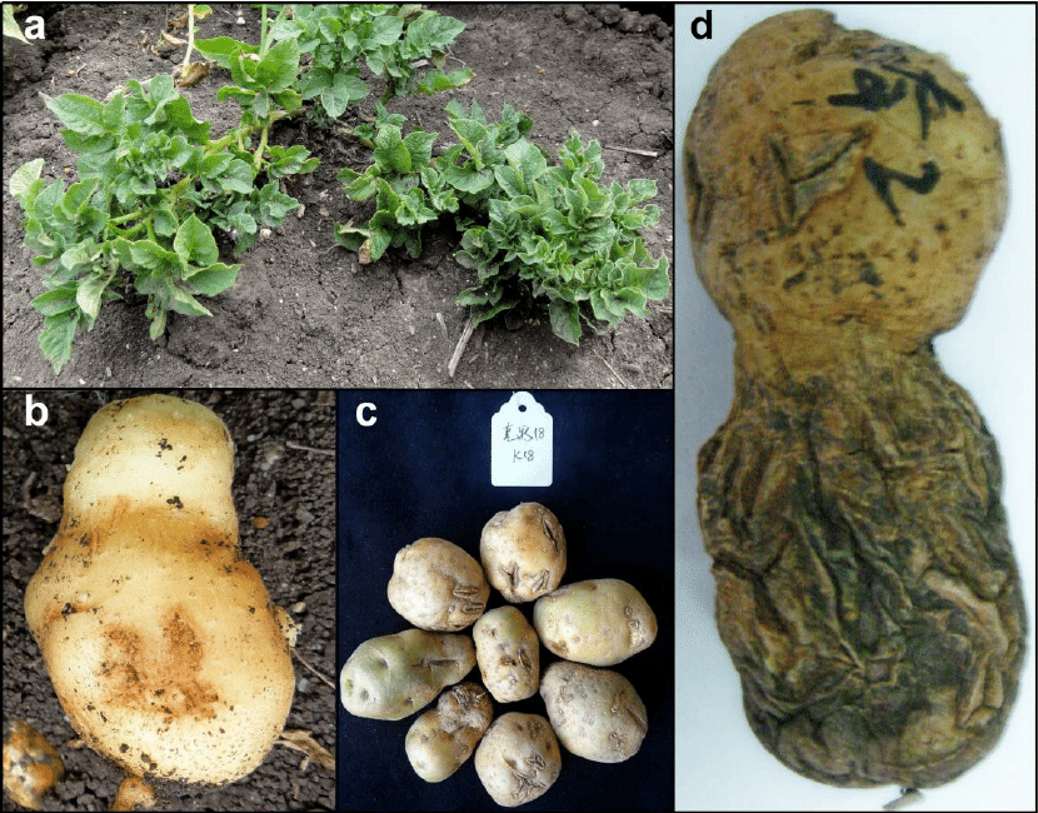
- •Potato spindle tuber disease / PSTV
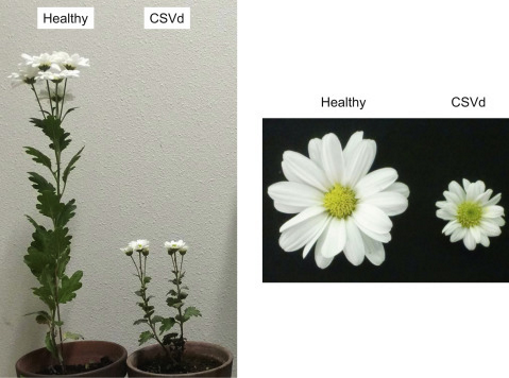
- •Chrysanthemum stunt
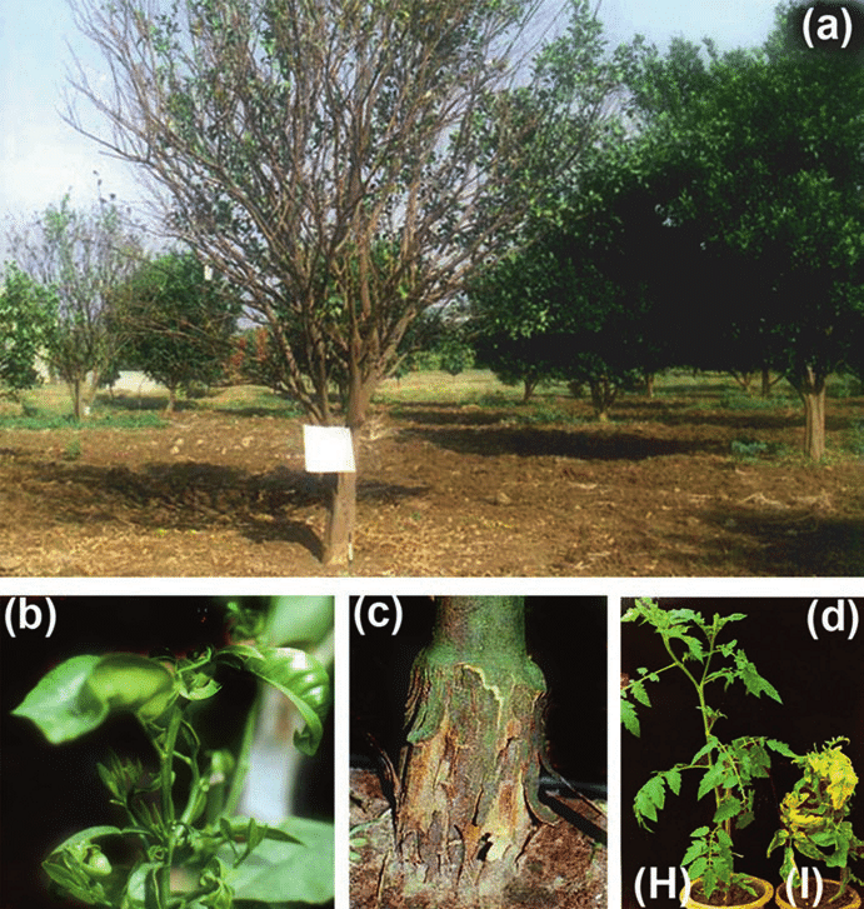
- •Citrus exocortis
- •Cucumber pale fruit
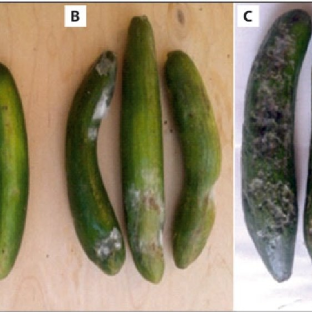
Examples
❖ Potato Spindle Tuber Viroid: Stunting + elongated malformed tubers + cracking
❖ Citrus Exocortis: Bark scaling + stunted growth + reduced yield
📖
Virusoid
Small satellite RNA requiring a helper virus for replication and encapsidation
📖
Satellite virus
Virus dependent on helper virus; example: Hepatitis-D virus depends on Hepatitis-B virus
📖
Virion
Completely assembled mature infective virus particle outside host cell
📖
Provirus
Viral genome integrated into eukaryotic host DNA
📖
Prophage
Phage genome integrated into bacterial chromosome
📖
Nucleocapsid
Viral nucleic acid + capsid
📚
PLANT DISEASES CAUSED BY VIRUS
Table 1: Important Viral Diseases of Plants
Disease | Plant / Virus |
|---|---|
Tobacco mosaic | Tobacco mosaic virus |
Cauliflower mosaic | Cauliflower mosaic virus |
Dahlia mosaic | Dahlia mosaic virus |
Papaya leaf curl | Papaya |
Potato leaf roll | Potato leafroll virus |
Tomato leaf curl | Tomato leaf curl virus |
Yellow vein mosaic | Bhindi / Okra |
Vein banding mosaic | Potato |
Bunchy top | Banana bunchy top virus |
Tungro disease | Rice tungro virus complex |
Commonly Confused Non-viral Diseases
❖ Grassy shoot of sugarcane: Phytoplasma
❖ Little leaf disease: Usually phytoplasma
📚
HIGH-YIELD ONE-LINERS
Table 1: CEE Rapid Revision
Question Point | Answer |
|---|---|
Complete infective viral particle | Virion |
Genome + capsid | Nucleocapsid |
Capsid subunit | Capsomere |
Virus infecting bacteria | Bacteriophage |
Integrated phage DNA | Prophage |
Integrated viral DNA in eukaryotic host | Provirus |
Protein-only infectious agent | Prion |
Naked infectious plant RNA | Viroid |
Helper-virus-dependent RNA | Virusoid / satellite RNA |
Phage causing immediate lysis | Virulent / lytic phage |
Phage capable of lysogeny | Temperate phage |
Release of enveloped virus | Usually budding |
Release of phage / many naked viruses | Usually lysis |
Virus with complex symmetry | Bacteriophage / Poxvirus |
DNA virus replicating in cytoplasm | Poxvirus |
RNA virus with important nuclear replication phase | Influenza virus |
Virus containing reverse transcriptase | Retrovirus + Hepatitis-B virus |
Q1.
Tobacco mosaic disease is caused by a:
📅CEE Nursing 2024